Batman's IQ is stated as 192 in DC Comics canon — a genius-level score that places Bruce Wayne above Albert Einstein, above Bill Gates, and among the two or three most intelligent humans in the entire DC Universe. No superpowers. No alien physiology. Just a grieving billionaire who decided to out-think every opponent he could not simply overpower.
This article examines what Batman's IQ of 192 actually means in DC lore, how it was established, how it compares to other characters — and most interestingly — what a real human being with that kind of cognitive profile would actually look like.
What Is Batman's IQ in DC Comics?
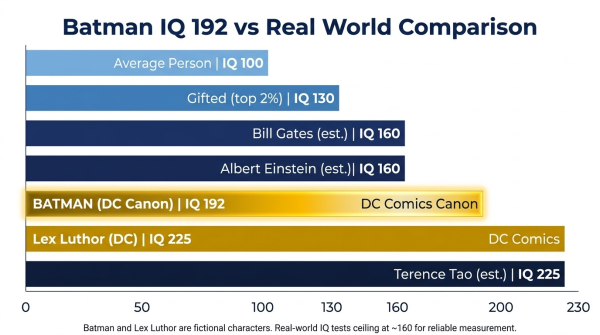
The most widely cited figure across DC Comics sources places Batman's IQ at 192. This number appears in various DC reference materials and is consistent with how Batman is portrayed across most continuities — as a near-peerless analytical mind whose intellectual capacity is second among humans only to Lex Luthor.
To contextualise that number: in the real world, an IQ of 192 would place someone approximately 6.1 standard deviations above the mean — a statistical rarity found in fewer than 1 in several billion people. For reference, the highest verified childhood IQ score ever recorded was Terence Tao's estimated 225–230, itself a childhood ratio score that modern psychometricians cannot directly compare to adult deviation IQ. Batman's 192, in real-world terms, would be among the most extreme scores ever documented.
It is worth noting that some DC sources dispute whether 192 is specifically Batman's score or was originally attributed to Ted Kord (Blue Beetle II). The broader consensus across DC lore — including the Doomsday Clock miniseries by Geoff Johns, in which Ozymandias confirms Batman and Lex Luthor as the two smartest men on the planet — supports Batman as an IQ-level genius regardless of the precise number. What the number represents is not in question: DC consistently portrays Bruce Wayne as operating at the absolute ceiling of human cognitive ability.
For context on what IQ scores in this range mean in the real world, see our guide on IQ 160 and the highest IQ of all time.
How Batman's Intelligence Was Built: The Bruce Wayne Training Arc
Batman's IQ is not innate in the way Superman's strength is. DC canon is explicit that Bruce Wayne systematically constructed his intelligence through years of deliberate, structured study — beginning immediately after his parents' murder at age 8 and continuing through his early twenties.
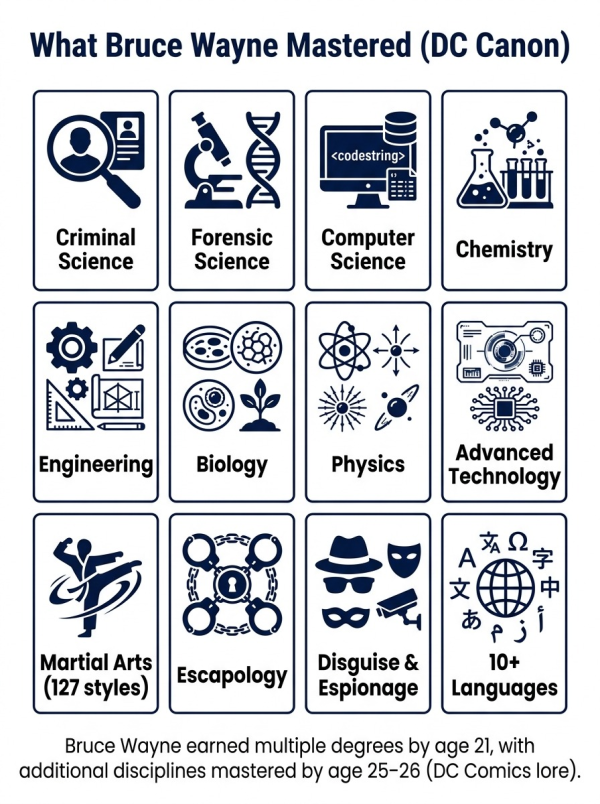
According to DC lore, Bruce Wayne's academic record includes:
- By age 21: Degrees in Criminal Science, Forensic Sciences, Computer Sciences, Chemistry, and Engineering — earned under various aliases at institutions across the world
- By age 23: Mastery of Diverse Environmental Training, Security Systems, and sleight of hand/illusion
- By age 25: Additional degrees in Biology, Physics, Advanced Chemistry, and Technology
- By age 26: Degrees in dozens of additional scientific, mathematical, and technological fields
Alongside this academic programme, Bruce simultaneously trained in 127 martial arts styles, studied under Giovanni Zatara (stage magic and illusion), trained with various intelligence agencies, and developed fluency in more than ten languages including Spanish, French, Latin, German, Japanese, Russian, Cantonese, and Mandarin.
This combination — breadth of academic mastery plus physical and technical discipline — is the narrative foundation of his 192 IQ. It is not about raw cognitive speed alone; it is about the deliberate construction of knowledge across every domain relevant to his mission. This concept maps closely onto real cognitive science research on multiple intelligences and cognitive flexibility.
The Five Pillars of Batman's Genius
1. Detective Intelligence — The World's Greatest Detective
Batman's primary intellectual identity in DC canon is as a detective — specifically, the World's Greatest Detective. He is described as capable of "observation, forensic investigation, and inductive and deductive reasoning of the highest calibre." The Riddler — whose entire identity is based on intellectual superiority — is regularly outthought by Batman. In one storyline, Batman deduced the physics and mechanics of a Green Lantern ring purely through observation, with no prior knowledge of the technology.
His eidetic memory (total recall) underpins this capacity. He can re-examine crime scenes mentally, cross-reference thousands of data points simultaneously, and identify the one connection that resolves an apparently impossible mystery with far less information than any normal investigator would require.
2. Strategic and Tactical Intelligence — The Contingency Plans
The most famous demonstration of Batman's strategic intelligence is the Tower of Babel storyline, in which it is revealed that Batman had developed secret contingency plans to neutralise every member of the Justice League if they ever went rogue — including Superman. His plans for taking down kryptonians, gods, and individuals with reality-altering powers were so effective that Ra's al Ghul stole and deployed them with devastating results.
This is not tactical intelligence in the conventional military sense — it is meta-strategic intelligence: the ability to model how any given system can be defeated from the inside, regardless of how overwhelmingly superior that system appears. In real cognitive science terms, this maps onto extremely high scores in abstract reasoning and systems thinking — the kind of cognitive profile associated with IQ scores well above 130 in the real world.
3. Engineering and Scientific Intelligence
Batman designed and built the Batmobile, the Batsuit (in most continuities), numerous gadgets, the Batcave's computer systems, and the Brother Eye satellite surveillance network — a system capable of monitoring every metahuman and superhero on Earth. He reverse-engineered alien technology. He developed compounds and forensic tools that did not previously exist. Wayne Enterprises, under his management, became one of the leading technology companies in the DC Universe.
4. Medical and Biological Intelligence
Batman has performed surgery on himself and others in the field. He has synthesised antidotes to novel toxins within minutes of exposure. He developed the Dionesium compound (in certain continuities) and has a working knowledge of human physiology, pharmacology, and forensic pathology that exceeds the training of most medical professionals.
5. Psychological Intelligence
Batman's greatest villains — the Joker, the Riddler, Two-Face, Ra's al Ghul — are all defined by psychological complexity. His ability to outmanoeuvre them relies not on physical superiority (he frequently lacks it) but on understanding their psychology more deeply than they understand themselves. His criminal psychology expertise was built through formal study and decades of direct observation — and it is consistently portrayed as his most valuable tool against unpredictable opponents.
Batman vs the Smartest Characters in DC and Marvel
| Character | Universe | Stated IQ | Primary Intelligence Domain |
| Reed Richards (Mr. Fantastic) | Marvel | 300+ | Physics, dimensional science |
| Tony Stark (Iron Man) | Marvel | 270 | Engineering, technology |
| Lex Luthor | DC | 225 | Scientific genius, strategy |
| Peter Parker (Spider-Man) | Marvel | 250 | Physics, biology, engineering |
| Batman (Bruce Wayne) | DC | 192 | Detective work, strategy, polymath |
| Mr. Terrific | DC | ~180+ | Technology, 14 PhDs |
| Bruce Banner (Hulk) | Marvel | ~180 | Gamma radiation, biology |
The comparison with Tony Stark is particularly interesting for real-world analysis. Stark's 270 IQ is primarily expressed through engineering genius — he is essentially the world's greatest inventor. Batman's 192 is expressed through detective reasoning, strategic planning, and multi-domain knowledge. In the fictional context, both are described as operating at levels no real human could match. But the type of intelligence portrayed is meaningfully different.
Fictional IQ vs Real-World Intelligence: The Key Distinction
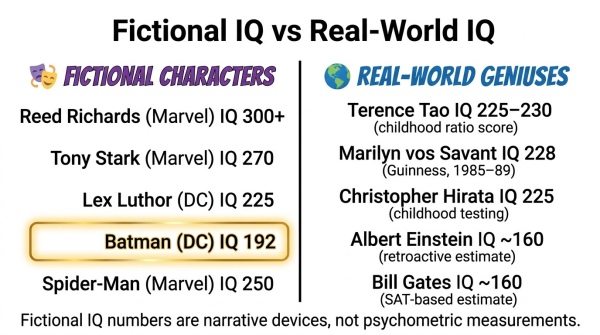
It is important to understand what fictional IQ numbers are and are not. In comics, IQ figures are narrative signals, not psychometric measurements. When DC says Batman's IQ is 192, they are communicating: "this character operates at the absolute ceiling of human intelligence and should be understood as the most analytically capable human in this story." The number is chosen to be impressive and to signal hierarchy, not to reflect a score on any actual test.
Real-world psychometrics works very differently. Modern standardised tests ceiling at approximately 160 for adults — above that level, there simply are not enough people to anchor reliable comparisons. An IQ of 192 in the real world would be nearly impossible to verify through any standardised assessment. The closest real-world analogues are people like Terence Tao — whose childhood ratio IQ of 225–230 is derived from a different methodology entirely — or Marilyn vos Savant's 228, the only score ever officially listed in the Guinness World Records.
What is realistic about Batman's portrayal is the underlying cognitive architecture. Eidetic memory, abstract pattern recognition, rapid synthesis of information from multiple domains, and the ability to model opponents' psychology — these are all traits associated with very high real-world IQ, and they are the traits DC consistently uses to demonstrate his genius rather than raw computational speed.
What Would Batman's Intelligence Look Like in the Real World?
If we try to translate Batman's cognitive profile into real-world terms, the picture is fascinating — and partly impossible:
- What is plausible: An IQ of 192 would place someone at approximately the 99.999th percentile — statistically improbable but not theoretically impossible. Eidetic memory exists in rare documented cases. Elite-level forensic and deductive reasoning is a real cognitive skill, present in exceptional investigators and analysts
- What is implausible: The breadth is the impossible part. Real cognitive science shows that exceptional people specialise. A person who spent their twenties earning degrees in forensic science, engineering, chemistry, biology, and computer science would not simultaneously master 127 martial arts styles, escapology, and 10 languages. The time does not exist. Even with genius-level IQ, depth requires exclusive focus
- The real constraint is not intelligence — it is time. Batman's fictional training arc compressed decades of specialisation into roughly 12 years. In the real world, that compression is not achievable regardless of IQ
This distinction between intelligence and mastery is one of the most important insights in real cognitive science. IQ measures the capacity to learn — not the accumulation of learning itself. For more on this, see our guides on IQ vs problem-solving and can IQ be improved?
The Most Batman-Like Real Person
The real-world figure whose profile comes closest to Batman's fictional cognitive archetype is perhaps Dolph Lundgren — a chemical engineer with a Fulbright Scholarship to MIT who simultaneously became a European Heavyweight Karate Champion. Elite academic + elite athletic + broad practical skills is the Batman template, and Lundgren achieved it at a level no Hollywood action star has matched before or since.
More seriously, the detective intelligence archetype that defines Batman's genius maps closely onto what cognitive scientists call crystallised intelligence with exceptional working memory — the ability to rapidly access and cross-reference large stores of domain knowledge under pressure. People scoring in the IQ 145 to IQ 160 range in the real world — the highest reliably measurable levels — demonstrate exactly this cognitive signature in clinical assessment.
Batman's IQ of 192 is a fictional narrative signal, not a psychometric score. But the type of intelligence it represents — eidetic recall, abstract pattern recognition, multi-domain synthesis, and strategic modelling — is real. It describes, at an extreme, the cognitive profile of the most analytically gifted people who have ever existed.
Curious where your own analytical profile sits? Take our free IQ test — no registration, results in under 20 minutes. For more on fictional genius vs real intelligence, explore our Celebrity IQ database or see Tony Stark's IQ for the Marvel equivalent.
Frequently Asked Questions
What is Batman's IQ?
Batman's IQ is stated as 192 in DC Comics canon, classifying him as a genius-level intellect. This places Bruce Wayne above most superheroes and nearly all humans in the DC Universe, with only Lex Luthor (IQ 225) consistently ranked higher among human characters.
Is Batman smarter than Iron Man?
In DC vs Marvel comparisons, Tony Stark's IQ is typically cited as 270 in Marvel canon, placing him higher than Batman's 192. However, Batman is generally considered a superior detective and strategic planner, while Iron Man excels in engineering and technological innovation. See our article on Tony Stark's IQ for a full comparison.
What degrees does Bruce Wayne have?
In DC Comics canon, Bruce Wayne earned degrees in Criminal Science, Forensic Sciences, Computer Sciences, Chemistry, and Engineering by age 21. By age 25, he had added Biology, Physics, Advanced Chemistry, and Technology — all earned under various aliases at institutions worldwide.
Who is smarter — Batman or Lex Luthor?
In DC Comics, Lex Luthor's IQ of 225 is numerically higher than Batman's 192. Luthor is generally ranked as the smartest human in the DC Universe. However, the Doomsday Clock miniseries confirms both as the two smartest men on the planet. Luthor has superior raw scientific genius; Batman excels in detective work, strategy, and preparation.
Could Batman's intelligence exist in the real world?
An IQ of 192 would be among the rarest in real-world population terms. What is impossible in reality is the breadth: mastering dozens of academic disciplines simultaneously alongside elite martial arts and detective work. Real cognitive science shows that exceptional people specialise rather than achieving mastery in every domain regardless of IQ level.

Comments
Share Your Thoughts