Search "Elon Musk IQ" and you'll encounter the same figure repeated confidently across thousands of websites: 155. Sometimes 160. Occasionally higher. But before examining what these numbers mean, it's worth asking a more fundamental question: where do they come from? This article separates what is documented from what is speculation, examines what Musk's actual cognitive profile looks like based on observable evidence, and addresses the Asperger's disclosure that adds important context to any discussion of his intelligence. For broader context on how IQ is measured and what high scores mean, see the complete guide to IQ and the Celebrity IQ Database.
The IQ Claim: What Is and Isn't Verified
The commonly cited estimate of IQ 155 for Elon Musk has no documented source. Musk has never publicly taken a standardized IQ test, and no biographer or journalist has cited a verified assessment. The number appears to originate from journalistic extrapolation — a combination of his academic background, professional achievements, and comparisons to other figures. It circulates because it is plausible and has been repeated enough times to seem established.
The same pattern applies to most celebrity IQ estimates. As we noted in our analysis of Stephen Hawking's IQ and Albert Einstein's IQ, numbers like 155, 160, and 180 function as cultural shorthand for "genius-level" rather than as psychometric facts. An IQ of 155 would correspond to approximately the 99.99th percentile — roughly 1 in 10,000 people. Whether or not Musk's score would fall there if tested is genuinely unknowable. What we can examine is the observable evidence.
What We Actually Know: Musk's Educational Record
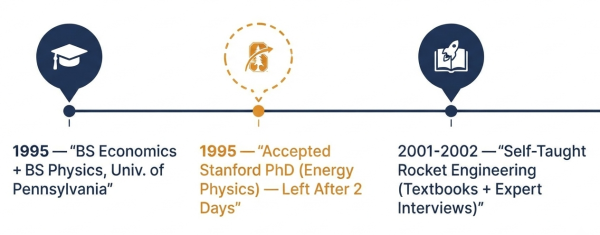
Musk's academic record is documented and provides genuine cognitive evidence:
- Dual bachelor's degrees from the University of Pennsylvania: One in Economics (Wharton School) and one in Physics — completed simultaneously. Dual-degree completion across Wharton and Physics, two demanding programs, indicates above-average academic ability.
- Accepted to Stanford PhD program in Energy Physics (1995): Stanford's PhD programs in physics are among the most competitive in the world. Acceptance is a meaningful credential in itself.
- Left Stanford after two days to found Zip2 with his brother — not because of academic difficulty but because he saw a business opportunity in the internet's early growth phase.
- Self-taught rocket engineering: After founding SpaceX, Musk reportedly learned orbital mechanics, rocket propulsion, and aerospace engineering primarily through textbooks and intensive discussions with experts. This self-directed learning capacity is one of the more credible indicators of exceptional cognition documented about him.
The Asperger's Disclosure: A Cognitive Context
On May 8, 2021, Elon Musk publicly disclosed during a Saturday Night Live appearance that he has Asperger's syndrome — his first acknowledged statement of the diagnosis. He noted that his manner of speaking and communication style can seem unusual as a result. Asperger's syndrome is now classified under Autism Spectrum Disorder (ASD) in the DSM-5.
This disclosure is relevant to any discussion of his intelligence profile for several reasons:
- Asperger's / ASD is associated with intense, focused interest in specific domains — a pattern clearly visible in Musk's career trajectory across physics, engineering, and economics
- Research on ASD consistently shows elevated pattern-recognition and systematic thinking capacities relative to the general population
- The condition is associated with different social cognition — which aligns with public observations about Musk's communication style
- Individuals with ASD may perform differently on different components of standardized IQ tests, with particular strengths in fluid reasoning and pattern recognition
This context does not inflate or deflate any estimate of his IQ. It does suggest that a single overall IQ number would be a particularly poor summary of his cognitive profile, which is likely to show significant variation across different cognitive domains. For more on the relationship between cognitive profiles and intelligence measurement, see the WAIS-IV guide.
Musk's Cognitive Style: What the Evidence Shows
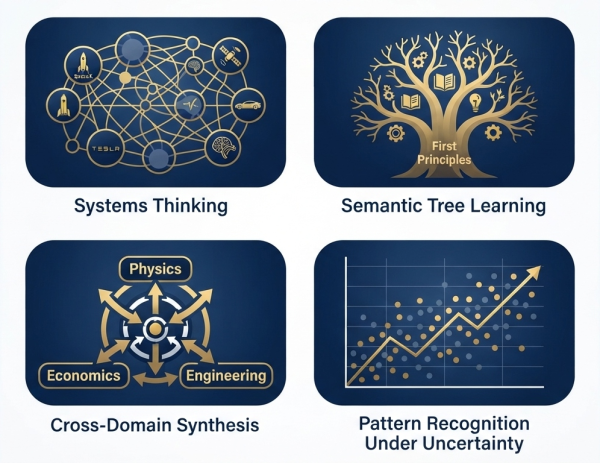
The "Semantic Tree" Learning Method
In various interviews, Musk has described his approach to learning as building a "semantic tree" — ensuring you understand foundational principles (the trunk and main branches) before absorbing details (the leaves). He has applied this approach to rocket engineering, battery technology, and artificial intelligence — domains where he had no formal training but built genuine technical depth.
This metacognitive strategy — thinking systematically about how to learn, not just what to learn — is associated with high-level intelligence in cognitive research and is distinct from simple memorization or even analytical raw ability. It reflects what researchers describe as cognitive flexibility — the ability to restructure existing knowledge frameworks when encountering new domains.
First Principles Reasoning
Musk frequently describes thinking from "first principles" — breaking problems down to their most fundamental components and reasoning up from there, rather than reasoning by analogy from existing solutions. This approach is characteristic of how physicists approach novel problems and is one of the more credible cognitive traits documented about him through consistent public statements over many years.
Systems Thinking Across Domains
Perhaps the most observable dimension of Musk's intelligence is his capacity for cross-domain synthesis: seeing Tesla's battery technology as connected to Starlink's infrastructure needs, SpaceX's reusable rocket economics as connected to Mars colonization, and Neuralink's brain-machine interface as connected to AI safety. The ability to perceive structural connections across fields that most specialists keep separate is a cognitive capacity associated with high fluid intelligence. For context on this dimension, see the IQ vs creativity guide and IQ vs problem-solving.
Five Industries — What the Record Shows
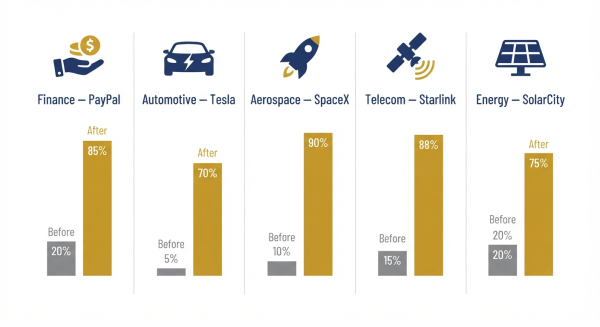
| Industry | Company | Key Achievement |
| Digital Payments | PayPal (co-founder) | First mass-market internet payment system |
| Automotive | Tesla | First mass-market electric vehicle; largest EV manufacturer by market cap |
| Aerospace | SpaceX | First privately funded reusable orbital rocket; NASA Commercial Crew partner |
| Telecommunications | Starlink (SpaceX) | Largest satellite internet constellation; first to provide broadband via low-orbit satellites at scale |
| Energy | SolarCity / Tesla Energy | Large-scale battery storage systems; grid-level energy solutions |
These achievements are verifiable facts — not estimates. Whatever IQ score is attached to them, the operational execution across five distinct industries over approximately 25 years represents a level of sustained, high-complexity achievement that exists in a small category of historical entrepreneurs.
The 2008 Crisis: What It Reveals About Cognitive Resilience
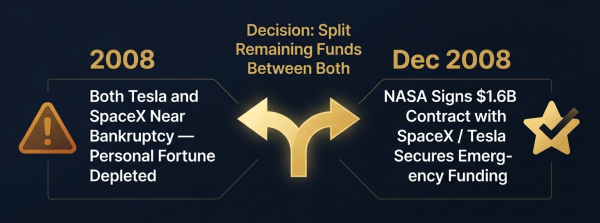
In 2008, both Tesla and SpaceX were simultaneously near collapse. Tesla could not secure additional funding. SpaceX had suffered three consecutive Falcon 1 launch failures. Musk's personal fortune — accumulated from the PayPal sale — was nearly depleted. By several accounts, he split his remaining funds between the two companies, accepting the risk that both might fail.
In December 2008, NASA announced a $1.6 billion Commercial Resupply Services contract with SpaceX. Shortly after, Tesla secured an emergency funding round. Both companies survived and went on to define their industries.
The decision-making in 2008 — allocating limited resources across two high-risk ventures under severe time pressure — is a case study in what researchers call decision-making under uncertainty. The ability to maintain coherent strategic reasoning under existential pressure is a cognitive capacity not captured by standard IQ tests. For context on how this relates to intelligence broadly, see the IQ vs EQ guide.
What Does All This Say About His IQ?
Honestly: less than most articles claim. The documented evidence about Musk's cognition — his educational record, self-directed learning capacity, first-principles reasoning style, and cross-domain synthesis — is consistent with very high intelligence, but does not pinpoint a specific IQ score. An estimate of "somewhere well above average" is supportable. An estimate of "exactly 155" is not.
What is observable is this: Musk's intelligence is primarily systems-level and operational — the capacity to synthesize insights across engineering, physics, and economics, and translate them into functioning organizations. This is a different cognitive profile from theoretical academic genius, and IQ tests are only partially designed to measure it.
For a broader view of how intelligence relates to entrepreneurial and professional success, see IQ and income research and how to succeed without being naturally smart. For comparisons with other high-profile figures, see Bill Gates IQ, Albert Einstein IQ, and Stephen Hawking IQ.
Frequently Asked Questions
What is Elon Musk's IQ?
No verified IQ score exists for Elon Musk. The commonly cited estimate of 155 is unverified speculation without a documented source. Musk has never publicly taken or released results from a standardized IQ test. The number circulates because it is plausible given his achievements, not because it reflects an actual assessment.
Did Elon Musk disclose a diagnosis that affects his cognitive profile?
Yes. On May 8, 2021, Musk publicly disclosed during a Saturday Night Live appearance that he has Asperger's syndrome. This was his first public acknowledgment of the diagnosis. Asperger's / ASD is associated with intense focused interest in specific domains, elevated pattern-recognition capacity, and different social cognition — all consistent with the cognitive style publicly attributed to him.
What degrees does Elon Musk have?
Musk holds two bachelor's degrees from the University of Pennsylvania: one in Economics (Wharton School) and one in Physics. He was accepted to Stanford's PhD program in Energy Physics in 1995 but left after two days to found his first company, Zip2. He subsequently taught himself rocket engineering through textbooks and expert consultation.
How did Musk teach himself rocket science?
According to multiple accounts and his own statements, Musk learned aerospace engineering primarily by reading textbooks on rocket propulsion, orbital mechanics, and materials science, supplemented by intensive discussions with aerospace engineers. This self-directed learning approach — what he has called building a "semantic tree" from first principles — is one of the more credible documented indicators of exceptional metacognitive ability.
How does Musk's intelligence compare to other famous figures?
This comparison is difficult without verified data for any of the individuals involved. What is more useful is recognizing that different types of intelligence are associated with different kinds of achievement. Musk's intelligence is primarily operational and systems-level. Compare with the theoretical physics genius documented in the Stephen Hawking article, the mathematical genius in the Albert Einstein article, and the broader Celebrity IQ Database.

Comments
Share Your Thoughts