Between the formal diagnosis of intellectual disability and the broad category of "average intelligence" lies a zone that affects approximately 12–14% of the general population — one of the most common cognitive conditions in the world, and simultaneously one of the least identified and least supported.
This zone is called Borderline Intellectual Functioning (BIF) — IQ scores in the approximate range of 70 to 85. People in this range sit above the threshold typically associated with intellectual disability (IQ below 70) but below the Average range (IQ 85+). They are not formally disabled in the clinical sense. But they face real, documented, and often significant challenges in academic settings, complex occupational environments, and daily life situations that require abstract reasoning, rapid information processing, or the navigation of complex institutional systems.
The research on BIF is consistent on a troubling point: this is the most underserved group in cognitive support systems. A person with IQ 68 typically qualifies for formal disability services — special education, supported employment, independent living programmes. A person with IQ 73 — facing comparable real-world difficulties — often qualifies for nothing, falls through the gap between disability support and standard expectations, and is left to struggle in environments that were not designed with their cognitive profile in mind.
This guide covers what borderline IQ means, how it is defined, what research shows about the challenges it creates, and what kinds of support make a meaningful difference.
Defining Borderline IQ: The Range and the Labels
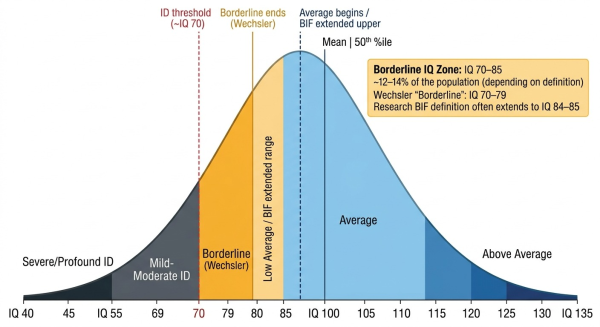
The term "borderline intellectual functioning" (BIF) appears in clinical literature with somewhat varying IQ boundaries depending on the source. Understanding these variations helps interpret clinical reports accurately.
The Wechsler scale definition. The Wechsler Adult Intelligence Scale (WAIS-IV) classifies IQ 70–79 as "Borderline" and IQ 80–89 as "Low Average." The Wechsler "Borderline" band is therefore IQ 70–79 specifically. For more on the Wechsler classification system, see our Wechsler IQ test guide and our WAIS-IV guide.
The research/clinical definition of BIF. Most clinical and research literature uses a broader definition of BIF that extends from IQ 70 to approximately IQ 84 or 85 — essentially, from the intellectual disability threshold to the lower boundary of the Average range. This is the definition used by the DSM-5 (which removed the specific IQ range from its description of BIF but continues to reference it as a condition warranting clinical attention) and by the broader research literature cited in peer-reviewed systematic reviews.
Population prevalence. BIF in the IQ 70–85 range affects approximately 12–14% of the general population — roughly 40–47 million Americans, and over 1 billion people globally. This is far more prevalent than intellectual disability (approximately 1–3% of the population) and represents an enormous unserved population.
For context on specific IQ scores within this range, see our guide on IQ 73 (the Wechsler Borderline zone) and our IQ scale explained.
BIF vs Intellectual Disability: The Critical Distinction
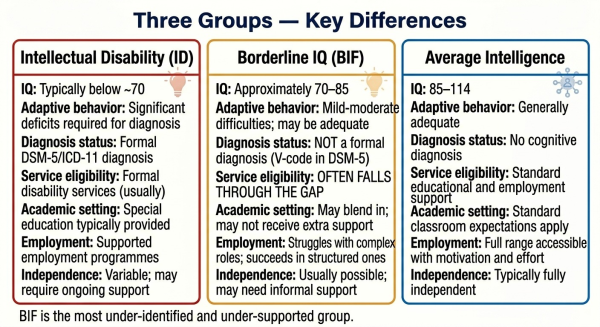
The distinction between Borderline Intellectual Functioning and Intellectual Disability (ID) is critical for understanding what BIF means and does not mean — and for navigating support systems accurately.
Intellectual Disability requires three criteria to be met simultaneously (DSM-5 and ICD-11):
- Significant deficits in intellectual functioning — typically IQ below approximately 65–75, depending on the assessment instrument and standard error of measurement
- Significant deficits in adaptive behaviour — the practical, social, and conceptual skills needed for independent daily functioning in everyday environments
- Onset during the developmental period (before age 18)
Borderline Intellectual Functioning is specifically defined as the zone above the ID threshold. People with BIF (IQ 70–85):
- Score above the typical IQ threshold for ID on cognitive assessment
- Generally have adequate adaptive behaviour for basic daily living in familiar, structured environments — they can typically manage personal care, navigate familiar community settings, and handle routine practical tasks
- Do not meet the full criteria for an ID diagnosis
- Are noted in the DSM-5 as a V-code condition (Additional Conditions That May Be a Focus of Clinical Attention) rather than a formal diagnostic category
The adaptive behaviour distinction matters practically. A 2023 study by Wexler et al. found that both the low-average IQ group (80–89) and the below-average IQ group (70–79) scored lower on adaptive functioning measures than the average IQ group — but the BIF group showed significantly better adaptive functioning than the mild intellectual disability group. This confirms that BIF is a real and meaningful functional level intermediate between ID and average, not simply a statistical category.
The Service Gap: The Most Important Clinical Problem with BIF
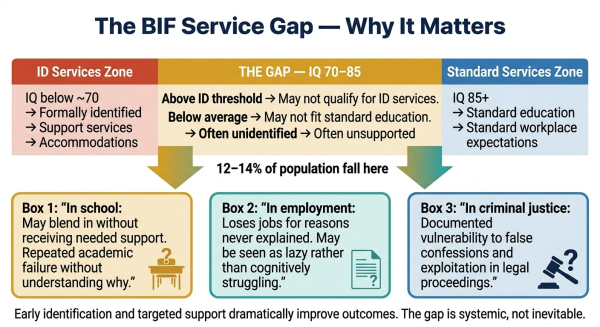
The most consistently documented concern in the research literature on BIF is the service gap: people in the 70–85 range face meaningful cognitive challenges, but are systematically excluded from the support systems designed to help people with cognitive limitations.
The mechanism of the gap is structural. In most Western education and disability service systems:
- People with IQ below 70 (with adaptive deficits) qualify for formal intellectual disability services: special education, supported employment, independent living programmes, legal protections
- People with IQ above 85 are expected to function within standard educational and employment systems designed for average cognitive ability
- People with IQ 70–85 fall between these two zones: above the threshold for formal ID services, but below the level for which standard systems were designed
The human consequences of this gap, documented in the research literature, include:
In education. Children with BIF often "blend in" in standard classrooms — they are present, not visibly disruptive, and not meeting the threshold for special education referral. But they are systematically failing to master academic content, particularly at secondary level where abstract reasoning demands increase substantially. Without identification, they receive no additional support. Repeated academic failure without understanding its cause contributes to the higher rates of anxiety, low self-esteem, and school disengagement documented in BIF populations.
In employment. Adults with BIF can often perform structured, practical, and routine work well. Where they struggle is in roles requiring rapid learning of complex new material, abstract verbal reasoning, navigation of complex written documentation, or fast adaptation to changing procedures. Without identification, they are seen as underperforming or unreliable rather than as needing different task design or support. Job loss rates in BIF are substantially higher than in the average population.
In criminal justice. Research has documented specific vulnerability for people with BIF in criminal proceedings. They are at elevated risk of false confessions (because they may not understand legal rights adequately and are more susceptible to coercive interrogation tactics), of inadequate legal representation (because they may not effectively communicate their situation to lawyers), and of exploitation generally. The DSM-5 specifically notes vulnerability to exploitation as a clinically relevant concern for this population.
In mental health. A 2025 systematic review published in a major psychiatric journal found that mental health outcomes in BIF consistently fall intermediate between average IQ and intellectual disability populations. Higher rates of anxiety, depression, and behavioural difficulties are documented compared to average-IQ populations. These are often secondary — consequences of chronic academic failure, employment instability, social difficulties, and the experience of struggling in environments not designed for one's cognitive level — rather than primary features of the cognitive condition itself.
Challenges, Strengths, and Effective Supports
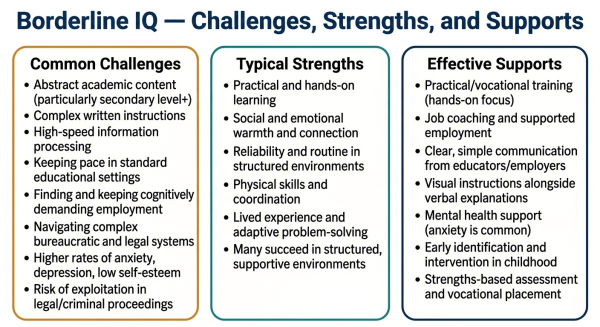
A complete understanding of borderline IQ requires acknowledging both the challenges it creates and the strengths and capabilities that coexist with it — and the supports that research shows to be effective.
Where challenges typically appear
Abstract academic content. The progressive abstraction of secondary school curriculum — algebraic reasoning, literary analysis, scientific hypothesis formation, essay writing — corresponds to the zone where BIF begins to impose meaningful constraints. Primary school content is often manageable; secondary level is where the gap with average peers becomes most evident and most consequential.
Complex multi-step instructions and procedures. Verbal and written instructions requiring the sequential tracking of multiple steps, abstract procedural reasoning, or rapid adaptation to novel procedures create disproportionate difficulty in the BIF range. Practical, hands-on demonstrations are typically far more effective than verbal or written instruction alone.
Navigating complex institutional systems. Healthcare, legal, financial, and government service systems require levels of verbal reasoning, written comprehension, and abstract procedural navigation that BIF makes significantly harder. Without support, accessing and maintaining access to services that people with average IQ navigate routinely can be extremely difficult.
Strengths that coexist with borderline IQ
BIF is a profile of cognitive limitations in specific domains — not a comprehensive judgment of a person's capability, value, or potential. Many individuals in the BIF range demonstrate clear strengths that IQ tests do not adequately capture: practical and hands-on intelligence; social and emotional warmth; reliability and routine consistency in structured environments; physical skill and coordination; and the adaptive problem-solving that comes from navigating a challenging world with limited cognitive resources. A 2024 systematic review on BIF and adaptive functioning confirmed that many individuals with BIF "can meet the demands of their environment" when that environment is appropriately structured and supportive.
What support makes a difference
The research on effective interventions for BIF is relatively recent and growing. Key findings:
- Early identification is the most consistently documented positive factor. Children identified with BIF in primary school and given appropriate educational support show substantially better outcomes than those identified in secondary school or adulthood
- Practical/vocational training with hands-on learning focus substantially outperforms abstract academic instruction for this population
- Job coaching and supported employment — matching task demands to capabilities, providing patient initial guidance, and building structured routine — dramatically improves employment retention rates
- Mental health support for the secondary anxiety and depression that chronic unsupported difficulty produces is both important and underutilised in this population
- Clear, simple communication from educators, employers, and service providers — visual instructions alongside verbal, demonstrated procedures, patient confirmation of understanding — reduces the gap between capability and performance in practical settings
The research consistently notes that the BIF population has "favorable intervention outcomes" — meaning that targeted support produces meaningful improvement in functional outcomes relative to the cost. The barrier is identification and access, not the effectiveness of support itself.
BIF and Co-occurring Conditions
Borderline intellectual functioning frequently co-occurs with other conditions that compound its effects and complicate identification:
ADHD. The most consistently documented co-occurrence. Research by Alloway (2010) found that children with BIF showed pervasive working memory and executive function deficits — a profile that overlaps substantially with ADHD. In some cases, attentional difficulties in BIF children may be a consequence of inappropriately demanding academic environments rather than a primary ADHD diagnosis. Accurate differential assessment matters for effective intervention.
Learning disabilities. Specific learning disabilities (dyslexia, dyscalculia) can co-occur with BIF and amplify academic difficulties substantially. A child with BIF and dyslexia faces compounded challenges in reading-dependent academic contexts.
Trauma and adverse childhood experiences. BIF does not always reflect genetic or neurodevelopmental factors alone. Childhood neglect, exposure to environmental toxins (particularly lead), and traumatic brain injury can all produce or amplify borderline-range cognitive functioning. This is clinically important: in some cases, BIF reflects treatable or preventable causes rather than fixed neurodevelopmental characteristics.
What IQ 70–85 Means for the Individuals Involved
The human reality of borderline IQ is often poorly captured by clinical language. People in the BIF range are typically aware that something about learning, working, and navigating complex systems is harder for them than it seems to be for others — but without identification, they often lack the framework to understand why. This absence of understanding is itself a meaningful harm: people in the BIF range are disproportionately likely to attribute their difficulties to personal failure (laziness, stupidity, carelessness) rather than to a cognitive profile that has specific challenges and specific strengths.
Identification — receiving an accurate cognitive assessment and understanding one's profile — is consistently reported by adults with BIF as meaningful and often transformative. Not because a number changes anything in itself, but because understanding the shape of one's cognitive strengths and limitations makes it possible to make better decisions about education, employment, and the kinds of support that will actually help.
Borderline IQ (IQ 70–85) affects approximately 12–14% of the population — one of the most common cognitive profiles in the world, and one of the most systematically underserved. Above the threshold for intellectual disability services, below the level for which standard educational and occupational systems were designed, people with BIF face real functional challenges with limited formal support. The research is consistent: early identification, practical vocational training, mental health support, and job coaching produce meaningful improvements in outcomes. The gap is systemic. The solutions exist. What is missing, most often, is the identification that makes those solutions accessible.
For more context on specific IQ scores in the borderline and average range, see our guides on IQ 73, IQ 90, and IQ 105. For an overview of the full IQ distribution, see our IQ scale explained. For parents seeking assessment for children, see our guide on IQ testing for ages 6–12.
Frequently Asked Questions
What is borderline IQ?
Borderline IQ refers to IQ scores in the approximate range of 70–85 — between the intellectual disability threshold (below ~70) and the Average range (85+). The clinical term is Borderline Intellectual Functioning (BIF). It affects approximately 12–14% of the general population and is noted in the DSM-5 as a V-code (Additional Conditions That May Be a Focus of Clinical Attention) rather than a formal diagnosis.
What IQ score is considered borderline?
The Wechsler scale classifies IQ 70–79 as Borderline specifically. Most clinical and research definitions extend BIF to include IQ scores from approximately 70 to 84 or 85. The DSM-5 removed the specific IQ range from its BIF description, defining it instead as a condition where reduced intellectual functioning is the focus of clinical attention.
What is the difference between borderline IQ and intellectual disability?
Intellectual Disability requires three criteria: significant intellectual deficits (IQ below ~70), significant adaptive behaviour deficits, and onset before age 18. Borderline IQ (70–85) sits above the typical ID threshold. People with BIF generally have fewer adaptive deficits, can usually manage basic daily living independently, and do not qualify for formal ID diagnosis. However, they face real functional challenges, particularly in academic and complex occupational settings.
How many people have borderline IQ?
BIF (IQ 70–85) affects approximately 12–14% of the general population — roughly 40–47 million Americans and over 1 billion people globally. This makes it far more prevalent than intellectual disability (~1–3% of the population).
What support is available for borderline IQ?
People with borderline IQ often fall into a service gap — above the ID threshold but below average expectations. Available supports include educational accommodations, vocational training, job coaching, supported employment, mental health services (anxiety and depression are common), and independent living skills programmes. Access varies by country — in many systems, formal disability services begin at IQ 70, meaning people with IQ 73–84 must specifically seek assessment and advocate for individual support arrangements.

Comments
Share Your Thoughts