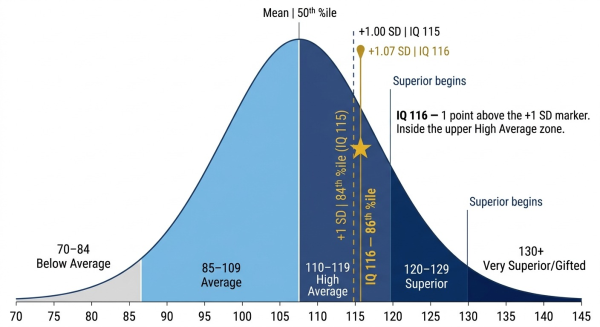
An IQ of 116 places you at approximately the 86th percentile — meaning you score higher than about 86 out of every 100 people in the general population. The Wechsler Adult Intelligence Scale classifies this as High Average intelligence. It represents 1.07 standard deviations above the population mean of 100, and roughly 1 in 7 people score at this level or above.
IQ 116 sits in the upper portion of the High Average band (IQ 110–119), just 1 point above the +1 SD marker at IQ 115 — the statistically significant reference point covered in our IQ 115 guide. It is 4 points below the Superior range that begins at IQ 120, and 14 points below the Mensa eligibility threshold. It is a genuinely above-average score that places a person well above most of their peers in general population environments and in line with the averages of many professional groups.
This guide covers what IQ 116 means: the population statistics, its relationship to the +1 SD marker just below it, what it opens professionally and academically, and what the research shows about outcomes at this cognitive level.
IQ 116 in Numbers: The Core Statistics
| Metric | Value at IQ 116 |
| Standard deviations above mean | +1.07 SD |
| Percentile | ~86th |
| Frequency in general population | ~1 in 7 |
| In a room of 100 people | ~14 score at or above this level |
| In the United States (~335M) | ~47 million people |
| Wechsler classification | High Average |
| Gap above +1 SD marker (IQ 115) | 1 point |
| Gap to Superior range (IQ 120) | 4 points |
IQ 116's position between the +1 SD marker (IQ 115) and the Superior range (IQ 120) is its defining statistical feature. IQ 115 (84th percentile, 1 in 6) is 2 percentile points below. IQ 119 (90th percentile, 1 in 10) is 4 percentile points above. IQ 120 (91st percentile, 1 in 11) is the professional average for doctors, lawyers, and engineers, and begins the Superior classification. IQ 116 sits in the zone between the key +1 SD statistical reference and the professional average cluster. For the full distributional context, see our IQ scale explained.
IQ 116 vs IQ 115: The +1 SD Question
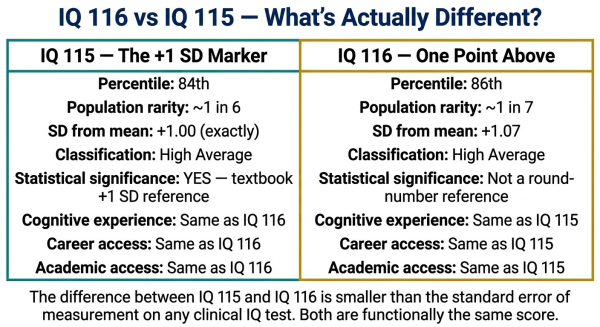
Many people who score 116 compare themselves specifically to IQ 115 — the exact +1 standard deviation marker — and wonder whether being 1 point above or below this reference point matters. The answer is straightforward: no, not in any practical cognitive or career sense.
IQ 115 carries statistical significance as a reference point because it is the round-number expression of the +1 SD boundary — the upper edge of the central 68% range of the population. This is explored in detail in our IQ 115 guide. The statistical significance is real: it is a useful reference point for understanding where a score sits in the distribution.
But the cognitive significance of the 1-point gap between IQ 115 (84th percentile) and IQ 116 (86th percentile) is essentially zero. Both scores are in the High Average classification on the Wechsler scale. Both reflect the same general cognitive level — faster than average information processing, above-average verbal comprehension, comfortable with moderately complex analytical demands. The standard error of measurement on the WAIS-IV (±3 points at 95% CI) means a person who scores 116 might score 113 or 119 on a retest — the 1-point gap between 115 and 116 is invisible against this background noise.
The practical implication: if you scored 116 and are comparing it to IQ 115, there is nothing meaningful to compare. Both scores represent the same thing. If you scored 115 and are wondering whether 116 would be meaningfully better, the answer is no. Focus on what the range means — upper High Average, 86th percentile — rather than on whether the specific integer crossed a reference line.
What IQ 116 Opens in Career and Academic Life
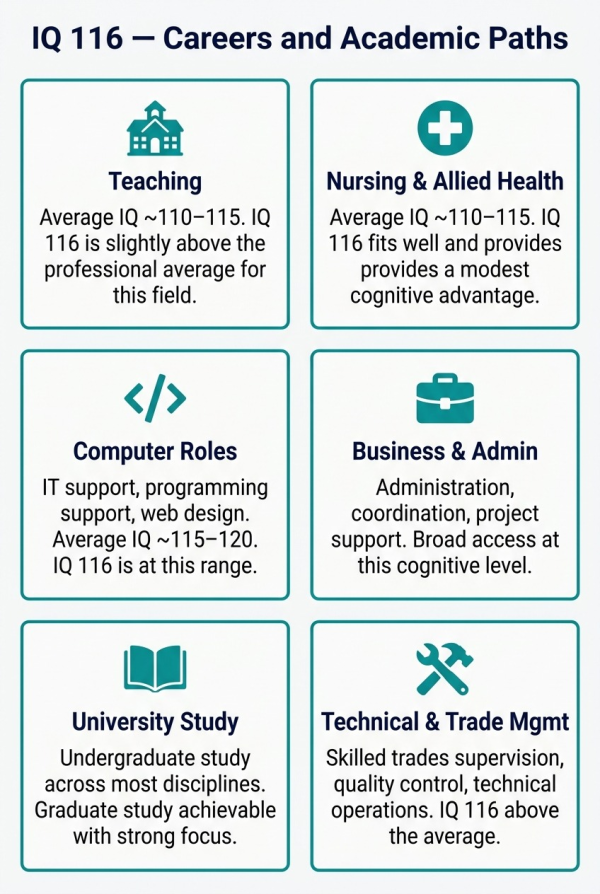
IQ 116 supports a broad range of professional and academic paths. As covered in detail in our IQ 120 guide, the professional cluster point — where doctors, lawyers, and engineers tend to average — sits at approximately IQ 120–125. IQ 116 sits 4 points below this cluster, near the average for the wider range of professional occupations:
- Teaching — average IQ approximately 110–115. IQ 116 is 1–6 points above the professional average
- Nursing and allied health — average approximately 110–115. IQ 116 sits above this range
- Business administration and management — average approximately 110–120. IQ 116 is within this range
- Computer support and programming roles — average approximately 115–120. IQ 116 is at the lower end of this range
- Skilled trades supervision — average approximately 110–115. IQ 116 is above this range
University-level study across most disciplines is accessible at IQ 116. Graduate study (MBA, JD, MSc, MD) is achievable with sustained effort and focus. The most mathematically intensive doctoral programmes tend to average above IQ 125–130, but IQ 116 does not represent a hard barrier for advanced study in most non-mathematical fields.
The key research finding for people at IQ 116: above approximately IQ 110–115, the incremental predictive value of additional IQ points decreases substantially. Motivation, conscientiousness, domain expertise, and emotional intelligence explain at least as much variance in career outcomes as the cognitive advantage that IQ 116 provides. For more on this, see our guides on IQ vs EQ and IQ and income.
The Cognitive Experience at IQ 116
At 1.07 standard deviations above the mean, IQ 116 produces a consistent and genuine cognitive advantage over most everyday peers:
Above-average processing speed. New information is absorbed faster than approximately 86% of the general population. In most educational and professional settings, this translates to following complex explanations readily on first exposure, needing less repetition than most peers, and picking up new material with relative ease.
Good verbal comprehension. Above-average vocabulary, reading comprehension, and analytical communication. This is one of the most practically valuable cognitive advantages in most professional environments that require written analysis, complex communication, or client interaction.
Comfortable with moderate analytical demands. Multi-step logical problems are approached with above-average facility. Most professional analytical demands — the kind encountered in law, business, teaching, healthcare, and engineering practice — fall comfortably within cognitive reach at IQ 116.
Context-dependent experience. In most everyday environments drawn from the general population, IQ 116 is a clear cognitive advantage — you are above 86% of the people around you on analytical tasks. In highly selective academic environments where peers average 125–130, this advantage narrows significantly. This context effect is explored in detail in our IQ 115 guide and IQ 112 guide.
IQ 116 in Context: The Full Comparison
| IQ Score | Percentile | Rarity | Key Note |
| 110 | 75th | 1 in 4 | High Average begins |
| 112 | 79th | 1 in 5 | High Average centre |
| 115 | 84th | 1 in 6 | +1 SD marker — statistical anchor |
| 116 | 86th | 1 in 7 | IQ 116 — just above +1 SD marker |
| 119 | 90th | 1 in 10 | High Average upper boundary |
| 120 | 91st | 1 in 11 | Superior begins / professional average |
| 123 | 93rd | 1 in 14 | Superior range |
The table shows IQ 116's position clearly: 1 point above the +1 SD marker (IQ 115), in the upper portion of the High Average band, 4 points below the Superior range. For adjacent score guides, see our pages on IQ 115, IQ 119, and IQ 120. For the broader High Average context, see our IQ 112 guide.
IQ 116 is at the 86th percentile — top 14%, 1 in 7 people, 1 point above the +1 SD marker and 4 points below the Superior range. It is classified as High Average on the Wechsler scale and reflects genuine above-average cognitive ability across processing speed, verbal comprehension, and analytical reasoning. The 1-point gap between IQ 116 and IQ 115 is psychometrically meaningless — both reflect the same cognitive level and support the same range of career and academic paths. At this level, what determines outcomes is not the specific integer but what is built with it: the motivation, the domain expertise, the emotional intelligence, and the consistency of effort that turn cognitive ability into actual achievement.
Find out where you sit with our free IQ test — no registration, results in under 20 minutes. For adjacent scores, see our guides on IQ 115, IQ 119, and IQ 120. For the full scale, see our IQ scale explained.
Frequently Asked Questions
What does an IQ of 116 mean?
An IQ of 116 is classified as High Average on the Wechsler scale, at approximately the 86th percentile. It represents 1.07 standard deviations above the population mean of 100 — just 1 point above the +1 SD marker at IQ 115 (84th percentile). It corresponds to roughly 1 in 7 people and reflects genuine above-average cognitive ability in the upper portion of the High Average band.
How rare is an IQ of 116?
IQ 116 corresponds to approximately the 86th percentile — roughly 1 in 7 people. In a room of 100 randomly selected people, approximately 14 would score at this level or above. In the United States, approximately 47 million people are expected to score at or above IQ 116.
Is IQ 116 High Average?
Yes. The Wechsler Adult Intelligence Scale classifies IQ 116 in the High Average range (approximately IQ 110–119). It is above the Average range (ending at IQ 109) and below the Superior range (beginning at IQ 120). It sits in the upper portion of the High Average band, 1 point above the +1 SD marker at IQ 115.
What is the difference between IQ 116 and IQ 115?
The 1-point difference is psychometrically meaningless — well within the standard error of measurement (±3 points at 95% CI) on any clinical IQ test. Both are in the High Average range, both are at the 84th–86th percentile, and both support the same range of career and academic paths. IQ 115 has statistical significance as a round-number +1 SD reference; IQ 116 does not. Their practical implications are identical.
What careers are associated with IQ 116?
IQ 116 is above the average for teachers (~110–115), nurses (~110–115), and skilled trades supervisors (~110–115), and within the average range for business administrators (~110–120) and computer support roles (~115–120). University-level study across most disciplines is accessible at this level. At IQ 116, motivation, domain expertise, and conscientiousness are at least as important as the IQ score in determining career outcomes.

Comments
Share Your Thoughts