An IQ of 119 places you at approximately the 90th percentile — meaning you score higher than about 90 out of every 100 people in the general population. The Wechsler Adult Intelligence Scale classifies this as High Average. It represents 1.27 standard deviations above the population mean of 100, and roughly 1 in 10 people score at this level or above.
IQ 119 is the highest score in the High Average range (IQ 110–119). One point higher — IQ 120 — begins the Superior classification. This makes IQ 119 a boundary score: the last point in one band, one step from the next. And it raises the most practical question anyone scoring 119 is likely to ask: does that 1-point gap to Superior actually matter?
The honest answer, established by the psychometric research, is: no. The difference between IQ 119 (High Average) and IQ 120 (Superior) is a classification convenience — the product of having to draw a line somewhere on a continuous distribution. In cognitive terms, in career terms, and in academic terms, they are functionally indistinguishable. As one leading psychometric source puts it directly: "A score of 119 and a score of 121 are functionally indistinguishable given test error."
This guide covers what IQ 119 actually means: the population statistics, the boundary question answered honestly, what it opens professionally and academically, and how to think about this score in the broader context of what determines outcomes.
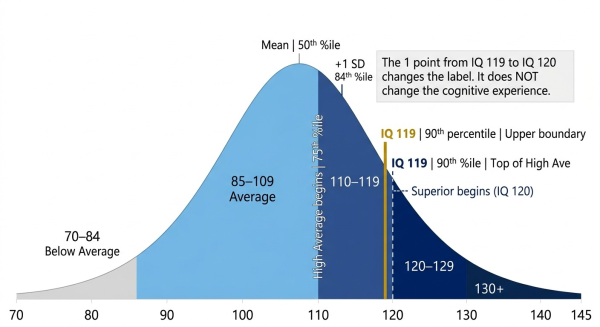
IQ 119 in Numbers: The Core Statistics
| Metric | Value at IQ 119 |
| Standard deviations above mean | 1.27 SD |
| Percentile | ~90th |
| Frequency in general population | ~1 in 10 |
| In a room of 100 people | ~10 score at or above this level |
| In the United States (~335M) | ~33 million people |
| Wechsler classification | High Average (highest score in this band) |
| Gap to Superior range (IQ 120) | 1 point |
| Gap to +1 SD marker (IQ 115) | 4 points above |
The 1-point gap between IQ 119 and IQ 120 is real but the percentile difference is negligible: IQ 119 is at the 90th percentile and IQ 120 is at the 91st percentile — a difference of less than 1 percentile point. For comparison: IQ 112 (79th percentile) and IQ 115 (84th percentile) are both meaningfully further from IQ 119 than IQ 120 is. For the full distributional context, see our IQ scale explained.
The Boundary Question: Does the 1-Point Gap to IQ 120 Matter?
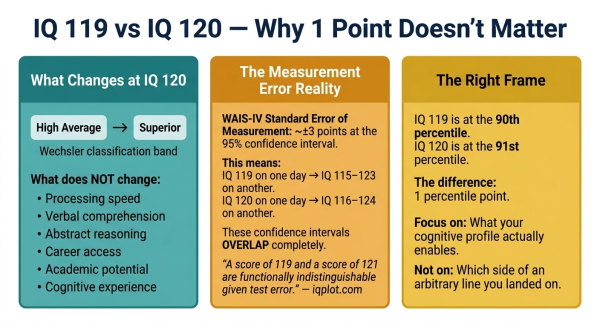
The question most people arriving at this guide are asking is: "I scored 119 instead of 120 — what did I miss out on?" The answer requires understanding both what the classification labels mean and what they don't.
What the 119/120 boundary changes
Exactly one thing changes when a score moves from IQ 119 to IQ 120 on the Wechsler scale: the classification label. IQ 119 carries the label "High Average." IQ 120 carries the label "Superior." The label change is a psychometric administrative decision — the Wechsler scale needed to divide the distribution into bands, and the boundary between High Average and Superior was placed at IQ 120.
What the 119/120 boundary does not change
Everything else. Processing speed. Verbal comprehension. Abstract reasoning capability. Pattern recognition. Working memory. Career access. Academic performance. The cognitive experience of being this person in this world. All of these are continuous functions of cognitive ability — they do not step up discontinuously at IQ 120. A person who scores 119 on a Tuesday and 121 on a Thursday has not become more cognitively capable on Thursday. They have received a slightly different estimate of the same underlying ability level, from a measurement process that carries inherent variability.
The measurement error reality
The standard error of measurement (SEM) on the WAIS-IV is approximately 2.16 points at the 95% confidence interval for the Full Scale IQ. This means a reported score of 119 carries a 95% confidence interval of approximately 115–123. A reported score of 120 carries an interval of approximately 116–124. These intervals overlap almost entirely. As psychometric reference sources note: "A score of 119 and a score of 121 are functionally indistinguishable given test error."
A person who scores 119 on one testing occasion might score 122 on another — officially "Superior" — without any change in actual cognitive ability. This is not a bug in the testing; it is an expected property of measurement under uncertainty. The appropriate response is to interpret the score as a range, not a point, and to focus on what the range means for cognitive and career life — not on which classification label falls 1 point away. For more on measurement error, see our guide on IQ 128 and the Mensa threshold, where the same principle is explored in a different context.
What IQ 119 Opens in Career and Academic Life
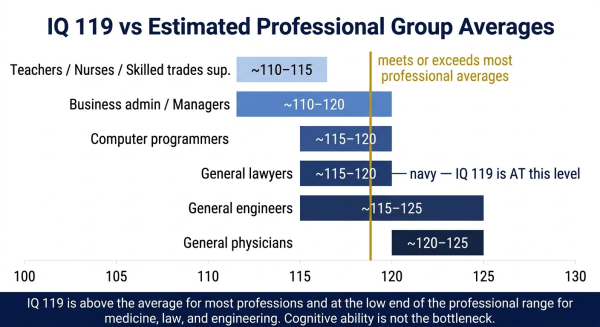
IQ 119 at the 90th percentile provides cognitive access to virtually all professional and academic paths. The research on average IQ by occupation — covered in detail in our IQ 120 guide — consistently shows that IQ 119 sits at or above the average for most demanding professional fields:
- Above the average for teachers (~110–115) and nurses (~110–115)
- Above the average for business administrators and managers (~110–120)
- At or above the average for computer programmers (~115–120)
- At or below the average for lawyers (~115–120) and general engineers (~115–125)
- Below the average for physicians (~120–125) and research scientists (~125–130)
IQ 119 provides sufficient cognitive foundation for university-level study across most disciplines and for graduate study in many fields. The most mathematically intensive doctoral programmes (pure mathematics, theoretical physics) tend to average above IQ 125–130 in their entering student bodies, but IQ 119 does not represent a hard barrier for advanced study in most fields — particularly when combined with strong domain expertise, sustained effort, and effective study strategies.
The key practical insight from the research: at IQ 119, cognitive ability is genuinely above average, and this provides a real advantage in most environments. But above approximately IQ 110–115, the incremental variance in outcomes explained by additional IQ points decreases substantially. At IQ 119, you are in the zone where what you do with your cognitive resources — the domain you focus on, the effort and consistency you bring, the emotional intelligence you develop — matters at least as much as the score itself. For more on this research, see our guides on IQ vs EQ and IQ and income.
The Cognitive Experience at IQ 119
At 1.27 standard deviations above the mean, IQ 119 reflects consistent above-average performance across the core cognitive dimensions:
Above-average processing speed. New information is absorbed faster than approximately 90% of the general population. Standard educational and professional pacing is comfortable — not as slow as it might feel at IQ 130+, but faster than average. Complex explanations follow with relative ease on first exposure.
Strong verbal comprehension. Above-average vocabulary and reading comprehension. Analytical writing and argumentation come more naturally than for most peers. This is one of the most practically valuable cognitive advantages in most professional environments.
Comfortable with moderate abstraction. Multi-step logical problems are approached with above-average facility. Mathematical reasoning and conceptual frameworks are navigated more easily than for the majority of the population. The most complex mathematical abstractions (at the research mathematics level) may require more deliberate effort, but the vast majority of professional analytical demands fall comfortably within cognitive reach.
Context-dependent experience. In most everyday environments — general population settings, most workplaces, most communities — IQ 119 is a clear cognitive advantage. In highly selective academic or research settings — competitive doctoral programmes, elite research institutions — the peer group may average significantly above 119, and the advantage narrows. This context-dependence is explored in detail in our IQ 115 guide.
IQ 119 in Context: The Full Comparison
| IQ Score | Percentile | Rarity | Classification & Key Note |
| 112 | 79th | 1 in 5 | High Average — centre of band |
| 115 | 84th | 1 in 6 | High Average +1 SD marker |
| 117 | 87th | 1 in 8 | High Average (upper) |
| 119 | 90th | 1 in 10 | Highest High Average score |
| 120 | 91st | 1 in 11 | Superior begins / professional average |
| 123 | 93rd | 1 in 14 | Superior range |
| 128 | 97th | 1 in 33 | 4 points from Mensa |
The table makes the boundary position of IQ 119 clear: it is 10 points above IQ 109 (the top of Average) and 1 point below IQ 120 (the bottom of Superior). The 1-point gap to Superior is less than the 11-point distance from the Average range. For adjacent score guides, see our pages on IQ 115, IQ 120, and IQ 123. For the broader context of the High Average band, see our IQ 112 guide.
IQ 119 is the 90th percentile — top 10%, 1 in 10 people, the highest score in the High Average range. One point separates it from the Superior classification, but that 1-point gap is smaller than the standard error of measurement on any properly administered IQ test. What it reflects is a genuine and consistent cognitive advantage over approximately 90% of the general population — sufficient for virtually any professional or academic path, at or above most professional group averages, and in the zone where what you build with your cognitive capacity matters at least as much as how much of it you have. The label High Average describes its statistical position on the Wechsler scale. It does not describe a ceiling on what is achievable from here.
Find out where you sit with our free IQ test — no registration, results in under 20 minutes. For adjacent scores, see our guides on IQ 115 and IQ 120. For the broader context of what IQ scores mean in life, see our guides on IQ vs EQ and what IQ actually measures.
Frequently Asked Questions
What does an IQ of 119 mean?
An IQ of 119 is the highest score classified as High Average on the Wechsler scale, at approximately the 90th percentile. It represents 1.27 standard deviations above the population mean, corresponding to roughly 1 in 10 people. It is 1 point below the Superior classification (which begins at IQ 120) — a gap that is psychometrically meaningless given standard test measurement error.
How rare is an IQ of 119?
IQ 119 corresponds to approximately the 90th percentile — roughly 1 in 10 people. In a room of 100 randomly selected people, approximately 10 would score at this level or above. In the United States, approximately 33 million people are expected to score at or above IQ 119.
Is IQ 119 High Average or Superior?
On the Wechsler scale, IQ 119 is officially classified as High Average — the highest score in this band before Superior begins at IQ 120. However, the psychometric research is clear that a score of 119 and a score of 121 are functionally indistinguishable given test error. The classification label changes at IQ 120, but the cognitive reality does not.
Is there a real difference between IQ 119 and IQ 120?
No — not in any practical cognitive sense. The 1-point difference is well within the standard error of measurement on any clinical IQ test (±3–5 points at 95% CI). IQ 119 and IQ 120 are at the 90th and 91st percentiles respectively — less than 1 percentile point apart. The label changes at IQ 120; the cognitive experience does not.
What careers are associated with IQ 119?
IQ 119 is at or above the average for a wide range of professional roles: teaching (~110–115), nursing and allied health (~110–115), business administration (~110–120), computer programming (~115–120), and skilled trades supervision (~110–115). It is near the average for lawyers (~115–120) and general engineers (~115–125), and below the average for physicians (~120–125) and research scientists (~125–130). At this level, cognitive ability is not the limiting factor in most career or academic paths.

Comments
Share Your Thoughts