An IQ score of 85 places you in the Low Average range — below the population midpoint of 100, but well within the normal spectrum of human cognitive ability. It is not a score associated with intellectual disability, and it does not define what you are capable of achieving. This article explains what an IQ of 85 actually means, how it compares to the broader population, and what it does and does not predict about your life outcomes.
What Does an IQ of 85 Mean?
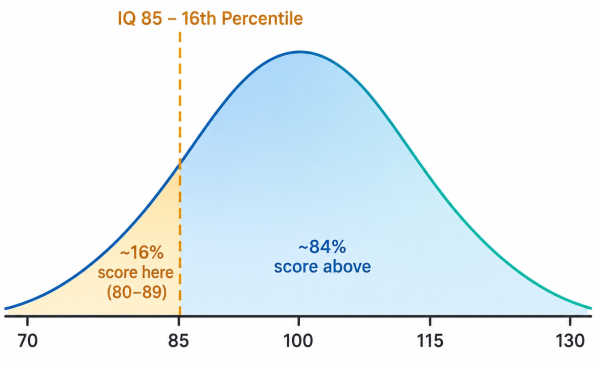
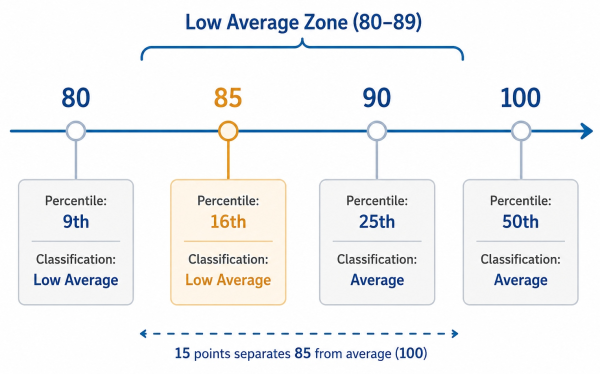
A score of 85 sits at approximately the 16th percentile, meaning around 84% of the population scores higher and 16% scores lower. It falls within the Low Average classification, which spans from roughly 80 to 89 on most standardised scoring systems including the Wechsler Adult Intelligence Scale (WAIS) and Stanford-Binet.
Importantly, Low Average does not mean low functioning. People in this range process information and solve problems at a slightly slower pace than the median, but they are fully capable of independent living, meaningful employment, and a wide range of social and personal achievements. For a full breakdown of how IQ scores are classified across the spectrum, see the IQ scale explained from low to genius.
IQ 85 Percentile and Population Context
| IQ Score | Percentile | Classification | % of Population |
| 130+ | 98th and above | Very Superior / Gifted | ~2% |
| 120–129 | 91st–97th | Superior | ~7% |
| 110–119 | 75th–90th | High Average | ~16% |
| 90–109 | 25th–74th | Average | ~50% |
| 80–89 | 10th–24th | Low Average | ~16% |
| 70–79 | 3rd–9th | Borderline | ~7% |
| Below 70 | 2nd and below | Extremely Low | ~2% |
As the table shows, roughly 16% of the population scores in the same Low Average band as an IQ of 85. This is not a rare or unusual result — it represents a significant portion of the general population and encompasses a wide range of functional abilities.
Is an IQ of 85 Bad?
No — and the framing of “bad” misses the point of what IQ scores measure. An IQ of 85 reflects cognitive performance on a specific test under specific conditions. It does not measure motivation, creativity, emotional intelligence, practical skills, social ability, or character — all of which contribute far more to real-world outcomes than a single cognitive score.
Many people with IQs in the 80–89 range live full, successful, and satisfying lives. They hold steady employment, raise families, build businesses, and contribute meaningfully to their communities. The idea that a score below 100 predicts failure is not supported by research. For broader context, see can someone with a low IQ be successful? and should I worry about my IQ score?
What Are the Cognitive Characteristics of IQ 85?
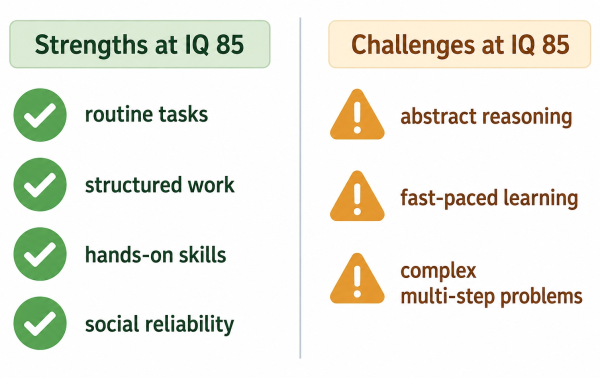
People scoring around 85 typically demonstrate the ability to learn new skills and information at a somewhat slower pace than average, handle routine tasks and structured environments effectively, follow multi-step instructions with some support in complex situations, and manage everyday problem-solving independently. They may find highly abstract reasoning or rapidly changing cognitive demands more challenging, but this does not prevent competent performance across a wide range of real-world activities.
IQ tests measure a specific subset of cognitive ability — primarily logical reasoning, pattern recognition, working memory, and processing speed. An IQ of 85 on these dimensions says nothing about a person’s verbal creativity, interpersonal intelligence, mechanical aptitude, artistic ability, or emotional depth. For a foundational explanation of what IQ actually measures, see what is IQ — a complete guide to intelligence quotient.
IQ 85 and Education
In educational settings, a score of 85 is generally sufficient for completing standard secondary school curricula, though students in this range may benefit from additional support in subjects that demand high levels of abstract reasoning or fast-paced information processing. They are fully capable of engaging with most academic content when given adequate time, clear instruction, and appropriate scaffolding.
It is worth noting that academic performance depends heavily on factors beyond IQ — including study habits, teacher quality, home environment, motivation, and emotional wellbeing. Students with IQs around 85 who are well-supported often outperform higher-scoring peers who lack those advantages. The relationship between cognitive ability and academic outcomes is explored in IQ vs academic achievement.
IQ 85 and Career Outcomes
An IQ of 85 is compatible with a wide range of careers. Research on IQ and job performance shows that cognitive ability matters more in roles involving high complexity, rapid learning, and novel problem-solving — and matters less in roles with clear structure, established procedures, and hands-on skills.
Roles that tend to suit people with IQs in the Low Average range include skilled trades such as electrician, plumber, carpenter, and mechanic; service and support roles in healthcare, retail, and hospitality; administrative and clerical positions; logistics, delivery, and operations roles; and customer-facing roles that reward interpersonal skill and reliability. Emotional intelligence, work ethic, punctuality, and domain expertise often compensate significantly for lower cognitive scores in most employment contexts. See IQ vs EQ for a deeper look at why emotional intelligence frequently outweighs raw cognitive ability in career success.
IQ 85 vs IQ 100: How Different Are They Really?
The 15-point gap between 85 and 100 represents exactly one standard deviation — a meaningful statistical difference, but one that should not be overstated in practical terms. In everyday life, most tasks do not require the cognitive resources needed to expose a 15-point IQ difference. Social interaction, most forms of work, creative pursuits, and personal relationships are far more dependent on personality, motivation, and social skill than on where someone falls on a cognitive bell curve.
The practical differences tend to emerge most clearly at the extremes of the IQ scale — below 70 or above 130 — rather than in the middle bands where most people cluster. A score of 85 and a score of 100 produce meaningfully different results in some high-complexity academic or technical contexts, but very similar outcomes across the vast majority of life situations.
Could Your IQ Score Be Higher Than 85?
Possibly. IQ scores are estimates with a margin of error of roughly 5 points in either direction on a well-administered professional test. A score of 85 today might reflect 80 or 90 under different conditions. Factors such as poor sleep, test anxiety, an unfamiliar test format, low motivation, or a distracting environment can all suppress performance below true ability level.
This is particularly relevant for online IQ tests, which lack the standardised conditions and professional administration of clinical assessments and often produce less reliable results. The reliability concerns around informal testing are covered in are free online IQ tests accurate? and what affects your IQ test results.
IQ 85 in Children: What It Means for Parents
If a child has been assessed at around 85, it is important for parents not to treat this as a fixed ceiling. Children’s IQ scores are considerably less stable than adult scores, particularly before age 10. A score of 85 at age 7 does not predict a score of 85 at age 14. Cognitive development is ongoing and influenced by environment, education, nutrition, emotional security, and stimulation.
The most productive response to a below-average score in a child is not worry — it is targeted support. Identifying which specific areas the child finds difficult and providing appropriate resources, encouragement, and time tends to produce far better outcomes than focusing on the number itself. Parents will find practical guidance in how to support a child with a below-average IQ and should parents be concerned about their child’s IQ?
Can an IQ of 85 Be Improved?
Test performance can be improved through better preparation, sleep, anxiety management, and familiarity with question formats — and these improvements are real, even if they do not reflect changes in underlying intelligence. Over longer timeframes, sustained mental engagement, physical health, quality education, and cognitive stimulation are associated with maintaining and in some cases modestly improving cognitive performance. The neuroscience behind this is covered in neuroplasticity of the brain and can IQ be improved?
Signs That a Score of 85 May Not Reflect True Ability
A score of 85 deserves scrutiny if the test was taken online without proper standardisation, if the person was sleep-deprived, anxious, or unwell during testing, if English is not their first language and the test was heavily verbal, if the person was unmotivated or rushed through the test, or if the score differs significantly from how the person performs in real-world problem-solving. In any of these situations, retesting under better conditions — ideally with a professionally administered assessment — is worth considering before drawing conclusions.
Final Thoughts on IQ 85
An IQ of 85 is a Low Average score that sits within the normal range of human cognitive ability. It is shared by roughly 16% of the population, is not associated with intellectual disability, and does not prevent success across the vast majority of life goals and career paths. Intelligence is broader, more varied, and more dynamic than any single number can capture. What you do with your cognitive profile — through effort, learning, emotional skill, and persistence — matters far more than where the number sits. Explore more in our IQ Scores section and take our free IQ test to get your current score.

Comments
Share Your Thoughts