An IQ score of 70 can trigger concern, fear, or confusion — in the person who receives it, and in the people who care about them. But does it automatically mean intellectual disability? The answer, grounded in current diagnostic criteria and research, is more nuanced than most articles acknowledge. This guide gives you the accurate classification, the DSM-5 diagnostic framework, what the Flynn Effect means for this score, and a realistic picture of real-life outcomes. For full IQ range context, see the IQ Scores guide and The IQ Scale Explained.
IQ 70: The Exact Statistics
On the standard bell curve (mean = 100, SD = 15), a score of 70 sits exactly 2 standard deviations below the population mean, placing it at the 2nd percentile. This means approximately 2% of the general population scores at this level or below.
| IQ Range | WAIS-IV Classification | Percentile |
| Below 70 | Extremely Low | Below 2nd |
| 70 | Borderline (lower boundary) | 2nd |
| 70–79 | Borderline | 2nd–8th |
| 80–89 | Low Average | 9th–23rd |
| 90–109 | Average | 25th–73rd |
A critical classification point: IQ 70 sits at the exact boundary between Extremely Low and Borderline on the WAIS-IV. A score of 70 is technically the lowest score in the Borderline classification. A score of 69 falls into Extremely Low. This boundary distinction matters significantly in educational, clinical, and legal contexts — and is one reason a single test score should never be interpreted in isolation. For comparison: IQ 73 sits in the Borderline range, while IQ 75 and IQ 80 move progressively away from this boundary.
Does IQ 70 Mean Intellectual Disability? What DSM-5 Actually Says
This is the most important section of this article — and the one most online resources get wrong. Under the DSM-5 (Diagnostic and Statistical Manual, 5th Edition, 2013), intellectual disability is diagnosed only when all three of the following criteria are met simultaneously:
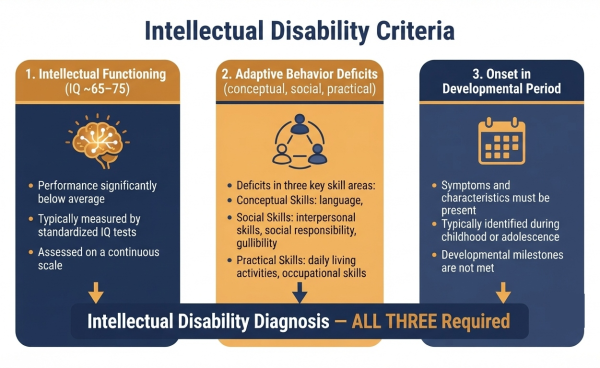
- Criterion A — Intellectual Functioning Deficits: Measured by standardized IQ tests, typically in the range of approximately 65–75 (roughly 2 SD below mean). IQ 70 falls within this range.
- Criterion B — Adaptive Behavior Deficits: Significant limitations in adaptive functioning across at least one of three domains: conceptual (language, reading, money, time), social (interpersonal skills, social judgment, communication), and practical (self-care, job skills, safety, transportation). This is assessed separately from IQ — and carries equal diagnostic weight.
- Criterion C — Onset During the Developmental Period: The deficits must have originated during childhood or adolescence, not later in life.
A single IQ score of 70 does not constitute an intellectual disability diagnosis. All three criteria must be present and professionally assessed. Adaptive functioning — how a person manages real life — carries equal diagnostic weight to the IQ score itself.
This shift — from IQ-alone criteria to the three-criterion model — was one of the most significant changes in DSM-5. It reflects decades of research showing that IQ scores, especially at the boundary regions, are imprecise predictors of functional outcomes. Many people who score around 70 on a single test session show adaptive functioning that is substantially stronger than the score suggests.
The Flynn Effect: Why IQ 70 Today May Not Mean the Same as IQ 70 in 1990
One of the most underreported factors in interpreting low IQ scores is the Flynn Effect — the documented rise of average IQ scores by approximately 3 points per decade throughout the 20th century, attributed to environmental improvements: better nutrition, expanded education, smaller family sizes, and more cognitively demanding daily environments.
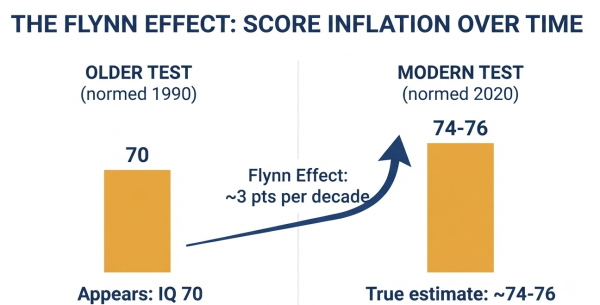
The Flynn Effect has a particularly important consequence at the lower end of the IQ distribution: when a test's normative sample becomes outdated, scores systematically appear lower than they would on a freshly normed test. An observed IQ of 70 on a test normed 10–15 years ago could correspond to a score of 73–76 on a current normative sample — a difference that may meaningfully affect whether someone meets Criterion A for an intellectual disability diagnosis.
This is one reason clinical guidelines increasingly emphasize that IQ scores should be interpreted within the confidence interval (typically ±5 points), and why recently normed tests are preferred for diagnostic decisions. Read the full Flynn Effect guide for the research behind this phenomenon.
Adaptive Functioning: The Equal Partner to IQ
The three-domain adaptive behavior model in DSM-5 assesses how a person actually functions in daily life — not what they score on a single test day. These domains are:
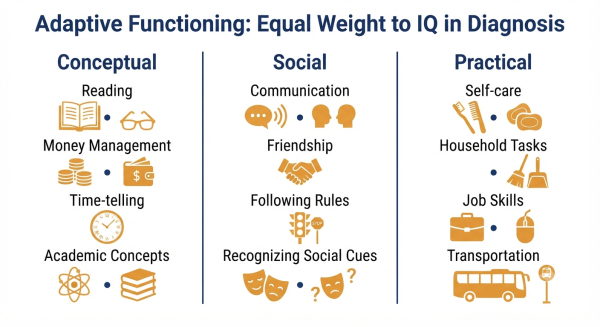
Conceptual Domain
Language, reading, writing, math, reasoning, knowledge, and memory. Includes practical skills like managing money, time, and schedules.
Social Domain
Interpersonal skills, social judgment, communication, the ability to follow rules, avoid exploitation, and form and maintain relationships.
Practical Domain
Self-care, household tasks, job skills, financial management, transportation, safety awareness, and health management.
Research consistently shows that many individuals with IQ scores near 70 show adaptive functioning substantially stronger than their IQ score would predict — particularly in practical and social domains built through lived experience rather than abstract reasoning. The environment in which someone grows up — supportive family, consistent schooling, access to resources, emotional safety — is a powerful predictor of adaptive functioning outcomes independent of IQ.
What Measurement Error Means at IQ 70
All IQ tests carry a standard error of measurement of approximately ±5 points. An observed score of 70 means the true score likely falls somewhere between 65 and 75 — a range that spans the Extremely Low classification, the diagnostic boundary, and the Borderline range. This is precisely why clinical guidelines require multiple assessment sources, multiple test sessions, and adaptive behavior evaluation before any diagnostic conclusion is drawn. A single online or informal test result is never sufficient for diagnosis.
For more on how IQ scores should be interpreted, and what factors affect test performance, read whether IQ can be improved and the guide on neuroplasticity.
What the Research Shows About Real-Life Outcomes at IQ 70
Research on individuals with IQ scores in the 65–75 range who do not have significant adaptive functioning deficits consistently shows outcomes that challenge the "intellectual disability" framing:
- Many complete secondary education and some post-secondary vocational training
- Employment rates in structured, supportive settings are substantially higher than stereotypes suggest
- Independent living is common when early support has been provided and adaptive skills developed
- Social and emotional life — relationships, community participation, personal goals — is not meaningfully constrained by IQ 70 alone
What research identifies as the most significant predictors of positive outcomes: early intervention focused on adaptive skills, inclusive educational environments that build practical competence, family and community support, and opportunities to develop vocational skills aligned with natural strengths. See the guide on low IQ success for documented examples. For parents supporting a child in this range, supporting a child with below-average IQ provides practical, research-based guidance.
Howard Gardner's Multiple Intelligences: What IQ Tests Don't Measure
IQ tests primarily measure verbal-linguistic and logical-mathematical reasoning — the forms of cognition most valued in academic settings. Howard Gardner's research on Multiple Intelligences identifies several additional domains that standardized tests do not capture:
- Musical intelligence — rhythm, tone, and harmonic perception
- Bodily-kinesthetic intelligence — physical coordination, craft, and practical skill
- Intrapersonal intelligence — self-awareness and emotional insight
- Naturalistic intelligence — attunement to natural environments and living systems
- Linguistic intelligence — oral communication and narrative reasoning
Individuals with IQ scores near 70 frequently demonstrate genuine strength in one or more of these areas — strengths that contribute meaningfully to quality of life, vocational success, and interpersonal connection, but that remain invisible to standard IQ measurement. Emotional intelligence is particularly worth exploring separately — take the EQ Test and read the guide on IQ vs EQ.
When Support Makes the Difference
Some individuals with IQ scores near 70 do experience learning or adaptive challenges that benefit from structured support. The goal of such support is not to "fix" the person but to build practical competence and confidence. Effective interventions include:
- Individualized Education Programs (IEPs) that align teaching methods to the student's actual strengths and learning pace
- Speech or occupational therapy focused on communication and daily living skills
- Life skills coaching covering budgeting, social interaction, transportation, and workplace behavior
- Supported employment programs that match abilities to appropriate job structures with mentorship
When intervention is early, consistent, and grounded in the person's real strengths rather than deficits, outcomes are frequently far better than IQ scores alone would predict. The guide on borderline IQ covers the research on this population in more depth. For parents of children in this range, also see IQ testing for kids and should parents worry about their child's IQ.
Frequently Asked Questions
What percentile is IQ 70?
IQ 70 corresponds to approximately the 2nd percentile on the standard bell curve (mean = 100, SD = 15). It sits exactly 2 standard deviations below the population mean. Roughly 2% of the general population scores at this level or below.
Does IQ 70 automatically mean intellectual disability?
No. Under DSM-5 (2013), intellectual disability requires all three of the following simultaneously: deficits in intellectual functioning (typically IQ ~65–75), significant deficits in adaptive behavior across conceptual, social, or practical domains, AND onset during the developmental period. A single IQ score of 70 is insufficient for diagnosis. Adaptive functioning — how a person actually manages real-life tasks — carries equal diagnostic weight.
What is the WAIS-IV classification for IQ 70?
IQ 70 sits at the exact lower boundary of the Borderline classification on the WAIS-IV. A score of 70 is the lowest score in the Borderline range (70–79); a score of 69 falls into Extremely Low. This boundary matters considerably in clinical, educational, and legal contexts — which is why assessment should never rely on a single test score.
How does the Flynn Effect affect IQ 70?
The Flynn Effect — rising average IQ scores linked to environmental improvements — has a proportionally larger impact at the lower end of the distribution. On an outdated normative sample, an observed score of 70 might correspond to a score of 73–76 on a current normative sample. This score shift can be diagnostically meaningful at the 70-threshold boundary. See the Flynn Effect guide for full details.
Can someone with IQ 70 live independently?
Many can. Adaptive functioning — not IQ score — is the strongest predictor of independent living outcomes. Many individuals with IQ scores in the 70–75 range live independently, maintain employment in structured settings, manage daily responsibilities, and sustain meaningful relationships. Early support, inclusive environments, and opportunities to build practical skills are the most significant factors in outcomes — not the IQ number itself.

Comments
Share Your Thoughts