Certain careers consistently attract people with above-average cognitive ability — not because high IQ is formally required, but because the cognitive demands of the role create a natural selection process. Understanding which careers draw the highest cognitive profiles, what specifically makes them demanding, and what role IQ actually plays in career success helps both career planners and employers make better decisions. For the foundation on what IQ measures, see What Is IQ?
Average IQ by Profession: What Research Shows
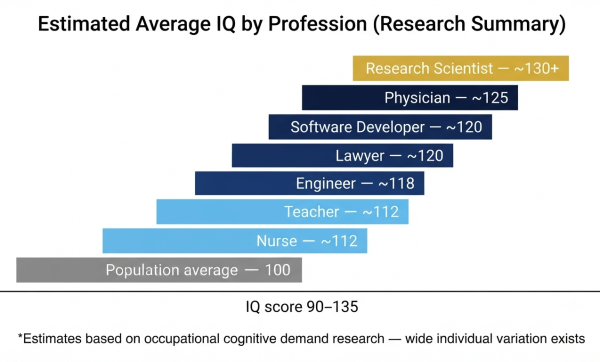
Research on average IQ by profession — including meta-analyses drawing on military aptitude data, professional licensing exam performance, and occupational cognitive demand studies — consistently produces a ranked picture. The estimates below represent population averages for each profession, with wide individual variation within each field:
| Profession | Estimated Average IQ | Primary Cognitive Demand |
| Research Scientist / Physicist | ~130+ | Abstract reasoning, original problem formulation |
| Physician / Surgeon | ~125 | Medical knowledge integration, rapid judgment |
| Attorney / Lawyer | ~118–125 | Verbal reasoning, logical argumentation |
| Software Engineer / Architect | ~115–125 | Abstract logic, pattern recognition, systems thinking |
| Engineer (Civil, Aerospace, Chemical) | ~115–120 | Quantitative reasoning, spatial visualization |
| Nurse | ~110–115 | Medical protocol application, patient assessment |
| Teacher / Educator | ~110–115 | Verbal comprehension, curriculum organization |
| Population Average | 100 | — |
For detailed breakdowns by specific role, see average IQ of doctors, average IQ of lawyers, average IQ of engineers, and average IQ by profession guide. Note: these are estimated averages based on occupational research — wide individual variation exists within every profession.
What Makes a Job Cognitively Demanding
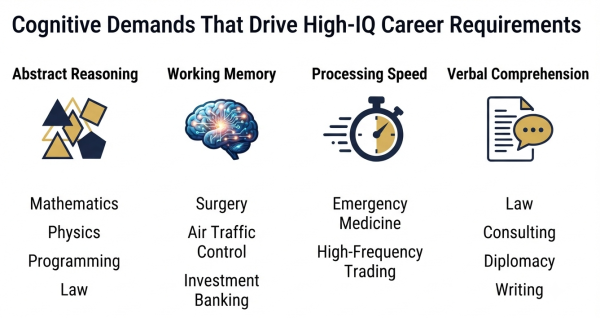
High cognitive demand in a job typically means one or more of the following:
- Abstract reasoning at high complexity: Working with formal systems (mathematics, logic, legal codes, programming languages) that require sustained abstract thinking — research science, mathematics, software architecture
- High working memory load: Holding and integrating many pieces of information simultaneously — surgery (multiple patient variables), investment banking (real-time market data), air traffic control
- Rapid processing under pressure: High-consequence decisions in time-constrained environments — emergency medicine, high-frequency trading, crisis management
- Verbal reasoning at depth: Constructing and evaluating complex arguments in language — law, management consulting, diplomacy, academic publishing
- Sustained learning curve: Roles requiring continuous acquisition of new knowledge at high volume — medicine (pharmaceutical advances), technology (rapidly evolving stacks), research (new literature)
High-Cognitive-Demand Careers: What Each Requires
Research Science and Mathematics
Research scientists — particularly in theoretical physics, mathematics, and chemistry — consistently appear at the top of profession-IQ rankings. The cognitive demand is abstract reasoning at the frontier: working with formal systems, generating novel hypotheses, and identifying patterns in complex data sets without established precedent. For specific career context: IQ for software engineers and jobs requiring high IQ.
Medicine and Surgery
Physicians and surgeons need high cognitive ability for two distinct demands: sustained knowledge acquisition across medical school and residency (crystallized intelligence), and rapid integration of patient data under time pressure during clinical practice (fluid intelligence + working memory). Surgical specialties add fine motor precision and spatial reasoning demands. See average IQ of doctors.
Law
Legal practice at the highest levels demands exceptional verbal reasoning — constructing and deconstructing complex arguments in precise language, identifying logical flaws, and anticipating counter-arguments. Law school itself functions as a cognitive filter (LSAT scores correlate strongly with general verbal reasoning). See average IQ of lawyers.
Software Engineering and Architecture
Software development has one of the clearest cognitive demand profiles: abstract logic (programming requires thinking in formal rule systems), pattern recognition (identifying structural patterns in code and data), and working memory (tracking complex state across a large codebase). Senior architects and AI engineers additionally require systems thinking at high abstraction levels. See IQ for software engineers.
Engineering
All engineering disciplines demand quantitative reasoning and spatial visualization, but the specific profile varies. Aerospace and electrical engineering require the highest abstract reasoning; civil and mechanical engineering require strong spatial reasoning and applied mathematics. See average IQ of engineers.
The Threshold Hypothesis: How Much IQ Is Enough?
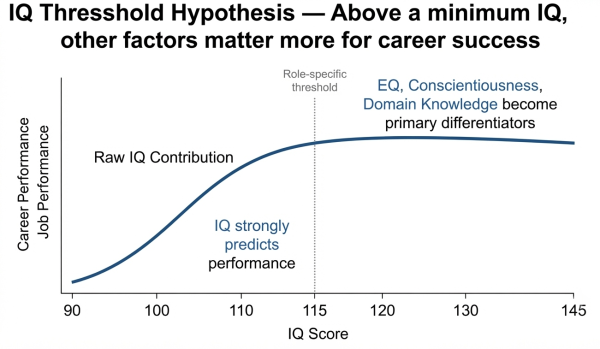
One of the most important findings in the IQ-career research is the threshold hypothesis: for any given profession, there is a minimum cognitive level required to meet the demands of the role. Below that threshold, cognitive ability is a strong limiting factor. Above it, cognitive ability predicts diminishing returns — other factors become the primary differentiators of outstanding performance.
This means that for most high-demand careers, the relevant question is not "do I need IQ 140 to be a doctor?" but "do I meet the cognitive threshold for medical school and clinical practice?" — which research suggests is in the 115–125 range for most physicians. Above that threshold, discipline, domain expertise, emotional intelligence, and communication determine who becomes exceptional.
What Matters Beyond IQ in High-Demand Careers
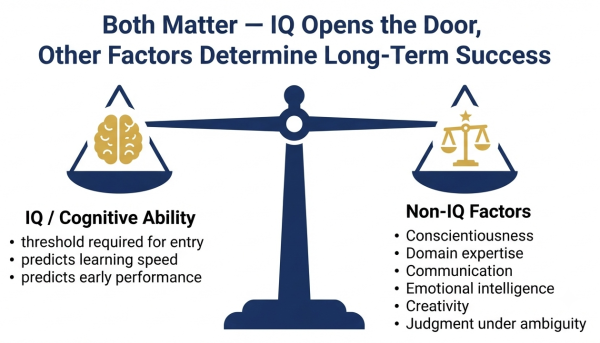
Across high-cognitive-demand professions, factors beyond IQ consistently predict long-term career outcomes:
- Conscientiousness: The single strongest non-cognitive predictor of career success across all professions — willingness to work systematically, meet commitments, and persist through difficulty
- Domain expertise: Accumulated specific knowledge over years of deliberate practice — much of what looks like "intelligence" in senior professionals is domain knowledge efficiently organized
- Communication ability: In nearly all high-demand professions, the ability to communicate complex ideas clearly — to clients, colleagues, policymakers, or patients — becomes a critical differentiator at senior levels
- Emotional intelligence: Leadership, collaboration, and client-facing roles all require EQ alongside IQ. See IQ vs EQ and the EQ Test
- Creativity and judgment under ambiguity: The most valuable professionals in complex fields are those who can navigate novel situations with imperfect information — a capacity that pure IQ does not fully capture
For the research on career success without necessarily high IQ, see succeeding without being naturally smart and business success with lower IQ.
Frequently Asked Questions
What IQ do you need for a demanding career?
Research places the most cognitively demanding professions — physicians, lawyers, engineers, research scientists — in the IQ 115–130+ range on average. The threshold hypothesis suggests that a minimum cognitive level is required for each role, but above that threshold, other factors (conscientiousness, EQ, domain expertise) become more important predictors of long-term success. See the full average IQ by profession guide.
What are the highest IQ jobs?
Research consistently places research physicists and mathematicians highest (~130+), followed by physicians and surgeons (~125), attorneys (~118–125), and software engineers and architects (~115–125). These are population averages with wide individual variation. See average IQ of doctors, lawyers, and engineers.
Does IQ determine success in high-demand careers?
IQ predicts entry and early performance in cognitively demanding professions — learning speed, training outcomes, and analytical task performance. But long-term career success depends substantially on conscientiousness, communication, emotional intelligence, domain expertise, and creativity. Above the role's cognitive threshold, IQ predicts diminishing returns. See IQ vs EQ.
Can someone with an average IQ succeed in a high-IQ career?
Yes. Average IQ is 100, and many successful professionals in demanding fields don't dramatically exceed the role's typical average. Above the cognitive threshold required by the role, outcomes are shaped more by dedication, specific learning, communication, and emotional intelligence. The threshold hypothesis: cognitive ability matters most for entry and initial performance, with diminishing returns above that threshold. See succeeding without being naturally smart.

Comments
Share Your Thoughts