If you scored 117 on an IQ test, the first question is usually some version of: is this actually good, or just slightly above normal? The precise answer matters — and most articles either overstate it or understate it. This guide gives you the exact statistics, the correct classification, what research shows about outcomes at this level, and a realistic picture of career fit and cognitive strengths. For the full IQ range context, see the IQ Scores guide.
IQ 117: The Exact Statistics
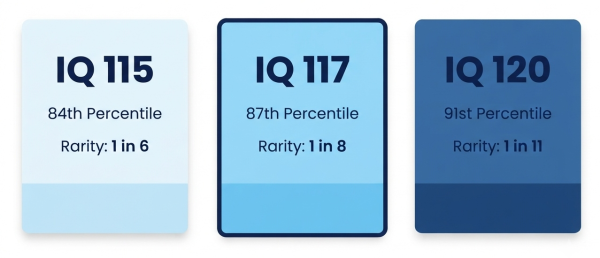
On the standard bell curve (mean = 100, SD = 15), a score of 117 sits 1.13 standard deviations above the population mean, placing it at the 87th percentile. You score higher than approximately 87% of the general population. Roughly 1 in 8 people score at this level or above.
| IQ Score | Percentile | SD Above Mean | Rarity |
| 100 | 50th | 0.0 | 1 in 2 |
| 110 | 75th | +0.67 | 1 in 4 |
| 115 | 84th | +1.0 | 1 in 6 |
| 117 | 87th | +1.13 | ~1 in 8 |
| 120 | 91st | +1.33 | 1 in 11 |
| 126 | 96th | +1.73 | 1 in 25 |
On the WAIS-IV, IQ 117 is classified as High Average — the band covering 110–119. One useful reference point: IQ 115 is exactly 1 standard deviation above the mean (84th percentile). IQ 117 moves 3 points beyond that milestone, into the 87th percentile — a meaningful shift in statistical terms even if the cognitive experience is similar. To understand the full classification framework, read The IQ Scale Explained and What Is IQ.
For neighboring score comparisons: IQ 115 at the 84th percentile, IQ 119 at the 90th, and IQ 120 at the 91st — the boundary into the Superior range.
So: Above Average or Just Normal?
The direct answer: genuinely above average — not marginally. An IQ of 117 places you in the top 13% of the general population. To put that concretely: if you walked into a room of 100 randomly selected adults, approximately 87 would score lower than you on a standardized IQ test.
The word "normal" is statistically meaningful: roughly 68% of people score between 85 and 115, the central one-standard-deviation band. IQ 117 is above that band, outside the average clustering range. It is not in the Superior range (120–129) and well below the Gifted threshold (130+), but it is a measurable, consistent cognitive advantage over the population majority. The question worth asking is not "is this above average?" but "what does this mean in practice?"
IQ 117 is not a stepping stone to genius — it is a solid foundation for nearly any professional or academic goal that matters to you.
What Research Says About IQ 117 Outcomes
Gottfredson's landmark research on occupational IQ thresholds is the most practical lens for understanding what IQ 117 means in the real world. Her analysis shows that most professional and technical careers have cognitive demands in the 100–115 range — meaning IQ 117 exceeds the typical threshold for most mainstream careers. At this level, cognitive capacity is rarely the limiting factor in professional performance. What differentiates outcomes is domain expertise, work ethic, communication skill, and emotional intelligence.
Research on graduate school average IQs clusters most programs in the 115–125 range. IQ 117 sits at the lower bound of that range, making graduate-level study cognitively accessible — with sustained effort and strong domain preparation playing an increasingly important role the further into specialization you go.
See average IQ by profession, IQ and income research, and average IQ by education level for data across different fields and academic tracks.
Cognitive Traits at IQ 117
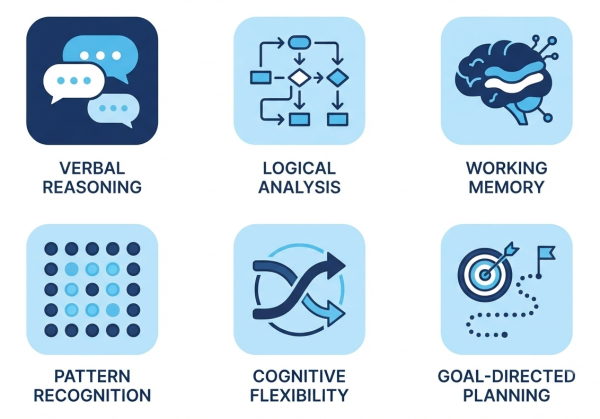
1. Strong Verbal Reasoning
People in the High Average range typically show above-average verbal comprehension — the ability to understand, evaluate, and express complex ideas through language. This manifests as articulate communication, persuasive writing, and the ability to adapt explanation to different audiences. It is directly relevant to law, education, management, marketing, and any communication-heavy role. For more on this dimension, see the Linguistic Intelligence guide.
2. Reliable Logical Analysis
IQ 117 supports consistent analytical reasoning — breaking complex situations into component parts, evaluating cause and effect, and identifying the most productive path through ambiguous problems. This is less the "intuitive leap" style of very high-range intelligence and more the reliable, methodical reasoning that most professional environments depend on. The IQ vs critical thinking guide explores how these two capacities relate.
3. Above-Average Working Memory
Working memory — the ability to hold and manipulate multiple pieces of information simultaneously — is typically above average at IQ 117, enabling effective multi-step planning, following complex instructions, and tracking several variables at once. This is practically relevant in project management, healthcare, data work, and any role requiring sustained cognitive load. See the IQ and Memory guide for the research behind this connection.
4. Cognitive Flexibility
People at this level adapt reasonably well when initial approaches don't work — shifting frameworks, incorporating new information, and updating their understanding without significant resistance. This cognitive flexibility is particularly valuable in fast-changing environments: technology, healthcare, management, and creative fields.
5. Effective Pattern Recognition
IQ 117 supports reliable pattern detection — identifying trends in data, structural similarities across problems, and recurring dynamics in social or professional situations. This is the cognitive basis of good strategic thinking, useful across analytics, marketing, education, and research.
Best Career Paths for IQ 117
At IQ 117, the relevant question is not "what careers can I access?" but "which environments will challenge and reward me over time?" Cognitive ability at this level opens a very wide range of professional doors — the key is matching your strengths with the right domain.
Healthcare and Human Services
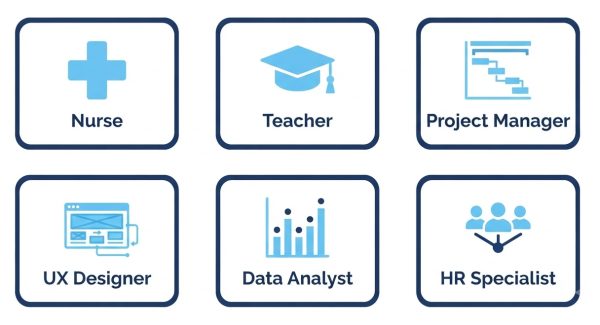
- Registered Nurse: Complex clinical reasoning, patient communication, structured protocol. Mean nurse IQ clusters around 110–115 — IQ 117 exceeds this baseline. See average IQ of nurses.
- Occupational / Physical Therapist: Combines clinical knowledge with interpersonal problem-solving.
- Social Worker / Counselor: Procedural knowledge, empathetic reasoning, case complexity.
Education and Training
- Teacher (K–12 or higher education): Curriculum design, explanation clarity, adaptive teaching. One of the most consistent IQ-117 fits in occupational research.
- Corporate Trainer / Learning Designer: Translating complex material into accessible, structured learning.
- Educational Consultant: Systemic thinking about learning outcomes and curriculum design.
Technology and Analysis
- UX Designer: Combines logical systems thinking with user empathy and creative problem-solving.
- Data Analyst / Business Intelligence: Pattern recognition, quantitative reasoning, data storytelling.
- IT Project Manager / Systems Analyst: Structured troubleshooting, stakeholder communication, technical documentation. See IQ for software engineers.
Business and Management
- Project Manager / Operations Manager: Multi-task coordination, deadline management, cross-functional communication.
- Marketing Strategist / Content Lead: Audience analysis, verbal reasoning, structured campaign thinking.
- HR Specialist / Recruiter: Policy interpretation, structured interviewing, interpersonal judgment.
For broader career context, see jobs for IQ 110–120 and average IQ by profession. For comparison with the score range just below, see IQ 110 and IQ 116.
What IQ 117 Does Not Tell You
IQ 117 measures specific cognitive capacities — abstract reasoning, working memory, processing speed, verbal comprehension. It does not measure:
- Emotional intelligence, empathy, or social skills
- Creativity, artistic ability, or practical wisdom
- Persistence, conscientiousness, and work ethic
- Leadership presence or interpersonal influence
- Domain knowledge built through deliberate practice
Research consistently shows that at the High Average IQ level, these non-cognitive factors become the primary differentiators in career and life outcomes. Understanding your full profile matters as much as your IQ score. Consider taking the EQ Test, reading IQ vs EQ, and exploring MBTI or DISC for a broader picture of how you think and interact.
IQ 117 Is Not Fixed
All IQ scores carry measurement variance of ±5–10 points — an observed 117 means the true score likely ranges from approximately 107 to 127. Environmental factors including sleep, stress, test familiarity, and language background affect results meaningfully. Research on neuroplasticity confirms that cognitive performance responds to sustained intellectual demand throughout adulthood, and the Flynn Effect demonstrates that measured IQ across populations responds significantly to environmental improvements — better education, nutrition, and cognitively demanding environments. Read whether IQ can be improved for what the evidence actually supports.
Frequently Asked Questions
What percentile is IQ 117?
IQ 117 corresponds to the 87th percentile — meaning you score higher than approximately 87% of the general population. It sits 1.13 standard deviations above the mean on a standard SD-15 scale. Roughly 1 in 8 people score at this level or above.
Is IQ 117 considered above average?
Yes — clearly. IQ 117 is classified as High Average on the WAIS-IV and places you in the top 13% of the population. It is above the 84th percentile milestone marked by IQ 115 (exactly 1 SD above mean). It is below the Superior range (120+) and well below Gifted (130+), but it is a genuine, measurable cognitive advantage over the population majority.
What is the difference between IQ 115 and IQ 117?
IQ 115 is exactly 1 standard deviation above the mean, at the 84th percentile (1 in 6). IQ 117 is 1.13 standard deviations above the mean, at the 87th percentile (1 in 8). Both fall in the High Average classification on WAIS-IV. The 3-point difference is modest in cognitive experience but represents a meaningful rarity shift statistically.
Is IQ 117 enough for college or graduate school?
Yes. IQ 117 is well above the cognitive baseline for undergraduate success and sufficient for most graduate programs. Research suggests graduate school averages cluster in the 115–125 range — IQ 117 sits at the lower end of that band, meaning sustained effort, domain preparation, and strong study habits become increasingly important alongside cognitive ability at this level.
How does IQ 117 compare to IQ 110 or IQ 120?
IQ 110 sits at the 75th percentile (1 in 4), IQ 117 at the 87th (1 in 8), and IQ 120 at the 91st (1 in 11). IQ 120 also marks the boundary into the Superior classification. IQ 117 is meaningfully above both the population average and the IQ 110 High Average lower bound, and a few points below the Superior threshold. See IQ 110 and IQ 120 for detailed comparisons.

Comments
Share Your Thoughts