An IQ of 138 is one of those scores that raises an immediate question: what does this actually mean in practice? Not just the label, but the real implications — for how you think, what careers fit, and what research says about long-term outcomes at this cognitive level. This guide gives you the precise statistics, the research citations, and the honest picture. For the full IQ range context, see the IQ Scores guide.
IQ 138: The Exact Statistics
On the standard bell curve (mean = 100, SD = 15), a score of 138 sits 2.53 standard deviations above the population mean. That places it at the 99.4th percentile — meaning you score higher than approximately 99.4% of the general population. Roughly 1 in 200 people reach this level, placing IQ 138 in the top 0.5% of the population.
| IQ Score | Percentile | SD Above Mean | Rarity |
| 130 | 98th | +2.0 | 1 in 50 |
| 135 | 99th | +2.33 | 1 in 100 |
| 138 | 99.4th | +2.53 | ~1 in 200 |
| 140 | 99.6th | +2.67 | 1 in 261 |
| 145 | 99.87th | +3.0 | 1 in 741 |
On the WAIS-IV, IQ 138 is classified as Very Superior — the same band as IQ 130–144. In educational psychology, it falls firmly in the Gifted category, well above the most commonly used giftedness threshold of 130 (2 SD above mean). To understand where this sits in the full IQ framework, read The IQ Scale Explained and the WAIS-IV complete guide.
IQ 138 and High-IQ Society Eligibility
IQ 138 sits at a distinctive position on the high-IQ society threshold scale — above Mensa and Intertel, approaching but not yet reaching the Triple Nine Society.
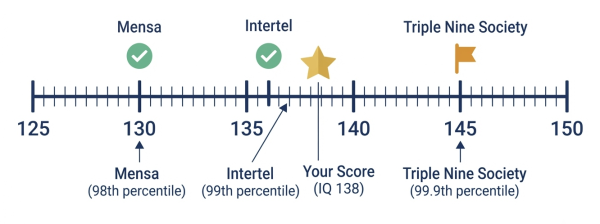
| Society | Threshold (SD-15) | Percentile | IQ 138 Eligible? |
| Mensa International | ~130 | 98th | ✔ Yes — with significant margin |
| Intertel | ~137 | 99th | ✔ Yes |
| Triple Nine Society | ~146 | 99.9th | ✘ Not yet |
IQ 138 qualifies for both Mensa and Intertel. The Triple Nine Society requires approximately IQ 146 on SD-15 tests, making 138 clearly below that threshold. Read more in the What Is Mensa guide and the full High IQ Societies overview. To push your score at this range, the High Range IQ Test is designed specifically for above-average cognitive profiles.
What Research Actually Says About IQ 138 Outcomes
The most important research foundation for understanding IQ 138 is Lewis Terman's landmark longitudinal study of gifted individuals — those scoring at the 98th percentile and above. Terman tracked hundreds of gifted subjects across their lifetimes and concluded that most became well-adjusted adults with successful careers and above-average job satisfaction. Later meta-analyses confirmed that gifted individuals are disproportionately represented among strong contributors to technological progress and organizational performance.
More specifically, research tracking high IQ at age 13 into adulthood found it to be a strong predictor of job success and satisfaction in STEM careers — a finding directly relevant to IQ 138, which sits well above the 98th percentile threshold used in those studies.
A key finding from more recent gifted adult research: the primary challenge at IQ 138 is sustaining interest, not building capability. At this cognitive level, virtually any intellectual domain is accessible. The more common career and life difficulty is finding environments that remain sufficiently stimulating over time — not whether the person can handle the work. This framing matters for career decisions. See careers requiring IQ above 130 and high IQ low EQ career pitfalls for practical guidance.
At IQ 138, the question is rarely "can I do this?" — it is "will this keep me engaged long enough to do it well?"
Cognitive Profile at IQ 138: What the Score Reflects
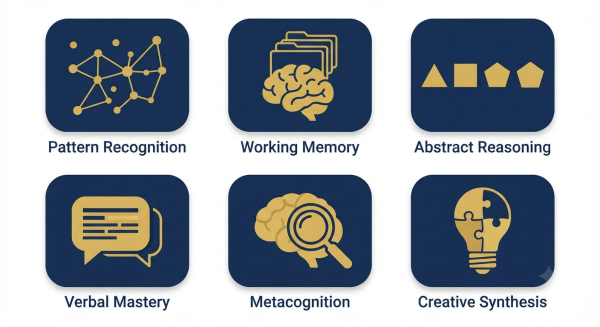
1. Pattern Recognition Across Domains
People at IQ 138 naturally identify structural relationships — in data, arguments, language, systems, and social dynamics — that others miss. This cross-domain pattern detection is the cognitive basis of strong performance in mathematics, programming, strategic thinking, and research. It is one of the most consistent findings in gifted cognitive research. See Verbal and Nonverbal Tests of Intelligence for how this is measured.
2. High Working Memory Capacity
Working memory — the ability to hold, manipulate, and apply multiple pieces of information simultaneously — is a consistent strength at this cognitive level. It underlies effective planning, complex multi-step reasoning, and the ability to track competing variables in real time. The guide on IQ and Memory covers the research on this connection in detail.
3. Advanced Metacognition
Individuals at IQ 138 consistently show strong metacognitive awareness — the ability to monitor, evaluate, and adjust their own reasoning processes in real time. They catch logical errors in their own thinking before others point them out, model multiple competing hypotheses simultaneously, and shift analytical frameworks efficiently when a problem resists initial approaches.
4. Verbal and Linguistic Precision
Command of language at this level tends toward sophistication: nuanced vocabulary, structured argumentation, recognition of subtext and implication, and the ability to translate complex ideas into clear explanation for different audiences. This strength is directly relevant to careers in law, writing, leadership, teaching, and research communication.
5. Creative Synthesis
At IQ 138, creative thinking is not separate from analytical thinking — it is an extension of it. The ability to connect concepts across traditionally separate domains, find unexpected structural similarities between problems, and generate solutions that reframe the question rather than just answering it is characteristic of gifted cognition. This is the basis of the strongest innovations in science, technology, and the arts.
Personality Patterns Commonly Associated with IQ 138
While IQ and personality are distinct constructs, research on gifted adults identifies consistent patterns that are worth understanding — not as fixed traits, but as tendencies that shape experience:
- Depth orientation over breadth: Gifted individuals tend to pursue fewer topics to greater depth rather than skimming many areas. Shallow engagement feels unrewarding.
- High internal standards and perfectionism: The same metacognitive awareness that supports strong performance also makes every gap visible. Gifted individuals often find their own work more flawed than others perceive it.
- Social calibration mismatch: At IQ 138, the population of natural intellectual peers is roughly 0.5% — meaning that in most social settings, conversations resolve at a pace and depth that feels somewhat understimulating. This is not antisociality; it is a calibration difference.
- Existential and abstract curiosity: Questions about purpose, meaning, consciousness, and human behavior emerge earlier and persist longer in gifted individuals than in average-range peers.
- Emotional reactivity: Research on the hyper-brain/hyper-body hypothesis suggests gifted individuals may experience heightened psychological and physiological reactivity — deeper rumination, more intense emotional responses, greater sensitivity to environmental stimuli.
Understanding the emotional dimension of high IQ is as important as the cognitive dimension. The EQ Test, the IQ vs EQ guide, and the EQ vs IQ in the workplace guide all provide practical frameworks for developing this dimension alongside cognitive strength.
Best Career Paths for IQ 138
At IQ 138, cognitive access is not the issue — engagement is. The careers most likely to sustain performance and satisfaction over the long term are those with intellectual depth, autonomy, and continuous novel challenge.
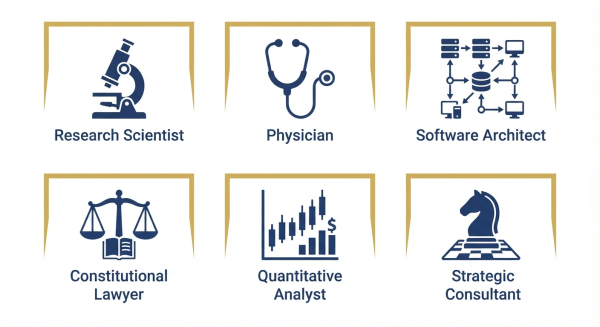
Research and Hard Sciences
- Research Scientist (physics, neuroscience, chemistry): Open-ended problems, abstract modeling, intellectual autonomy.
- AI / ML Engineer or Architect: Systems thinking, frontier problems, rapid domain evolution. See IQ for software engineers.
- Physician / Surgeon: Complex diagnostic reasoning, continuous learning. See average IQ of doctors.
Law, Strategy, and Finance
- Constitutional or Corporate Lawyer: Multi-layered argumentation, novel precedent, high cognitive stakes.
- Quantitative Analyst / Portfolio Manager: Mathematical modeling, probabilistic reasoning, rapid market complexity.
- Management Consultant / Strategic Advisor: Cross-domain synthesis, diagnostic reasoning, high-stakes decision frameworks.
Academia and Creative Work
- University Professor / Research Fellow: Intellectual autonomy, long-form mastery, mentorship.
- Author, Screenwriter, or Philosopher: High-concept creative work where depth and originality are the product.
- Entrepreneur (complex domains): System innovation, pattern-based opportunity identification.
For additional guidance on career and cognitive fit, see jobs for IQ 130–140, what jobs require high IQ, and neighboring score profiles: IQ 132, IQ 140, and IQ 143.
IQ 138 Is Not a Fixed Score
All IQ scores carry measurement variance of ±5–10 points. An observed 138 means the true score likely ranges from approximately 128 to 148 — spanning from the upper edge of Superior to the lower edge of Exceptionally Gifted. Environmental factors (sleep, stress, test familiarity, language background) affect results meaningfully.
Beyond measurement, research on neuroplasticity confirms that cognitive performance continues to respond to environmental demands throughout adulthood. The Flynn Effect — rising global IQ scores linked to environmental improvements — demonstrates that measured IQ is substantially shaped by education, nutrition, and cognitive engagement, not genetics alone. Read whether IQ can be improved for what the evidence actually supports.
Frequently Asked Questions
What percentile is IQ 138?
IQ 138 corresponds to the 99.4th percentile — meaning you score higher than approximately 99.4% of the general population. It sits 2.53 standard deviations above the mean on an SD-15 scale. Roughly 1 in 200 people score at this level or above.
Is IQ 138 considered gifted?
Yes. IQ 138 falls in the Very Superior / Gifted classification on the WAIS-IV, exceeding the most common giftedness threshold of 130 by a full 8 points. It comfortably qualifies for Mensa and Intertel membership, and meets the admission criteria for most gifted education programs.
What is the biggest challenge for people with IQ 138?
The primary challenge at this level is not capability — it is engagement. Research on gifted adults consistently identifies chronic understimulation, difficulty finding intellectual peers, perfectionism, and social calibration mismatch as more common difficulties than actual cognitive barriers. Choosing environments that remain genuinely challenging over the long term is the most important career decision at this IQ level.
How does IQ 138 compare to IQ 132 or IQ 140?
All three scores fall in the Very Superior / Gifted range. IQ 132 sits at the 98th percentile (1 in 50), while IQ 138 reaches the 99.4th (1 in 200) and IQ 140 the 99.6th (1 in 261). The practical differences in daily cognitive experience between these scores are modest — the meaningful threshold changes happen at larger intervals, like the jump from average (100) to gifted (130+). See IQ 132 and IQ 140 for detailed breakdowns.
What famous people have an IQ around 138?
Estimated celebrity IQ scores are widely debated and rarely verified. IQ 138 is commonly cited for a range of accomplished scientists, authors, and innovators. Explore the Celebrity IQ Database for detailed breakdowns — and the important caveats about how historical estimates are derived. For the very highest documented scores, see highest IQ in history.

Comments
Share Your Thoughts