On 2 June 2004, a 30-year-old software engineer from Salt Lake City, Utah, walked onto the Jeopardy! stage for the first time. Over the next six months, Kenneth Wayne Jennings III won 74 consecutive games, earned $2,520,700 in regular-season prizes, and became the most famous trivia player in the world. He averaged 35.9 correct responses per game — a record that no other contestant has come within 6 correct responses of matching.
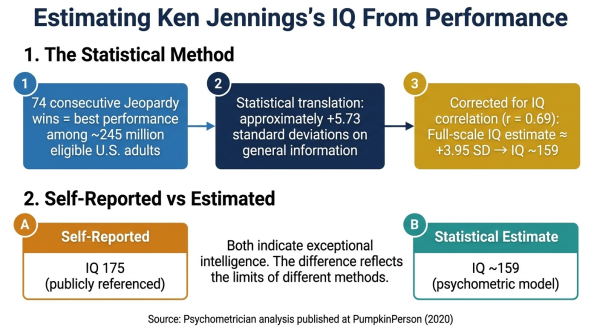
His IQ is most commonly cited as 175 — a figure he has referenced publicly and which appears across multiple biographical sources. A psychometrician analysing his Jeopardy performance through statistical modelling arrived at an independent estimate of approximately 159 — correlating his rank performance among 245 million eligible US adults with the information subtest of the WAIS-IV IQ scale. Both figures indicate extraordinary cognitive ability. The gap between them reflects the difference between a self-reported number and a statistical inference — each with its own limitations and its own validity.
This article examines what we actually know about Ken Jennings's intelligence, what his Jeopardy performance tells us about specific types of cognitive ability, and how his unusual life trajectory — from childhood in South Korea to software engineering to the most celebrated trivia run in television history — shaped the mind that made it possible.
What Is Ken Jennings's IQ?
Ken Jennings has publicly referenced an IQ of 175 on multiple occasions. No official clinical test record has been publicly released. The figure of 175 appears across numerous biographical sources and is treated as a self-disclosure rather than a derived estimate.
An independent psychometric analysis took a different approach — working backward from performance. The reasoning runs as follows: Jeopardy! performance closely resembles the Information subtest of the WAIS-IV IQ test, which measures general knowledge accumulated through experience and education. Being the greatest Jeopardy player in the history of the show among approximately 245 million eligible American adults corresponds statistically to approximately +5.73 standard deviations above the mean on that type of test. Given that the Information subtest correlates at approximately r = 0.69 with full-scale IQ (corrected for the fact that the subtest is itself used to calculate the full-scale score), this translates to a full-scale IQ estimate of approximately +3.95 standard deviations, or IQ 159.
This 159 estimate sits interestingly close to fellow Jeopardy champion James Holzhauer — the second-greatest player in the show's history — who claimed an IQ of 158. The convergence between independent methods and self-reported figures across the two greatest Jeopardy players ever is itself a kind of validation: the estimates are at least in the right ballpark, even if the precise numbers cannot be confirmed. For more context, see our guides on IQ 160 and the IQ scale explained.
The Record That Defines His Intelligence

The numbers behind Ken Jennings's Jeopardy performance are worth examining in detail, because they reveal something specific about the type of intelligence required to sustain the streak:
| Metric | Ken Jennings | Next Best |
| Consecutive wins | 74 (2004 run) | James Holzhauer: 32 |
| Regular season earnings | $2,520,700 | James Holzhauer: $2,462,216 |
| Total Jeopardy earnings | $4,522,700 | Brad Rutter: ~$4.9M (including tournaments) |
| Avg correct responses per game | 35.9 (original run) | No other contestant has exceeded 30 |
| Overall average | 33.1 (all appearances) | — |
The most revealing statistic is the average correct responses. The gap between Jennings's 35.9 and the next-best mark of under 30 represents not just a records difference but a consistent performance ceiling that the rest of the field has not been able to approach. This is not a single brilliant game — it is the sustained average across 74 appearances on the world's most demanding general knowledge programme.
The Cognitive Architecture: What Jeopardy Actually Tests

Understanding what Ken Jennings's performance means cognitively requires understanding what Jeopardy actually measures. The game tests a specific combination of two major types of intelligence identified in cognitive science:
Crystallised Intelligence — The Primary Driver
Crystallised intelligence is accumulated knowledge — the facts, vocabulary, historical data, scientific terminology, cultural references, and linguistic precision built up over a lifetime of learning. It is the intelligence measured by the Information and Vocabulary subtests of standard IQ assessments, and it is the primary cognitive requirement for Jeopardy success.
Jennings's childhood was an extraordinary environment for developing crystallised intelligence. By age 3 he was reading Laura Ingalls Wilder. By 5 he had absorbed Tolkien's Lord of the Rings. His family described their home as one where television was a word for books. During his decade in South Korea and Singapore, where his father worked as an international lawyer, Jennings was immersed in different languages, cultures, and educational environments while simultaneously absorbing reference books, encyclopedias, atlases, and the Guinness Book of World Records. He described himself to Britannica as "a weird information sponge" — a child who was annoyed that libraries would not let him take home the reference books he most wanted to read.
This is not typical childhood reading. It reflects the kind of broad, systematic knowledge acquisition that produces exceptional crystallised intelligence — the same cognitive substrate that allows someone to correctly respond to questions spanning marine biology, 18th-century French history, architectural styles, chemical elements, and Shakespearean quotations in the same 30-minute episode.
Fluid Intelligence — The Differentiator
Fluid intelligence — abstract reasoning, pattern recognition, processing speed, working memory — plays a secondary but important role in Jeopardy. The buzzer requires processing the question and committing to an answer faster than any opponent; Daily Double and Final Jeopardy wagering requires rapid probability calculation and risk assessment under time pressure; board strategy requires tracking opponent scores and planning category selections across a complete game.
Jennings's double major in English and Computer Science at BYU reflects exactly this dual profile — the verbal crystallised intelligence of an English major combined with the logical-analytical training of a computer science degree. His years captaining BYU's quiz bowl team further developed the rapid retrieval and competitive timing that fluid intelligence supports. For more on how these two intelligence types differ and interact, see our guide on cognitive flexibility.
The Childhood That Built the Mind
Ken Jennings's unusual childhood was not just intellectually stimulating in the generic sense — it was structured in a way that specifically developed the knowledge breadth Jeopardy rewards. Growing up in South Korea and Singapore for 11 years, attending Seoul Foreign School, watching Jeopardy on the Armed Forces Network in a household where his mother was a school librarian and his father an internationally-oriented attorney, Jennings absorbed facts about countries, cultures, and knowledge domains that most American children never encounter.
He then served a two-year religious mission in Madrid, Spain — adding Spanish language immersion and European cultural knowledge to the foundation of Asian geography and history he had accumulated abroad. By the time he arrived at BYU as a double-major in English and Computer Science, and then captained the quiz bowl team to national competitions, he had built what his BYU teammate described as a "top 10 among all competitors" general knowledge base — and the competitive fire that made him "not happy" when he lost.
Jennings himself attributes much of his success to the specific combination of breadth and competitiveness: "I was a pretty solid 10-year-old Trivial Pursuit player," he told Britannica, noting that being a "weirdly curious kid who remembered stuff" was his earliest self-assessment. That self-assessment, it turned out, was a significant understatement.
The Watson Match: When AI Beat the Greatest Human
In February 2011, IBM's Watson supercomputer competed against Ken Jennings and Brad Rutter — the two greatest Jeopardy players of their era — in a special two-game exhibition match broadcast nationally. Watson accumulated $77,147. Jennings accumulated $24,000. It was not close.
Jennings's response was widely celebrated: beneath his Final Jeopardy answer, he wrote: "I, for one, welcome our new computer overlords." It was simultaneously graceful, self-deprecating, funny, and precise — a demonstration of exactly the verbal and cultural intelligence that made him Jeopardy's greatest champion.
The Watson match matters beyond its headline result. It established a clear distinction between two types of general knowledge performance: the human pattern of accumulated crystallised intelligence with its limits on speed and breadth, and the machine pattern of indexed retrieval across vast data stores with limits on contextual reasoning and probabilistic inference. Watson won the retrieval competition. Jennings won the human one.
He has since become a thoughtful public voice on artificial intelligence — one of the few major public figures with both the personal experience of competing against an AI and the intellectual background to speak credibly about what the comparison means. This is a form of applied intelligence that no quiz show performance could predict or measure.
From Contestant to Host: A Unique Transition
In 2021, Ken Jennings became a host of Jeopardy! — initially sharing duties with Mayim Bialik, and increasingly becoming the show's primary host following Bialik's departure. He received a Primetime Emmy Award nomination for Outstanding Host for a Game Show in 2023.
The transition from the show's greatest-ever contestant to its permanent host is unique in game show history. It required a fundamentally different set of cognitive and emotional skills: the hosting role demands verbal precision, warmth, quick contextual wit, and the ability to manage contestant interactions in real time — skills that are adjacent to but distinct from the crystallised knowledge retrieval that made him a champion. His performance in the host role has been widely praised, suggesting that the cognitive breadth his BYU English major represents was not incidental to his success — it was the other half of the mind that Jeopardy only partly reveals.
How Ken Jennings Compares to Other Celebrity Intelligence Profiles
| Person | IQ Estimate | Evidence Quality | Intelligence Type |
| Ken Jennings | 159–175 | Self-reported + statistical performance model | Crystallised + fluid + verbal |
| James Woods | ~180 | Self-reported + SAT 800 verbal + MIT + Mensa | Verbal + analytical |
| Rowan Atkinson | ~178 | Oxford MSc Electrical Engineering | Engineering + spatial + verbal |
| Bill Gates | ~157–160 | SAT 1590/1600 + Harvard Mathematics | Analytical + systems |
| Nolan Gould | 150 | Self-disclosed on Ellen + Mensa membership | Academic + musical |
What makes Jennings's position in this table distinctive is that his IQ range is supported by two independent lines of evidence converging on a similar range — his self-reported 175, and the statistical inference from performance that arrives at approximately 159. No other celebrity on this list has that kind of dual-method support. The self-report and the performance model are different methodologies pointing to the same general neighbourhood. For more on what the IQ scale means at these levels, see our guides on IQ 160 and IQ 145. Explore more profiles in our full Celebrity IQ database.
Ken Jennings's IQ of 175 (self-reported) or approximately 159 (statistically estimated from performance) represents one of the most interesting convergences in celebrity intelligence analysis: two independent methodologies arriving at similar conclusions about the same mind. What both methods agree on is that the man who won 74 consecutive Jeopardy games with an average of 35.9 correct responses per game — a number no competitor has come within six responses of matching — operates at a cognitive level that places him among the most analytically capable people in public life.
Curious where your own cognitive profile sits? Take our free IQ test — no registration, results in under 20 minutes. For more on the type of crystallised intelligence that drives Jeopardy performance, see our guide on what IQ actually measures and our full Celebrity IQ database.
Frequently Asked Questions
What is Ken Jennings's IQ?
Ken Jennings's IQ is most commonly cited as 175 (self-referenced publicly). An independent psychometric analysis of his Jeopardy performance — modelling his rank among 245 million eligible US adults against the WAIS-IV information subtest — estimates a full-scale IQ of approximately 159. Fellow Jeopardy champion James Holzhauer claimed an IQ of 158, providing an interesting comparative data point. All figures indicate exceptional intelligence regardless of which estimate is more precise.
How many games did Ken Jennings win on Jeopardy?
Ken Jennings won 74 consecutive games in 2004, earning $2,520,700 in regular-season prizes and $4,522,700 across all Jeopardy appearances. He holds the record for the longest winning streak and the highest average correct responses per game in the show's history — 35.9, which no other contestant has come close to matching.
What did Ken Jennings study at university?
Ken Jennings graduated from Brigham Young University (BYU) in 2000 with a double major in English and Computer Science. He captained BYU's national quiz bowl team. Before BYU, he attended the University of Washington and served two years as a missionary in Madrid, Spain. He worked as a software engineer until his Jeopardy run in 2004.
Is Ken Jennings now the host of Jeopardy?
Yes. Ken Jennings has been the primary host of Jeopardy! since 2021, initially sharing duties with Mayim Bialik. He received a Primetime Emmy Award nomination for Outstanding Host for a Game Show in 2023. His transition from the show's greatest-ever contestant to its host is unique in game show history.
Did Ken Jennings lose to IBM Watson?
Yes. In February 2011, IBM's Watson AI competed against Jennings and Brad Rutter in a two-game exhibition match. Watson accumulated $77,147 to Jennings's $24,000. Jennings's response — writing "I, for one, welcome our new computer overlords" beneath his Final Jeopardy answer — became one of the most celebrated moments in the history of human-AI competition.
Comments
Share Your Thoughts