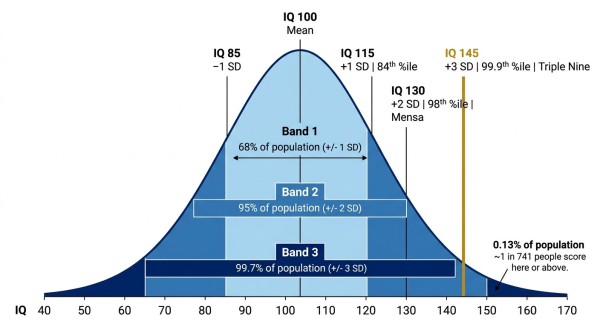
IQ 145 occupies one of the most precisely defined positions in the entire intelligence distribution. It is exactly +3 standard deviations above the population mean of 100 (100 + 3 × 15 = 145). In a normal distribution, approximately 99.7% of the population falls within three standard deviations of the mean — between IQ 55 and IQ 145. This makes IQ 145 the right-hand boundary of the empirical rule's three-sigma range: the point beyond which only approximately 0.13% of the population scores, or roughly 1 in 741 people.
It is the threshold score for the Triple Nine Society (TNS) — the high-IQ society requiring scores at or above the 99.9th percentile. And it sits at an important boundary in the gifted education research literature: the point where several frameworks transition from "highly gifted" to "exceptionally gifted" — a classification that implies qualitatively different cognitive and social experiences rather than merely more of the same.
This article covers what the research establishes about IQ 145: the statistical position, the high-IQ society landscape, the cognitive experience at this level, the honest state of the research on challenges at this extreme, and what the evidence says about what actually matters alongside — and sometimes more than — the score itself.
IQ 145 in Numbers: The Core Statistics
| Metric | Value at IQ 145 |
| Standard deviations above mean | +3.0 SD (exactly) |
| Percentile | ~99.9th |
| Frequency in general population | ~1 in 741 |
| In a city of 1 million | ~1,350 people |
| In the United States (~335M) | ~450,000 people |
| Globally (~8B) | ~10.8 million people |
| Wechsler classification | Very Superior |
| Position in 3-SD rule | Right-hand boundary of 3-sigma range (99.7%) |
| High-IQ society threshold | Triple Nine Society (~IQ 145–146) |
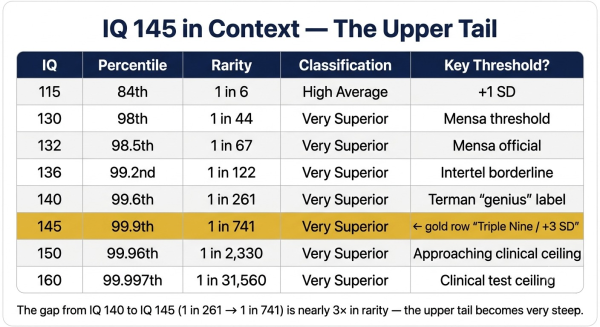
The rarity comparison is important for understanding IQ 145's position. IQ 136 (1 in 122) is about 6 times more common. IQ 140 (1 in 261) is about 2.8 times more common. IQ 160 (1 in 31,560) is about 43 times rarer. The upper tail of the distribution becomes dramatically steeper above IQ 140 — each additional point represents an increasingly sharp increase in rarity. For the full distributional picture, see our IQ scale explained.
The +3 SD Significance: Why This Number Matters
The statistical significance of exactly +3 standard deviations makes IQ 145 one of the most precisely defined thresholds in the IQ distribution. The empirical rule — also called the 68-95-99.7 rule — states that in a normal distribution:
- 68% of values fall within ±1 SD of the mean (IQ 85–115)
- 95% fall within ±2 SD (IQ 70–130)
- 99.7% fall within ±3 SD (IQ 55–145)
IQ 145 is the right-hand boundary of the third of these bands. Above IQ 145, the population thins to approximately 0.13% — the fraction of the normal distribution beyond 3 standard deviations from the mean. This is why IQ 145 is used as the Triple Nine Society threshold: it is the approximately correct value for the 99.9th percentile boundary on a standard SD-15 scale, and it aligns with the three-sigma marker that has intuitive statistical meaning.
For comparison: IQ 115 is the right-hand boundary of the ±1 SD range (84th percentile). IQ 130 is approximately the right-hand boundary of the ±2 SD range (98th percentile). IQ 145 is the right-hand boundary of the ±3 SD range (99.9th percentile). Each step represents a dramatically sharper jump in rarity than the previous one. For more on the IQ 115 and IQ 140 reference points, see their respective guides.
IQ 145 and the Label Confusion: "Profoundly Gifted" vs "Exceptionally Gifted"
One of the most common sources of confusion about IQ 145 is the label applied to it. Many online sources — and some parents of high-scoring children — describe IQ 145 as "profoundly gifted." This label is historically inaccurate, and understanding why matters for understanding what IQ 145 actually means.
The term "profoundly gifted" was used by early IQ researchers, including Leta Hollingworth and Miraca Gross, to describe IQ scores above approximately 180 — individuals found fewer than 1 in a million. The Davidson Institute, a US non-profit supporting gifted youth, initially set IQ 145 as an administrative eligibility threshold for their programmes — not as a redefinition of "profoundly gifted" as a label. Over time, however, IQ 145 became widely associated with "profoundly gifted" in internet discussions, parent communities, and popular writing.
Most research-based frameworks place IQ 145 in the "Exceptionally Gifted" category — a genuinely important and rare classification, but distinct from what researchers originally meant by "profoundly gifted" (IQ 160 and above). The distinction matters because the documented experiences and needs of individuals at IQ 145 differ substantially from those at IQ 160 or IQ 180, and conflating them can create unrealistic expectations in either direction.
For IQ 145 specifically: it represents 1 in 741 people — extremely rare, genuinely exceptional, and associated with documented challenges that are more intense than at lower gifted levels. But it is not the 1-in-a-million level of Hollingworth's original "profoundly gifted" category. For more context on how historical IQ labels have been applied, see our guide on the highest IQ of all time.
The Triple Nine Society: The High-IQ Community at This Level
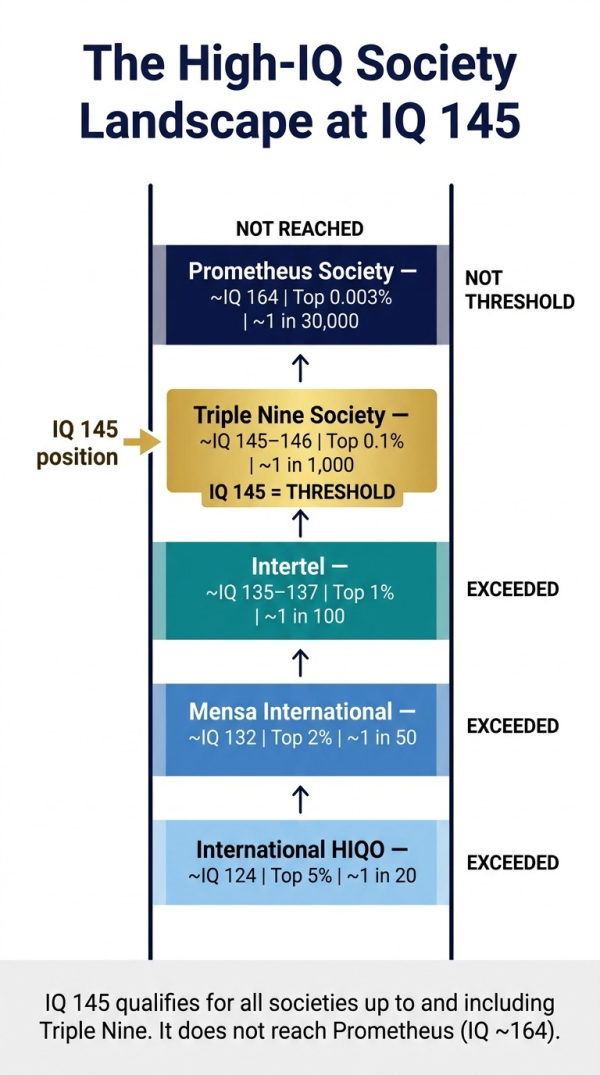
The Triple Nine Society (TNS) was founded in 1978 and requires scores at or above the 99.9th percentile from over 20 qualifying tests. As of 2025, it has approximately 1,900–2,000 members across more than 50 countries. TNS accepts scores from IQ tests (including the WAIS and Stanford-Binet), academic aptitude tests (including the SAT, GRE, LSAT, and ACT), and military assessments.
For IQ tests with SD = 15 (such as the WAIS-IV), the required score is approximately 146. For tests with SD = 16 (such as the older Stanford-Binet), the required score is approximately 149. For tests with SD = 24 (such as the Cattell III-B), the required score is approximately 173.
The landscape of high-IQ societies at IQ 145:
| Society | Approx. IQ Threshold | Percentile | IQ 145 Status |
| Mensa International | ~132 | Top 2% | ✅ Qualifies comfortably |
| Intertel | ~135–137 | Top 1% | ✅ Qualifies |
| Triple Nine Society (TNS) | ~145–146 | Top 0.1% | ✅ At threshold |
| Prometheus Society | ~164 | Top 0.003% | ❌ Does not qualify |
| Mega Society | ~176 | Top 0.0001% | ❌ Does not qualify |
IQ 145 at the Triple Nine threshold represents a distinctly different high-IQ community experience from Mensa. Where Mensa (1 in 50) is large enough to have active local chapters in most major cities globally, the Triple Nine Society (1 in 1,000) is far smaller — approximately 2,000 members worldwide versus Mensa's 145,000+. The peer density at Triple Nine level is what once Mensa became internationally famous, it did something paradoxical: it expanded awareness of documented high ability, but it also created a new dissatisfaction among some members and observers. A two-percent threshold was selective, yet not selective enough for everyone who wanted a more tightly defined peer environment. Triple Nine emerged in that atmosphere. For more, see our guide on high-IQ societies.
The Cognitive Experience at IQ 145
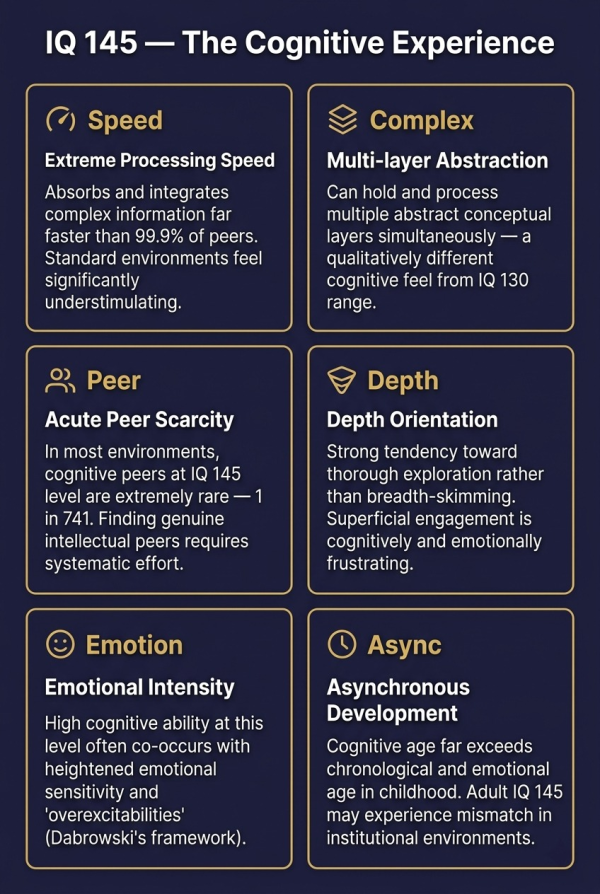
The research on what it is like to operate at IQ 145 suggests a qualitatively different cognitive experience — not merely "more intelligence" of the same kind experienced at IQ 120 or 130, but a distinct pattern of cognitive strengths, challenges, and social experiences:
Extreme Processing Speed and Depth
At IQ 145, the speed and depth of information absorption is at the extreme end of the human distribution. Standard educational and professional environments — designed for the median cognitive level — frequently provide insufficient challenge. Research on the SMPY (Study of Mathematically Precocious Youth) longitudinal data found that individuals at the top 0.1% (approximately IQ 145+) in mathematical reasoning at age 12 went on to achieve at dramatically higher rates than even the top 1% — publishing significantly more academic papers, patents, and occupying more senior positions than the already-gifted comparison group.
Acute Peer Scarcity
At 1 in 741, finding cognitive peers at the IQ 145 level in any normal environment is genuinely difficult. In a school of 1,000 students, you would expect to find approximately 1–2 students at this level. In a workplace of 200, you would expect to find approximately 0.3 students — effectively zero. The social isolation documented in the NAGC research on profoundly gifted children is particularly acute at this level: not the mild isolation of IQ 130 (1 in 44), but the severe and chronic isolation of someone whose intellectual peers are statistically extremely rare in any given environment.
The IQ Gap and Communication
The concept of an IQ "communication range" — the idea that meaningful intellectual connection is difficult when the IQ gap between two people exceeds a certain threshold — is widely circulated but poorly supported by rigorous research. The concept of a 30-point communication range was popularised by Grady Towers and attributed to Leta Hollingworth, but research shows this attribution is itself inaccurate. Hollingworth's original observation was specifically about leadership in groups of children, and made no claim about a universal 30-point barrier. The actual research literature does not support a specific universal threshold above which communication becomes impossible.
What the research does support is that large IQ gaps can create friction in communication — particularly around the depth, speed, and abstraction level of intellectual exchange — and that this friction increases as the gap widens. At IQ 145, the gap from most people (IQ 100) is 45 points, which is meaningfully different from the experience at IQ 130 (30 points). But this is a gradient of challenge, not a cliff edge. Many individuals at IQ 145 maintain rich and deep relationships across significant IQ gaps through shared values, humour, emotional connection, and the full range of human experience that is not reducible to analytical intelligence.
Asynchronous Development
In childhood, IQ 145 produces the most extreme version of the asynchronous development documented by the Columbus Group (1991): cognitive ability operating many years ahead of chronological age, while emotional and social development proceeds at chronological pace. This mismatch — being 10 years old cognitively but 10 years old emotionally and socially — creates specific challenges in educational placement, peer relationships, and adult relationships with teachers and parents. For parents navigating this for children, see our guide on gifted vs high achiever and signs of a gifted child.
What IQ 145 Predicts — and What Comes Next
The SMPY longitudinal research following individuals from the top cognitive tiers provides the strongest evidence base for what IQ 145-level cognitive ability predicts across a lifetime. The data consistently shows that the top 0.1% (approximately IQ 145+) significantly outperforms even the top 1% (IQ 135+) on objective measures of lifetime achievement — doctoral degrees, patents, publications, senior leadership positions, and income — at rates that demonstrate the continued predictive value of IQ at this extreme end of the distribution.
However, the same research shows that variation within the top 0.1% is enormous. Some individuals at this level achieve extraordinary outcomes; others do not. The non-cognitive factors that explain most of the remaining variance — motivation, conscientiousness, domain focus, resilience, and the quality of developmental support received in childhood and adolescence — are at least as important at IQ 145 as they are at any other level. As our profiles of Chris Langan (IQ 195–210) and Charles Darwin (~IQ 165) demonstrate, cognitive ability at the extreme end of the distribution does not automatically translate into the outcomes it theoretically supports.
A Note on Test Ceilings at IQ 145
At IQ 145 and above, an important technical limitation becomes relevant: most standard clinical IQ tests begin to run out of sufficiently difficult items and sufficiently large normative samples to produce highly reliable scores at this level. The WAIS-IV's normative sample thins significantly above IQ 140–145, and the precision of score estimates declines accordingly.
This means that a reported score of 145 from a standard clinical assessment carries somewhat more measurement uncertainty than a score of 115 or 120. At the extreme tails of the distribution, extended norms, multiple test administrations, and specialist assessment by clinicians with experience in high-ability assessment are important for producing reliable results. This is not to say that scores of 145 are unreliable — it is to say that they should be interpreted with appropriate confidence intervals and with awareness that the measurement challenge increases as scores move further into the upper tail. As ACIS notes: above approximately IQ 145, treat rarity estimates as theoretical approximations rather than precise counts. For more on this, see our guide on IQ 160, which discusses the clinical measurement ceiling in detail.
IQ 145 is exactly +3 standard deviations above the population mean — the 99.9th percentile, 1 in 741 people, and the Triple Nine Society threshold. It sits at the boundary of the 3-sigma range that contains 99.7% of the population. The cognitive experience at this level — extreme processing speed, acute peer scarcity, asynchronous development, and depth orientation — is qualitatively different from that at IQ 130 or IQ 140. The SMPY longitudinal research confirms that this level of cognitive ability continues to predict exceptional outcomes significantly above even the top 1%. And as at every other IQ level, what determines whether those outcomes are realised depends substantially on factors that no IQ test has ever been able to measure.
Curious where your own cognitive profile sits? Take our free IQ test — no registration, results in under 20 minutes. For adjacent score guides, see our pages on IQ 140 and IQ 160. For the high-IQ society landscape, see our guide on high-IQ societies.
Frequently Asked Questions
What does an IQ of 145 mean?
An IQ of 145 is exactly +3 standard deviations above the population mean of 100. On the Wechsler scale, it is classified as Very Superior (or Exceptionally Gifted in research frameworks), at approximately the 99.9th percentile. It represents the right-hand boundary of the 3-sigma range — above which only approximately 0.13% of the population scores. It is the threshold score for the Triple Nine Society.
How rare is an IQ of 145?
IQ 145 corresponds to approximately the 99.9th percentile — roughly 1 in 741 people. In a city of 1 million, approximately 1,350 individuals would score at this level or above. In the United States, approximately 450,000 people are expected to meet this threshold. Globally, approximately 10.8 million people.
Does IQ 145 qualify for Triple Nine Society?
Yes, at or very close to the threshold. The Triple Nine Society (TNS) requires scores at or above the 99.9th percentile — approximately IQ 145–146 on SD-15 tests like the WAIS-IV. IQ 145 sits right at this requirement. The exact qualification depends on the specific qualifying test used and its norming. TNS accepts scores from over 20 qualifying tests including the SAT, GRE, LSAT, and major IQ assessments.
Is IQ 145 considered profoundly gifted?
The label is contested. Historically, "profoundly gifted" was reserved for IQ 180+ (1 in a million). The Davidson Institute used IQ 145 as an administrative eligibility threshold, which led to widespread but inaccurate use of "profoundly gifted" for this level. Most research-based frameworks classify IQ 145 as Exceptionally Gifted — genuinely rare and distinct from lower gifted tiers, but not "profoundly gifted" in the original academic sense.
What is the +3 SD significance of IQ 145?
IQ 145 is exactly +3 standard deviations above the mean (100 + 3×15 = 145). The empirical rule states that 99.7% of a normally distributed population falls within ±3 SDs of the mean. IQ 145 is the right-hand boundary of this range — above it scores only approximately 0.13% of the population. This makes it one of the most statistically precise thresholds in the entire IQ distribution.

Comments
Share Your Thoughts