Warren Buffett has an estimated IQ of 155. He also believes that above an IQ of approximately 130, additional intelligence makes very little difference to investment outcomes.
This is the central paradox of the Oracle of Omaha: a man who is almost certainly smarter than 999 out of 1,000 people he meets has spent 70 years publicly arguing that his IQ is not the important part. He has said it plainly: "Investing is not a game where the guy with the 160 IQ beats the guy with the 130 IQ. Once you have ordinary intelligence, what you need is the temperament to control the urges that get other people into trouble in investing."
His track record supports the argument. Since 1965, Berkshire Hathaway's compounded annual gain has been approximately 19.8% per year — nearly double the S&P 500's 10.2%. Over 59 years, this translates to an overall gain of over 5,500,000% against the index's 39,000%. No other investor in history has compounded capital at this rate over this time horizon. This is not intelligence alone. This is intelligence combined with discipline, patience, and the emotional control to hold when everyone else is selling and buy when everyone else is panicking.
This article examines both sides of the paradox: what Buffett's estimated IQ of 155 means, and why he is almost certainly right that it is not what matters most.
What Is Warren Buffett's IQ?
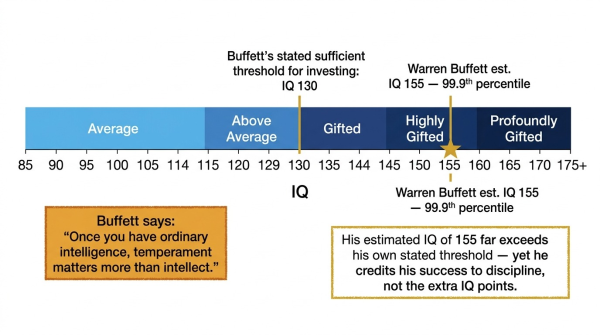
Warren Buffett's IQ is most commonly estimated at 155, across multiple analytical assessments. Some sources cite 150, others 160 — the range reflecting the absence of any publicly disclosed verified test. No official IQ score has ever been released.
An estimated IQ of 155 would place Buffett at approximately the 99.9th percentile — meaning he scores higher than roughly 999 out of every 1,000 people. This is the same general range as estimates for Bill Gates (~157–160) and Albert Einstein (~160), and significantly higher than Buffett's own stated threshold for investing competence. For context on what scores in this range mean, see our guides on IQ 150 and the IQ scale explained.
The evidence supporting the 155 estimate includes Buffett's documented extraordinary memory for business data and financial figures (he has described memorising numbers as effortless), his ability to perform complex calculations in his head rather than using calculators, his prodigy-level early business record, and his consistent analytical output over seven decades. No single piece of evidence is definitive — but the convergence is compelling. His lifelong business partner Charlie Munger, who was said by his own children to be "a book with legs," estimated that Buffett had extraordinarily high intelligence but that his emotional discipline was even more extraordinary.
The Youngest Businessman: A Prodigy Record That Speaks For Itself
Warren Edward Buffett was born on 30 August 1930 in Omaha, Nebraska. His father Howard Buffett was a stockbroker and later a US Congressman. From his earliest childhood, Warren displayed the kind of specific, applied intelligence that differentiates genuine business ability from mere academic aptitude.
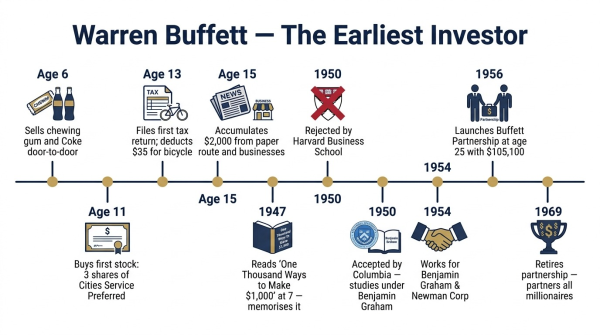
At age 6, he was selling chewing gum and Coca-Cola bottles door-to-door, calculating his margin on each transaction. At age 7, confined to a hospital bed, he read a library book called One Thousand Ways to Make $1,000 and later said he memorised it essentially entirely. At age 11, he bought his first stock — three shares of Cities Service Preferred — and filed his first tax return at 13, claiming a $35 deduction for the bicycle he used on his paper route. By age 15, he had accumulated $2,000 from paper delivery, a used pinball machine business, and other ventures.
These early records are significant not because the amounts of money involved were impressive — they were not — but because they reveal a mind that was doing something specific and unusual: applying systematic analytical thinking to real commercial problems at an age when most children are not yet thinking about money in commercial terms at all. The pattern is consistent with IQ research on gifted children, which consistently shows that high general intelligence in childhood expresses itself not through academic precocity alone but through unusually systematic engagement with whatever domain the child finds motivating. For Buffett, the domain was business, and it was motivating from his earliest memory. For more on early signs of this kind of applied intelligence, see our guide on gifted vs high achiever.
Harvard Rejection and the Columbia Accident
In 1950, Warren Buffett applied to Harvard Business School. He was rejected. He later described this as one of the luckiest events of his life.
The rejection led him to apply to Columbia Business School, where he discovered that Benjamin Graham — the father of value investing and author of The Intelligent Investor and Security Analysis — was a professor. Buffett read The Intelligent Investor, described it as "by far the best book on investing ever written," and enrolled at Columbia specifically to study under Graham. He was the only student in Graham's recorded history to receive an A+ grade.
After graduation, Buffett asked to work for Graham without pay. Graham initially declined but later hired him. Buffett worked for Graham & Newman Corp for two years, developing the foundational intellectual framework that would guide every investment decision he made for the next seven decades. Graham's central insight — that stocks represent ownership of real businesses, and that the market's short-term price fluctuations are noise around long-term intrinsic value — became the core of Buffett's method.
The Columbia accident illustrates something important about how intelligence interacts with opportunity and circumstance. Harvard rejection did not reduce Buffett's cognitive ability by one point. It redirected it toward the one teacher who could teach him the specific intellectual framework that matched both his analytical capabilities and his temperament perfectly. Intelligence provides the raw material; circumstance and character determine what is built with it. For more on this relationship, see our guide on IQ vs problem-solving.
The IQ Paradox: Why Buffett Says 130 Is Enough
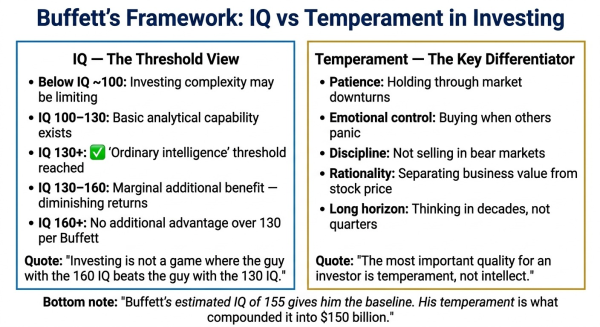
Buffett's statements on IQ and investing constitute one of the most counterintuitive bodies of public thought from any major investor. The man who is almost certainly smarter than 99.9% of the people he has competed against over his career has consistently argued that his intelligence is not the crucial variable.
His statements on the subject are consistent across decades:
- "Investing is not a game where the guy with the 160 IQ beats the guy with the 130 IQ. Once you have ordinary intelligence, what you need is the temperament to control the urges that get other people into trouble in investing."
- "Success in investing doesn't correlate with IQ once you're above the level of 25. Once you have ordinary intelligence, what you need is the temperament to control the urges that get other people into trouble in investing."
- "The most important quality for an investor is temperament, not intellect."
- "The most important thing in investments is not having a high IQ, thank God. The important thing is realism and discipline."
What Buffett is describing is a specific insight from behavioural finance: above a cognitive threshold sufficient to understand business analysis, the primary determinants of investment outcomes are behavioural rather than analytical. The most common investment failures — selling in market downturns, buying overvalued securities because everyone else is, holding losers too long because of sunk cost bias, selling winners too early — are not caused by insufficient intelligence. They are caused by emotional reactions to price movements that override whatever analytical conclusions the investor had previously reached.
Buffett's extraordinarily long track record of maintaining rational behaviour during market crises — buying during the 2008 financial crisis when virtually every other major investor was selling, avoiding the dot-com bubble when his competitors were generating spectacular short-term returns by riding it, holding Coca-Cola and American Express through decades of market volatility — reflects exactly this emotional discipline. His IQ of 155 gave him the analytical capability to identify value. His temperament gave him the discipline to act on it and hold through the periods of short-term pain that most investors cannot sustain.
This insight directly supports the research on the relationship between IQ and life outcomes: above approximately IQ 120–130, additional IQ points explain diminishing variance in many real-world outcomes, with non-cognitive factors — motivation, emotional regulation, perseverance — becoming increasingly important. See our guide on IQ vs EQ for more on this research.
The 500 Pages a Day: How He Builds His Edge
If there is a single habit that Buffett credits most directly with his investment performance, it is reading. He has reported reading 500–600 pages per day throughout his career — annual reports, financial statements, industry journals, newspapers, business histories, and biographies. He has described this as the mechanism by which knowledge compounds, using the metaphor of building interest on a financial investment: "That's how knowledge works. It builds up, like compound interest."
This reading habit reflects the same cognitive profile underlying his estimated IQ of 155. The ability to absorb and retain 500–600 pages of complex business and financial information per day, to extract the relevant signals from the noise, to cross-reference new information against existing mental models built over decades of accumulated reading — these are precisely the cognitive operations that high verbal comprehension and strong working memory support. His intelligence is not expressed through occasional flashes of inspiration; it is expressed through the sustained systematic accumulation and cross-referencing of a vast knowledge base built over seven decades of daily reading.
Charlie Munger, his partner at Berkshire Hathaway from 1978 until Munger's death in November 2023 at age 99, described Buffett's memory as extraordinary — able to recall the specific financial details of companies he had analysed 30 years earlier. Munger himself was said by his children to read all day, every day. Both men attributed their investment success first to the breadth and depth of their reading and second to their emotional discipline in applying what they had read. The IQ, in their framing, was the infrastructure that made the reading useful. For more on how crystallised knowledge relates to IQ, see our guide on what IQ actually measures.
The Track Record: What Compound Intelligence Looks Like
| Period | Berkshire Hathaway | S&P 500 |
| Compounded annual gain (1965–2024) | 19.8% | 10.2% |
| Overall gain (1965–2024) | 5,502,284% | 39,054% |
| Approximately $1,000 invested in 1965 worth in 2024 | ~$55 million | ~$390,000 |
This track record — sustained over 59 years, across multiple market cycles, recessions, bubbles, crashes, wars, and regime changes — is the strongest possible evidence for the combination of intelligence and emotional discipline that Buffett describes. No other investor in history has compounded capital at close to 20% annually for close to six decades. The outperformance is not explainable by luck at any reasonable statistical threshold. It reflects a systematic analytical and behavioural edge maintained across every market environment.
The intelligence provided the analytical framework — the ability to model intrinsic business value, to identify durable competitive advantages, to understand financial statements with depth and speed. The temperament provided the execution — the discipline to hold for decades, the courage to buy when others are selling, the restraint to avoid opportunities that do not meet the framework even when missing them looks costly in the short term.
How Buffett Compares to Other Investor-Geniuses
| Investor | Est. IQ | Academic Background | Investment Style |
| Warren Buffett | ~155 | Columbia — studied under Benjamin Graham | Long-term value investing, concentrated positions |
| Mark Zuckerberg | ~152 | Harvard CS + Psychology (dropout) | Technology platform builder, not investor |
| Bill Gates | ~157–160 | Harvard Mathematics (dropout) | Technology builder; later philanthropy and global health |
| Elon Musk | ~155 | Physics + Economics, Wharton | Technology risk-taking, contrarian bets |
The comparison with Gates and Musk — both estimated in a similar IQ range — is revealing. All three operate at roughly the same estimated analytical level, but their domains and approaches differ sharply: Gates built software platforms, Musk builds physical-world disruption technologies, and Buffett has spent 70 years applying patient value analysis to existing businesses. The IQ range is similar; the application, temperament, and domain are radically different. For more on this group, see our full Celebrity IQ database.
The Wisdom Behind the Paradox
The reason Buffett's statements about IQ are so valuable — and so frequently misunderstood — is that they are not self-deprecation or false modesty. They are a precise empirical observation about the specific domain of investing, supported by decades of evidence from his own career and that of his competitors.
Many highly intelligent investors have performed worse than Buffett over comparable periods. Long-Term Capital Management — managed by two Nobel Prize winners in economics (Robert Merton and Myron Scholes), mathematical geniuses by any measure, and a team with an average IQ almost certainly exceeding any reasonable estimate of Buffett's — collapsed catastrophically in 1998 because their models failed to account for the "irrationality" of market behaviour during the Russian financial crisis. Their analytical intelligence was extraordinary. Their behavioural framework — which assumed markets would revert to mathematical models in a predictable timeframe — was not robust to the actual unpredictability of human market behaviour under stress.
Buffett had no such framework. He did not model market behaviour mathematically. He simply refused to participate in opportunities he did not understand or could not value with confidence, held positions he believed in regardless of short-term price movement, and allowed time to do the compounding. This requires an IQ sufficient to do the business analysis — approximately 130 by his own estimate — and a temperament sufficient to execute the discipline for decades. He has the first at a level of 155. He also has the second at a level that appears to be genuinely extraordinary.
Warren Buffett's IQ of approximately 155 places him in the top 0.1% of the population — analytically exceptional by any standard. Yet his most consistent message about that IQ is that it is not what made him the greatest investor in history. The intelligence provided the analytical framework. The temperament — the patience to hold for decades, the courage to buy in a crisis, the discipline to avoid what he did not understand — is what compounded a $10,000 investment in the Buffett Partnership into a company worth hundreds of billions. The IQ is the entry ticket. The temperament is the performance.
Curious where your own intelligence profile sits? Take our free IQ test — no registration, results in under 20 minutes. Explore what IQ 155 means in our IQ 150 guide. See our full Celebrity IQ database.
Frequently Asked Questions
What is Warren Buffett's IQ?
Warren Buffett's IQ is most commonly estimated at 155, placing him at approximately the 99.9th percentile. No official verified test record has been publicly released. Interestingly, Buffett himself has stated that investing success does not correlate with IQ above approximately 130, arguing that temperament and emotional discipline matter far more than additional raw intelligence.
What did Warren Buffett say about IQ and investing?
Buffett's most famous statement: "Investing is not a game where the guy with the 160 IQ beats the guy with the 130 IQ. Once you have ordinary intelligence, what you need is the temperament to control the urges that get other people into trouble in investing." He has consistently argued that emotional discipline — patience, rationality during market panics, and the discipline to avoid opportunities you don't understand — matters far more than raw intelligence above a basic analytical threshold.
Why did Harvard reject Warren Buffett?
Warren Buffett was rejected by Harvard Business School in 1950. The rejection led him to apply to Columbia Business School, where Benjamin Graham — the father of value investing — was a professor. Buffett described this as one of the luckiest events of his life. He was the only student in Graham's history to receive an A+ grade, and he worked for Graham after graduation.
How did Warren Buffett start investing?
Buffett bought his first stock — three shares of Cities Service Preferred — at age 11. He had been accumulating savings since age 6 through selling chewing gum, delivering papers, and other childhood enterprises. He filed his first tax return at 13. He launched his investment partnership at age 25 with $105,100 and wound it down at 39 when all his partners had become millionaires.
What is Warren Buffett's reading habit?
Warren Buffett reportedly reads 500–600 pages per day — annual reports, financial statements, newspapers, and business books — a habit he has maintained throughout his career. He describes knowledge as compounding like financial returns: "That's how knowledge works. It builds up, like compound interest." His partner Charlie Munger was described by his own children as "a book with legs."

Comments
Share Your Thoughts