An IQ of 136 sits in a specific and well-defined position on the intelligence scale. It falls comfortably inside the gifted range, which begins at IQ 130. It exceeds the Mensa eligibility threshold of approximately IQ 132 by 4 points. And it sits right at the borderline of Intertel — the high-IQ society requiring scores at or above the 99th percentile, which corresponds to approximately IQ 135–137.
In population terms: IQ 136 corresponds to approximately the 99.2nd percentile — meaning you score higher than about 99.2 out of every 100 people in the general population. Roughly 1 in 122 people score at this level or above. The Wechsler Adult Intelligence Scale classifies this as Very Superior.
This article covers what the research establishes about IQ 136: the population statistics, the cognitive profile, the high-IQ society landscape, the experience of being in the gifted range, and what the evidence says about what this score predicts for academic and professional outcomes.
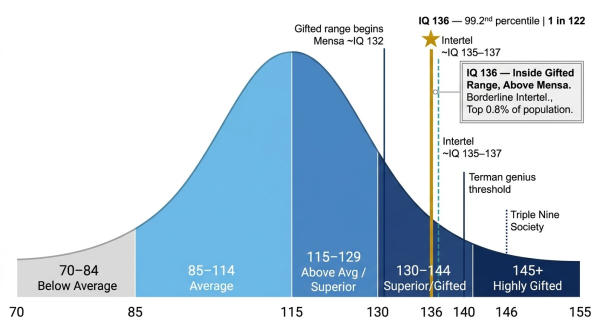
IQ 136 in Numbers: The Core Statistics
| Metric | Value at IQ 136 |
| Standard deviations above mean | 2.40 SD |
| Percentile | ~99.2nd |
| Frequency in general population | ~1 in 122 |
| In a room of 100 people | Fewer than 1 person expected at or above this level |
| In a city of 1 million | ~8,000 people |
| In the United States (~335M) | ~2.7 million people |
| Wechsler classification | Very Superior |
| Above Mensa threshold (~IQ 132) by | 4 points |
| Below Triple Nine Society threshold (IQ 146) by | 10 points |
The rarity comparison is instructive. IQ 120 (1 in 11) is 11 times more common than IQ 136. IQ 128 (1 in 33) is about 3.7 times more common. IQ 140 (1 in 261) is about twice as rare. The distribution in the gifted range (IQ 130–150) is compressed — each increment represents a meaningful but not dramatic change in rarity. For the full distributional picture, see our IQ scale explained.
IQ 136 and High-IQ Society Eligibility
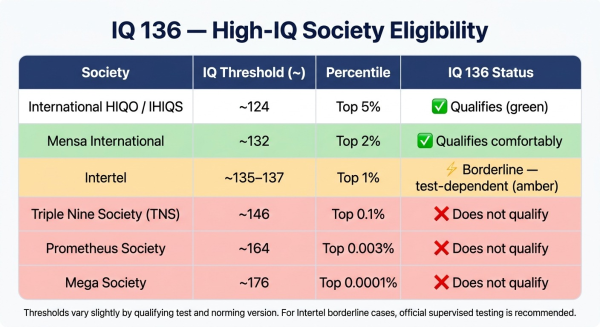
One of the most common practical questions about IQ 136 is which high-IQ societies it qualifies for. The answer is nuanced by the specific thresholds involved:
Mensa International — Qualifies
Mensa International requires a score at or above the 98th percentile (approximately IQ 130–132) on a qualifying standardised test. IQ 136 exceeds this threshold by 4 points, making Mensa eligibility clear and comfortable at this level. For more on Mensa membership, see our guide on what is Mensa. Notable Mensa members include Nolan Gould (IQ 150), James Woods (~IQ 180), and Geena Davis.
Intertel — Borderline
Intertel is a high-IQ society requiring scores at or above the 99th percentile. On the standard Wechsler scale (SD = 15), the 99th percentile corresponds to approximately IQ 135–137, depending on the specific test and norming version. IQ 136 at the 99.2nd percentile sits just above the 99th percentile target — making it borderline for Intertel eligibility, with the exact qualification depending on the specific qualifying test used. Anyone with a score in this range interested in Intertel should check the specific qualifying test requirements on Intertel's current admissions documentation.
Triple Nine Society — Does Not Yet Qualify
The Triple Nine Society (TNS) requires scores at or above the 99.9th percentile — approximately IQ 146. IQ 136 at the 99.2nd percentile is 10 IQ points and approximately 0.7 percentile points below this threshold. For more on high-IQ societies above the Mensa level, see our guide on high-IQ societies.
The Cognitive Profile at IQ 136
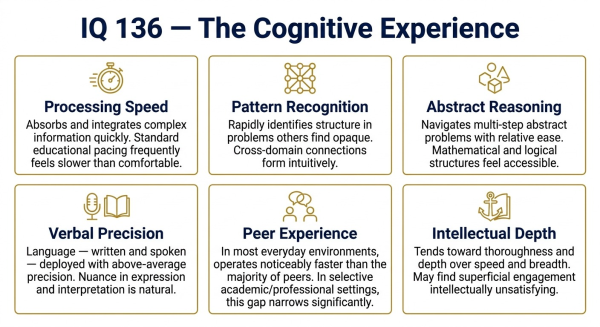
IQ 136 reflects a specific and consistently documented cognitive profile. Being fully inside the gifted range — rather than borderline at 130–131 — produces a noticeably different intellectual experience from that of average or even above-average individuals in most everyday contexts:
Processing speed. New information is absorbed and integrated significantly faster than the average person. Standard educational pacing — designed for the median student — often feels slower than comfortable. In professional settings, complex problems that others find daunting feel more tractable. This is not a subtle advantage at IQ 136: processing at 2.4 standard deviations above average represents a meaningful cognitive gap from most environments.
Abstract reasoning. Multi-step logical and mathematical problems are navigated with above-average ease. Hypothetical reasoning — holding multiple possible scenarios in mind simultaneously and tracing their logical consequences — is more natural. This is the cognitive capability most directly measured by IQ tests and most directly relevant to performance in analytically demanding roles.
Verbal precision. Language — written and spoken — is typically deployed with above-average precision and nuance. This reflects high verbal comprehension, which is one of the three major factors measured by most full-scale IQ assessments. People at IQ 136 tend to use vocabulary accurately and notice imprecision in others' language.
Cross-domain pattern recognition. The ability to see structural parallels between problems in different domains — to recognise that a challenge in law has the same underlying shape as a challenge in mathematics, or that an engineering problem resembles an organisational one — is more accessible at IQ 136 than at lower cognitive levels. This cross-domain transfer is one of the most practically valuable features of high cognitive ability in complex professional environments.
The peer experience. In most everyday environments, people at IQ 136 operate noticeably faster analytically than the majority of their peers. In selective academic and professional settings — elite universities, research institutions, leading professional firms — this gap narrows significantly. The cognitive experience of IQ 136 is therefore highly context-dependent: clearly exceptional in general population environments, less distinctive among cognitively selected groups. For more on how this plays out in childhood, see our guide on gifted vs high achiever.
What IQ 136 Predicts — and What It Doesn't
The research literature on what IQ 136 specifically predicts follows the broader pattern established for the gifted range (IQ 130+):
What IQ 136 predicts well
Academic achievement in demanding disciplines. IQ 136 supports exceptional performance across virtually all academic disciplines and degree programmes. The SMPY (Study of Mathematically Precocious Youth) longitudinal research — tracking individuals in the top 1% of cognitive ability from age 12 — consistently found that individuals at this cognitive level went on to earn advanced degrees, produce patents and publications, and achieve professional distinction at dramatically higher rates than the average population. IQ 136 sits within this range.
Occupational performance in the most analytically demanding roles. Research on IQ and job performance consistently finds that IQ is the single strongest predictor of performance in cognitively complex occupations. At IQ 136, essentially all professional cognitive demands fall comfortably within reach, and performance in roles requiring sustained abstract reasoning, novel problem-solving, and rapid learning is supported at an above-average level.
Learning efficiency. Absorbing and mastering new domains of knowledge faster than approximately 99% of the general population. Over a career, this learning advantage compounds — a person who acquires new skills significantly faster than peers will build substantially deeper expertise in the same number of working years.
What IQ 136 does not reliably predict
The same threshold effect that applies at IQ 120 and IQ 128 continues to operate at IQ 136. Above approximately IQ 115–120, incremental IQ points explain diminishing variance in most life outcomes. The factors that differentiate people at IQ 136 — whether they achieve at a high level, build meaningful relationships, maintain wellbeing, or make a distinctive contribution — are increasingly predicted by motivation, conscientiousness, domain focus, emotional intelligence, and the quality of their social and professional environments, not by further cognitive ability.
As Warren Buffett (IQ ~155) has argued: once above a certain cognitive threshold, temperament matters more than intelligence for investment performance. The same principle applies broadly across domains. For more on this, see our guides on IQ vs EQ and IQ and income.
Notable Figures With IQ Estimates Around 136
IQ 136 is cited in some sources as an estimate for Taylor Swift — though, as our full profile notes, her IQ has never been publicly verified through a disclosed test. Estimates for her range from approximately 120 to 160 across different sources, with no single figure having a credible evidentiary anchor. What is documented is exceptional verbal-linguistic intelligence (evidenced through her songwriting and commercial record) and strategic business intelligence (demonstrated through her catalogue ownership battle and the Eras Tour economic impact).
Other figures with estimated IQs in the 130–140 range include Napoleon Bonaparte (~140–145 in Cox's 1926 estimate — the lowest major military genius in her sample), Shakira (~140, self-confirmed on Jimmy Kimmel though the original Mensa attribution was denied by Mensa), and various historical and contemporary figures whose estimates cluster in this range. Explore more in our full Celebrity IQ database.
IQ 136 in Context: The Full Comparison
| IQ | Percentile | Rarity | Classification | Key Threshold? |
| 120 | 91st | 1 in 11 | Superior | Professional average |
| 128 | 97th | 1 in 33 | Superior | 4 points from Mensa |
| 130 | 98th | 1 in 44 | Very Superior | Gifted range begins |
| 132 | 98.5th | 1 in 67 | Very Superior | Mensa threshold |
| 135 | 99th | 1 in 100 | Very Superior | Intertel threshold (approx.) |
| 136 | 99.2nd | 1 in 122 | Very Superior | Borderline Intertel |
| 140 | 99.6th | 1 in 261 | Very Superior | Terman genius threshold |
| 146 | 99.9th | 1 in 1,000 | Very Superior | Triple Nine Society |
The table illustrates IQ 136's position clearly: solidly inside the gifted range, well above Mensa, borderline Intertel, and a meaningful distance from the Triple Nine Society threshold. For adjacent score guides, see our pages on IQ 128, IQ 140, and IQ 160.
A Note on Labels: "Gifted" vs "Genius" vs "Very Superior"
IQ 136 attracts multiple labels depending on which framework is applied. Understanding these distinctions prevents confusion:
- Wechsler (clinical standard): "Very Superior" — applies to all scores above 130. No "genius" label is used
- Gifted education frameworks: Generally "Gifted" — typically applied to scores above 130 in educational contexts
- Terman's historical classification: Below the "genius threshold" of 140. Terman would have classified 136 as "superior" in his 1916 system
- Popular usage: Often described as "near-genius" or "highly gifted" in non-technical writing
The most accurate clinical description is Very Superior. The most accurate educational description is Gifted. The word "genius" — as explored in our IQ 140 guide — is a popular label without precise scientific meaning, and IQ 136 does not conventionally fall within even this informal threshold. What it does represent is genuine, documented exceptional cognitive ability in the top 1% of the general population — which is meaningful regardless of what label is applied to it.
IQ 136 corresponds to the 99.2nd percentile — roughly 1 in 122 people. It sits fully inside the gifted range, well above Mensa, and at the borderline of Intertel eligibility. The cognitive profile it reflects — fast processing, strong abstract reasoning, high verbal precision, and cross-domain pattern recognition — is genuinely exceptional by any population standard. The score is 4 points below the conventional "genius threshold" of 140, but that gap reflects an arbitrary 1916 research classification rather than any fundamental difference in cognitive experience. IQ 136 is remarkable enough without borrowed labels.
Find out where you sit with our free IQ test — no registration, results in under 20 minutes. For adjacent scores, see our guides on IQ 128 and IQ 140. For the high-IQ society landscape that IQ 136 navigates, see our guides on Mensa and high-IQ societies.
Frequently Asked Questions
What does an IQ of 136 mean?
An IQ of 136 falls in the Very Superior or Gifted range on the Wechsler scale, at approximately the 99.2nd percentile. It represents 2.4 standard deviations above the population mean of 100, corresponding to roughly 1 in 122 people. It sits comfortably above the Mensa threshold (~IQ 132) and at the borderline of Intertel eligibility (~IQ 135–137).
How rare is an IQ of 136?
IQ 136 corresponds to approximately 1 in 122 people in the general population — the 99.2nd percentile. In a city of 1 million, approximately 8,000 people would score at or above this level. In the United States, approximately 2.7 million people are expected to meet or exceed this score.
Does IQ 136 qualify for Mensa?
Yes. IQ 136 exceeds the Mensa International threshold of approximately IQ 132 (top 2%) by 4 points. A score of 136 on a qualifying standardised test would comfortably meet Mensa's admissions criteria.
What is Intertel and does IQ 136 qualify?
Intertel is a high-IQ society requiring scores at or above the 99th percentile — approximately IQ 135–137 depending on the test. IQ 136 at the 99.2nd percentile sits marginally above this threshold, making it borderline for Intertel. Whether a specific score of 136 qualifies depends on the particular qualifying test used. Official supervised testing is recommended for borderline cases.
Is IQ 136 considered genius?
Not conventionally. The informal "genius threshold" is associated with IQ 140, based on Lewis Terman's 1916 classification. IQ 136 is 4 points below this. Modern clinical test manuals do not use "genius" as a formal label. IQ 136 is classified as Very Superior and represents genuine top-1% cognitive ability — which is exceptional without requiring the genius label.

Comments
Share Your Thoughts