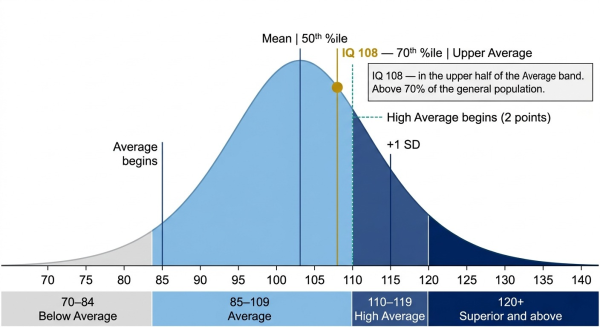
An IQ of 108 places you at approximately the 70th percentile — meaning you score higher than about 70 out of every 100 people in the general population. The Wechsler Adult Intelligence Scale classifies this as Average intelligence. It represents 0.53 standard deviations above the population mean of 100, and roughly 1 in 3.3 people score at this level or above.
IQ 108 sits in the upper portion of the Average band (IQ 85–109), just 2 points below the High Average classification that begins at IQ 110. It is above the population mean by 8 points, in the top 30% of the general population, and in the zone where the Average and High Average classifications sit very close together — close enough that the measurement error of any IQ test could shift the score across the boundary in either direction.
This guide covers what the research says about IQ 108: the population statistics, what the Average classification means at the upper end of its range, what it opens professionally and academically, and the 2-point question about the High Average boundary.
IQ 108 in Numbers: The Core Statistics
| Metric | Value at IQ 108 |
| Standard deviations above mean | +0.53 SD |
| Percentile | ~70th |
| Frequency in general population | ~1 in 3.3 (about 30% score at or above) |
| In a room of 100 people | ~30 score at or above; ~70 score lower |
| In the United States (~335M) | ~100 million people score at or above IQ 108 |
| Wechsler classification | Average |
| Position within Average band | Upper portion — 8 points above mean, 1 point below band ceiling |
| Gap to High Average (IQ 110) | 2 points |
IQ 108 sits near the top of the Average band, which spans IQ 85–109. Its symmetric reference points help contextualise its position: IQ 90 (25th percentile) is the opposite position within the Average band — 10 points below the mean, just as IQ 108 is 8 points above it. IQ 112 (79th percentile) is 4 points higher and begins the High Average band proper. IQ 115 (84th percentile) is the +1 SD marker. For the full distributional picture, see our IQ scale explained.
Upper Average: What It Means to Be Near the Band Ceiling
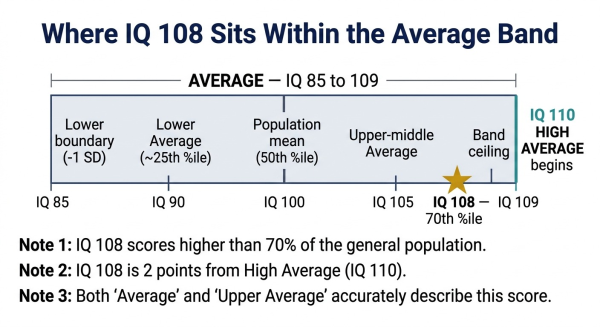
IQ 108 at the 70th percentile occupies a specific and well-defined position in the distribution: it is in the upper Average band, above the population mean by 8 points, and just 2 points from the High Average classification boundary. This positioning has several practical implications worth understanding clearly.
Above the mean — genuinely above average. IQ 108 scores higher than approximately 70% of the general population. In most everyday environments drawn from the general population, this represents a modest but consistent cognitive advantage. New information is processed somewhat faster than average, complex explanations are followed somewhat more readily, and academic and professional cognitive demands are met with somewhat less effort. This is a real advantage, even if it is a modest one relative to the +2 SD or +3 SD scores covered in other guides in this series.
Near the High Average boundary. The 2-point gap between IQ 108 and IQ 110 is within the standard error of measurement on any properly administered IQ test. The WAIS-IV SEM is approximately ±3 points at the 95% confidence interval — meaning a person who scores 108 might legitimately score 110 or 111 on a retest under slightly different conditions, and vice versa. The classification label difference between "Average" (IQ 108) and "High Average" (IQ 110) is a psychometric boundary rather than a meaningful cognitive discontinuity. For more on how SEM applies near classification boundaries, see our IQ 119 guide (which explores the same issue at the Average/Superior boundary) and our IQ 128 guide (which applies it to the Mensa threshold).
Inside the central band. IQ 108, like all scores from 85 to 114, is in the Average classification band — the single largest band, containing approximately 68% of the entire population. Being in the upper portion of this band means being above most of the people sharing your classification label, but the label itself ("Average") is the same from IQ 85 to IQ 109. Context matters: the cognitive experience of IQ 108 is closer to IQ 112 (just across the High Average boundary) than it is to IQ 88 (also "Average," but 20 points lower).
What IQ 108 Opens in Career and Academic Life
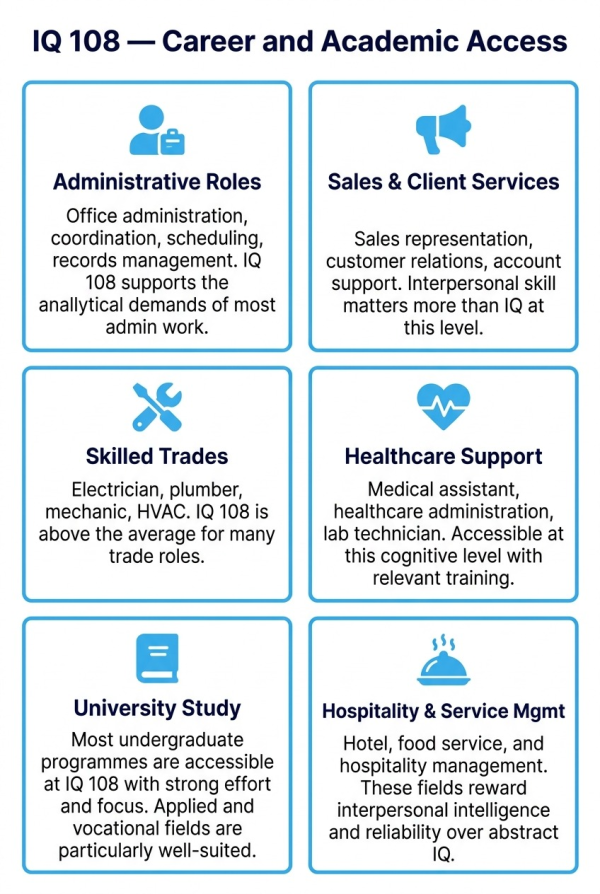
IQ 108 at the 70th percentile provides access to a broad range of career and academic paths. The research on average IQ by occupation shows that many common and economically stable professional roles cluster in the IQ 100–115 range — placing IQ 108 in a well-matched position for several of the most widely held professional occupations:
Administrative and office roles. Office administration, coordination, records management, and support roles typically require the kind of organised, systematic thinking and written communication that IQ 108 supports well. These roles are among the most widely held in most modern economies and are well-matched to the cognitive level IQ 108 represents.
Sales and client services. Sales roles, customer relations, account support, and client-facing work rely heavily on interpersonal intelligence, communication skill, and domain knowledge of the product or service. IQ 108 provides sufficient cognitive foundation for these roles, with success depending substantially on the non-cognitive capabilities the research consistently identifies as primary in sales success.
Skilled trades. As covered in our IQ 90 guide, skilled trades reward practical intelligence, physical skill, and apprenticeship learning. IQ 108 sits above the average for many trade occupations and provides a modest cognitive advantage in the analytical and problem-solving dimensions of skilled work.
Healthcare support roles. Medical assistant, healthcare administration, laboratory technician, and similar healthcare support roles are cognitively accessible at IQ 108, particularly when combined with relevant vocational or associate-degree training. These roles require systematic thinking, attention to protocol, and interpersonal skill — all of which are supported at this cognitive level.
University study. Undergraduate study across most applied and vocational disciplines is cognitively accessible at IQ 108 with appropriate effort and study habits. The most abstractly mathematical degree programmes (theoretical physics, pure mathematics) typically require higher average cognitive entry levels, but most applied, social science, humanities, and vocational degrees are navigable at IQ 108 through sustained effort and strategic study. For the research on effort and achievement, see our guide on can IQ be improved?
The Cognitive Experience at IQ 108
At 0.53 standard deviations above the mean, IQ 108 produces a modest but genuine cognitive advantage over the majority of the general population:
Slightly above-average processing. New information is absorbed and integrated faster than approximately 70% of the general population. This is not the dramatic advantage seen at IQ 120 or 130, but it is a real and consistent feature of cognitive life at IQ 108 in most everyday environments. Standard educational and professional pacing is comfortable — slightly easier than for those below the mean, slightly more effortful than for those well above it.
Comfortable with routine analytical demands. The cognitive demands of most administrative, service, trade, and entry-level technical roles fall comfortably within reach at IQ 108. Multi-step problems of moderate complexity are handled with relative ease. The most highly abstract analytical demands (graduate-level research mathematics, advanced theoretical reasoning) may require more effort.
Context-sensitive experience. In general population environments, IQ 108 produces a modest cognitive advantage. In specifically selected academic or professional environments where the average cognitive level is itself above 108, this advantage disappears — the person is at or below the peer average. This is the same context-dependence described for other scores in this series: see our IQ 115 guide for a fuller treatment of this effect.
What Matters Most at IQ 108
At IQ 108, the research on what determines real-world outcomes is consistent and important: non-cognitive factors explain at least as much variance in career success, income, and life satisfaction as cognitive ability at this level.
The landmark research on personality and job performance (Barrick and Mount, 1991) found that conscientiousness — persistence, reliability, organisation, and follow-through — is a valid predictor of job performance across all occupational categories and all IQ levels. At IQ 108, where the cognitive advantage over the mean is modest (0.53 SD), conscientiousness and other non-cognitive factors explain a very large share of the variance in who succeeds.
Additional factors with strong research support at this cognitive level:
- Interpersonal and emotional intelligence — critical in most client-facing, management, and care roles that are broadly accessible at IQ 108
- Domain expertise — accumulated knowledge and skill in a specific field built through deliberate practice; explains performance in trades and skilled roles far more than IQ does
- Motivation and work ethic — intrinsic drive to learn and improve in a domain is strongly associated with expertise development and career advancement
- Resilience — the ability to persist through setbacks and maintain effort over the long term is a robust predictor of career outcomes across all cognitive levels
For more on the relationship between IQ and life outcomes, see our guides on IQ vs EQ and IQ and income.
IQ 108 in Context: The Full Comparison
| IQ Score | Percentile | Classification | Key Note |
| 100 | 50th | Average | Population mean |
| 105 | 63rd | Average | Upper-middle Average |
| 108 | 70th | Average | Upper Average — Top 30% |
| 109 | 73rd | Average | Last score in Average band |
| 110 | 75th | High Average | High Average begins — 2 points above IQ 108 |
| 112 | 79th | High Average | Centre of High Average |
| 115 | 84th | High Average | +1 SD — statistical anchor |
| 120 | 91st | Superior | Professional average begins |
IQ 108 sits clearly at the upper end of the Average band — 8 points above the mean, 1 point below the band ceiling, and 2 points from High Average. For adjacent scores, see our guides on IQ 90, IQ 112, and IQ 115. For the full distributional context, see our IQ scale explained.
IQ 108 is at the 70th percentile — top 30%, in the upper portion of the Average band, just 2 points from the High Average classification. It scores above 70% of the general population, providing a modest but consistent cognitive advantage in most everyday environments. The 2-point gap to High Average is within normal measurement error and carries no meaningful cognitive significance. What matters most at IQ 108 — as the research consistently shows — is not the precise position within the normal range but the conscientiousness, domain expertise, interpersonal skill, and sustained effort that turn cognitive ability into achievement.
Find out where your own cognitive profile sits with our free IQ test — no registration, results in under 20 minutes. For adjacent scores, see our guides on IQ 112 and IQ 115. For broader context, see our IQ scale explained.
Frequently Asked Questions
What does an IQ of 108 mean?
An IQ of 108 is classified as Average on the Wechsler scale, at approximately the 70th percentile. It represents 0.53 standard deviations above the population mean of 100. It is in the upper portion of the Average band (IQ 85–109), just 2 points below the High Average range. It scores above approximately 70% of the general population — a modest but consistent cognitive advantage in most everyday environments.
How rare is an IQ of 108?
IQ 108 is not rare — approximately 30% of people score at IQ 108 or above, and about 70% score lower. In the United States, approximately 100 million people are expected to score at or above IQ 108. It is a commonly occurring cognitive level in the upper Average range.
Is IQ 108 considered above average?
Yes in everyday terms — IQ 108 is 8 points above the population mean of 100 and at the 70th percentile. In strict Wechsler classification terms, it is still "Average" rather than "High Average" (which begins at IQ 110), but colloquially "above average" accurately describes a score at the 70th percentile.
How close is IQ 108 to High Average?
IQ 108 is 2 points below High Average, which begins at IQ 110 on the Wechsler scale. This gap is within the standard error of measurement (±3 points at 95% CI) on any properly administered IQ test. The classification label changes at IQ 110, but the cognitive experience at IQ 108 and IQ 110 is functionally very similar.
What careers are associated with IQ 108?
IQ 108 is well-matched to administrative roles, sales and client services, skilled trades, healthcare support, hospitality management, and most vocational degree programmes. At this cognitive level, conscientiousness, interpersonal skill, domain expertise, and work ethic are at least as important as IQ in determining career outcomes.

Comments
Share Your Thoughts