In September 1785, Napoleon Buonaparte graduated from the École Militaire in Paris. He was 16 years old. He ranked 42nd out of 58 students in his graduating class. He had completed the standard two-year programme in approximately one year — not because he excelled in every subject, but because his exceptional mathematical ability allowed him to accelerate specifically in artillery theory, and because his father's death in 1784 had created financial urgency to graduate and begin earning a salary as an officer.
Over the next 19 years, this 42nd-ranked graduate would conquer most of Europe, restructure the French state, codify a legal system still in use today, and build the largest empire seen in the western world since the Romans. He commanded more than 60 major battles. He won 48 of them.
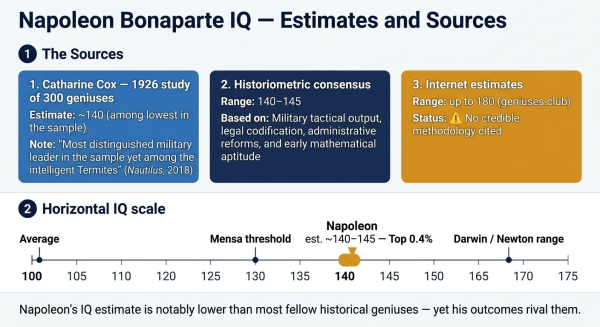
Napoleon Bonaparte's IQ is estimated at 140–145. In Catharine Cox's landmark 1926 study of 300 historical geniuses, he received one of the lowest IQ estimates in the sample — the Nautilus journal noted that he would have been "among the less intelligent Termites" (referring to Lewis Terman's gifted children study). Yet Cox herself acknowledged he was "the most distinguished military leader in the sample."
This paradox — a relatively modest IQ estimate producing the most extraordinary military career in European history — is the most instructive thing about Napoleon's intelligence. This article examines what his mind was actually doing, what the 140–145 estimate reflects and misses, and what his eventual failure tells us about the specific limits of even extraordinary intelligence when deployed without wisdom.
What Was Napoleon's IQ?
Napoleon Bonaparte's IQ is most consistently estimated at 140–145 across multiple academic and analytical sources. Catharine Cox's 1926 historiometric study — the most academically rigorous source for historical IQ estimation, discussed in detail in our articles on Leonardo da Vinci and Charles Darwin — placed Napoleon at approximately 140. Some individual estimates place him higher (145, occasionally up to 160); some internet sources cite 180 without any credible methodology.
An IQ of 140–145 would place Napoleon at approximately the 99.4th to 99.7th percentile — genuinely exceptional by any population standard, comfortably above the Mensa threshold of IQ 132, and within the range commonly called "gifted" or "genius." For context, this is notably lower than estimates for figures like Leonardo da Vinci (~180–220) or Marie Curie (~180–200), and comparable to estimates for Charles Darwin (~165) and Albert Einstein (~160).
The Cox estimate reflects the specific methodological approach of historiometric analysis: because Napoleon's early life left relatively limited biographical documentation of intellectual precocity compared to figures like Newton or Goethe, and because his primary achievements were operational and administrative rather than abstractly theoretical, the biographical evidence base produces a lower estimate than many contemporaries. This does not mean Napoleon was less impactful — it means the type of intelligence he deployed is harder to anchor in the kind of early-childhood cognitive records that historiometric analysis relies on. For more on this methodology, see our guide on the highest IQ of all time.
The Corsican Outsider: From Mockery to Mathematics
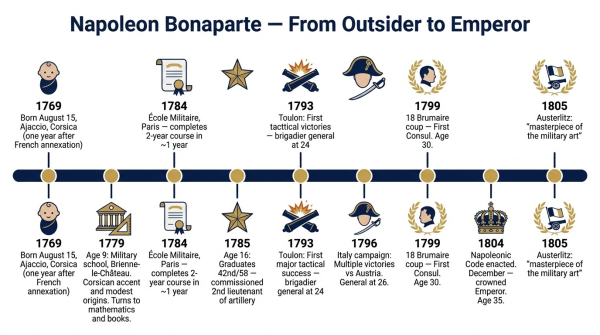
Napoleone Buonaparte was born on 15 August 1769 in Ajaccio, Corsica — one year after France had purchased the island from the Republic of Genoa. He was the fourth of eleven children of Carlo Buonaparte, a lawyer of minor Italian nobility, and Letizia Ramolino, a woman of iron character who Napoleon credited as the most important influence of his early life.
At age 9, he was sent to mainland France to attend the military school at Brienne-le-Château. He arrived speaking Corsican and Italian as his native languages; his French was accented and — throughout his life — his spelling remained notoriously poor. At school, he was mocked for his accent, his modest origins, and his Corsican patriotism. World History Encyclopedia notes that "lacking friends, Napoleon turned to the company of books." He wrote more than 60 essays, pamphlets, and novellas during his school years, including a history of Corsica — a remarkable intellectual output for a child who was simultaneously excelling in mathematics and military theory.
The pattern established at Brienne would define his entire life: isolation producing intense intellectual self-sufficiency; mathematical brilliance sharpening the analytical capabilities that would later allow him to absorb the logic of an entire battlefield in a glance; and a burning desire to prove that the outsider could outperform those who had every advantage he lacked.
When he transferred to the prestigious École Militaire in Paris in 1784, the examiners recognised his mathematical ability and permitted him to complete the standard two-year course in approximately one year. His father died in February 1784, requiring Napoleon to graduate quickly and begin sending money home to support his family. He graduated in September 1785 at age 16 — ranked 42nd out of 58, a position that reflected solid but not spectacular overall performance across all subjects, with his mathematical strengths concentrated in the artillery specialisation rather than distributed across the curriculum.
Three Domains of Intelligence: Where Napoleon Was Exceptional
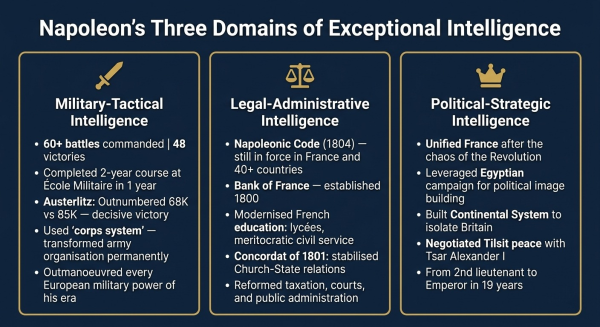
Understanding Napoleon's cognitive profile requires recognising that his intelligence was not uniformly distributed across domains. Like most exceptional figures, he had specific areas of extraordinary ability that drove his outcomes — and specific blind spots that ultimately contributed to his downfall.
Military-Tactical Intelligence: 48 Victories in 60 Battles
Napoleon's tactical intelligence is the most documented and most extraordinary aspect of his cognitive profile. He commanded more major battles than any general in European history, and his win rate across those battles — 48 victories, 3 draws, 4 losses in 55 major or significant engagements, by one widely cited count — has no parallel at comparable scale.
What made his battlefield intelligence distinctive was specific. He had an extraordinary ability to process what military theorists call "the fog of war" — the partial, contradictory, time-delayed information that commanders receive during an engagement — and synthesise it into a coherent picture of how the battle was evolving. He reportedly reviewed the terrain of upcoming battlefields with photographic attention, building mental models of attack and defence possibilities before engaging. He could identify the precise moment when an enemy's position had become vulnerable and direct his corps to exploit it faster than opponents could respond.
He also revolutionised military organisation itself. The corps system — dividing an army into independent self-sustaining corps that could march separately and unite before battle — was not invented by Napoleon but was systematised and deployed by him with unprecedented sophistication, allowing him to move forces faster than opponents who still relied on older, more rigid army structures. This is applied systems intelligence: the ability to redesign an organisation's structure to achieve a specific operational advantage.
Legal-Administrative Intelligence: The Code That Still Governs
The Napoleonic Code — enacted in 1804 — is Napoleon's most enduring intellectual achievement and the one that best demonstrates the analytical rather than tactical dimension of his mind. Before the Revolution, France operated under a patchwork of more than 400 separate local law codes, feudal customs, and royal decrees. The Code civil des Français replaced this chaos with a single, coherent set of civil laws covering contracts, property, family law, and individual rights.
The principles it established — equality before the law, protection of private property, freedom of religion, abolition of feudal privilege — were radical in 1804 and remain foundational to civil law systems across the world. Belgium, the Netherlands, Spain, Portugal, Italy, Romania, Louisiana, Quebec, much of Latin America, and many former French colonies all have civil law systems substantially derived from Napoleon's code. In France itself, the Code is still in force — modified but fundamentally intact — more than 220 years after its enactment.
Producing this code required Napoleon to absorb an enormous body of existing law, identify the principles worth preserving, discard those tied to privilege or arbitrariness, and produce a synthesis that was simultaneously comprehensive, internally consistent, and accessible to non-lawyers. He participated directly in the drafting sessions rather than delegating entirely to legal experts. This is legal and analytical intelligence of a high order — distinct from tactical military intelligence but operating at a comparable level of sophistication.
Political-Strategic Intelligence: From Second Lieutenant to Emperor in 19 Years
Napoleon's rise from 42nd-ranked artillery lieutenant to First Consul in 14 years and Emperor in 19 required a form of political intelligence that neither military skill nor legal analytical ability alone could explain. He understood intuitively that military victories were useful primarily as political currency — that control of France required controlling the narrative of French achievements in the field, and that the army's loyalty was more valuable than any parliamentary majority.
His Egyptian campaign of 1798–1799 is perhaps the purest demonstration of this political intelligence operating independently of military success. The campaign was, by any military measure, a failure — his fleet was destroyed by Nelson at the Battle of the Nile, stranding his army, and he eventually abandoned his troops and returned to France. Yet he managed the political presentation of the campaign's results — particularly the scientific discoveries, including the Rosetta Stone — so effectively that he returned to France as a hero, and parlayed that standing into the coup of 18 Brumaire (November 1799) that made him First Consul. The gap between military reality and political perception was managed with extraordinary skill.
The Austerlitz Blueprint: Intelligence at Its Peak
The Battle of Austerlitz on 2 December 1805 — fought exactly one year after his imperial coronation — is universally considered Napoleon's tactical masterpiece, and it perfectly illustrates how his military intelligence actually operated.
He was outnumbered: approximately 68,000 French troops against a combined Austro-Russian force of roughly 85,000 under Emperors Francis II of Austria and Alexander I of Russia. The conventional wisdom would suggest the larger force had the advantage. Napoleon reversed this by exploiting the enemy's reasoning against them.
He deliberately appeared weaker on his right flank — abandoning the Pratzen Heights, a dominant position — and even staged apparent hesitation in his diplomatic communications to suggest he feared the coming battle. The allied commanders, concluding that Napoleon was preparing to retreat, attacked his weakened right flank in force, exactly as he intended. The moment their centre had been stripped to reinforce the attacking left flank, Napoleon unleashed his main force up the Pratzen Heights, split the allied army in two, and destroyed it from the inside.
Allied casualties: approximately 36,000. French casualties: approximately 9,000. The battle lasted less than nine hours. The War of the Third Coalition effectively ended that day.
What the Austerlitz plan required was not merely tactical skill but psychological modelling at speed: the ability to construct an accurate model of how the allied commanders would reason given specific information, then manipulate that information to produce a specific response, then exploit that response before it could be corrected. This is theory of mind operating in a military context — the same cognitive operation that underlies strategic deception, and one that the IQ estimate of 140–145 genuinely captures as exceptional. For more on how this type of intelligence operates, see our guide on IQ vs problem-solving.
Where Napoleon's Intelligence Failed: The Three Fatal Errors
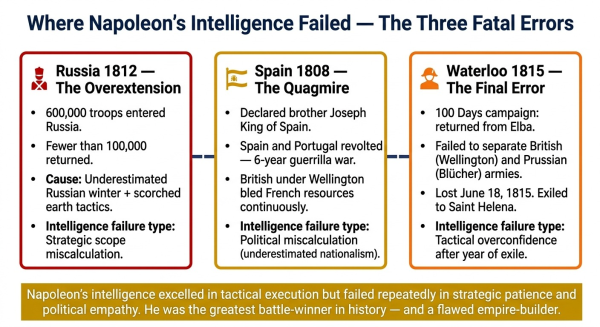
Napoleon's downfall is as instructive as his rise, because it illustrates the specific limits of his cognitive profile with equal clarity.
Russia 1812: The Scope Miscalculation
The Russian Campaign of 1812 is the most catastrophic military disaster in European history to that point. Napoleon marched approximately 600,000 troops into Russia in June 1812 expecting a decisive battle that would force a quick surrender. The Russians refused to provide one — they retreated, burned their own cities and crops, and extended the French supply lines to the breaking point. Napoleon entered Moscow in September to find it on fire and abandoned. He waited five weeks for a peace offer that never came, then retreated in October into the Russian winter with a starving, demoralised army. Fewer than 100,000 returned.
The failure was not tactical — Napoleon won every major engagement he fought in Russia. The failure was strategic: an inability or unwillingness to accurately model the full scope of what Russian space, Russian winter, and Russian national resilience would do to a conventional army over months rather than days. This reflects a specific cognitive blind spot — the tendency to solve problems through tactical action that his battlefield intelligence excelled at, applied to a strategic context that required patient waiting and political negotiation instead.
Spain 1808: The Nationalist Miscalculation
Napoleon's decision to place his brother Joseph on the Spanish throne in 1808 initiated a six-year guerrilla war that tied down hundreds of thousands of French troops and provided Britain under Wellington a permanent foothold on the European continent. Napoleon underestimated Spanish national identity and the capacity of an irregular population-based resistance to outlast a conventional military force. This was a failure of political intelligence — the same intelligence that had managed France's internal politics brilliantly proved less effective when applied to foreign national cultures he understood less well.
Waterloo 1815: The Overconfidence
After his return from Elba in March 1815 — the Hundred Days — Napoleon needed to prevent the British and Prussian armies from combining. He failed to maintain the separation, and when the Prussians arrived at Waterloo in the afternoon of 18 June 1815 to reinforce Wellington's defensive line, the battle was lost. The defeat reflects the attrition of 20 years of continuous warfare on a mind that had grown accustomed to tactical improvisation overcoming structural disadvantage — a reliance on the flexibility that had worked so often and failed here at the critical moment.
How Napoleon Compares to Other Historical IQ Estimates
| Person | Est. IQ | Primary Domain | Legacy Duration |
| Leonardo da Vinci | 180–220 | Art, science, engineering | 500+ years |
| Marie Curie | ~185 | Physics, chemistry | 120+ years (radioactivity framework) |
| Charles Darwin | ~165 | Natural history, biology | 165+ years (evolution still foundational) |
| Nikola Tesla | ~160–200 | Electrical engineering | 130+ years (AC power still in use) |
| Napoleon Bonaparte | ~140–145 | Military strategy, law, administration | 220+ years (Napoleonic Code still in force) |
The comparison reveals something significant: Napoleon's estimated IQ is the lowest in this group, yet his legal legacy — the Napoleonic Code — is actually the most immediately still-operative, being literally in legal force in France and dozens of other countries today. His military legacy influenced every army in the world for at least 100 years after his defeat. This gap between IQ estimate and real-world legacy is perhaps the most powerful demonstration of the principle that Warren Buffett articulated about investing — that above a threshold, what you do with intelligence matters more than how much of it you have. For more on this, see our guides on IQ vs problem-solving and multiple intelligences.
Napoleon Bonaparte's IQ of approximately 140–145 makes him the most exceptional low-estimate figure in the history of historiometric intelligence analysis. He had the lowest Cox IQ estimate of any figure in his cohort — and the most distinguished military record. He coded a legal system still in force 220 years later. He was defeated at Waterloo by failures of strategic patience and political empathy rather than failures of analytical intelligence. His story is the clearest possible demonstration that genius is domain-specific, that IQ estimates capture only specific cognitive dimensions, and that what you do with 140 IQ points, focused with obsessive intensity on a specific domain over a lifetime, can reshape the world.
Take our free IQ test to discover where your own cognitive profile sits. Explore more historical genius profiles in our Celebrity IQ database, or see how Napoleon's estimate compares to other historical figures in our guide on the highest IQ of all time.
Frequently Asked Questions
What was Napoleon Bonaparte's IQ?
Napoleon Bonaparte's IQ is most commonly estimated at 140–145, based on historiometric analysis. Catharine Cox's 1926 study of 300 historical geniuses placed him at approximately 140 — the lowest estimate among the major military and political figures in her sample, despite her also acknowledging him as the most distinguished military leader in the group. Some internet sources cite up to 180 without credible methodology. The 140–145 estimate is consistent with his documented early mathematical ability and his extraordinary tactical and administrative output.
How old was Napoleon when he graduated from military school?
Napoleon graduated from the École Militaire in Paris at age 16 in September 1785, ranked 42nd out of 58 graduates, commissioned as a second lieutenant of artillery. He completed the standard two-year programme in approximately one year, driven by exceptional mathematical ability and financial urgency following his father's death.
What is the Napoleonic Code and why does it matter?
The Napoleonic Code (1804) was a comprehensive codification of French civil law replacing feudal fragmentation with a unified system establishing equality before the law, property rights, and individual liberties. It directly influenced the legal systems of Belgium, Netherlands, Spain, Italy, Louisiana, Quebec, much of Latin America, and many former French colonies. A modified version remains in force in France today — making it Napoleon's most durable achievement, over 220 years after its enactment.
What was Napoleon's most brilliant military victory?
The Battle of Austerlitz (December 2, 1805) is universally considered his masterpiece. With 68,000 French troops against 85,000 Austro-Russian forces under two emperors, Napoleon deliberately weakened his right flank to draw the enemy there, then split and destroyed their centre. Allied casualties: ~36,000. French casualties: ~9,000. The battle ended the War of the Third Coalition and established French dominance over continental Europe.
What caused Napoleon's downfall?
Three intersecting failures: the Russian Campaign of 1812, which destroyed his Grande Armée to fewer than 100,000 from 600,000 through winter, disease, and scorched-earth tactics; the Peninsular War in Spain (1808–1814), a six-year guerrilla conflict that drained French resources continuously; and the Battle of Waterloo (June 18, 1815), where his failure to keep the British and Prussian armies separated led to his final defeat and exile to Saint Helena.

Comments
Share Your Thoughts