An IQ score of 135 places you in the Very Superior range — well above average and within the top 1% of the global population. It is a score associated with exceptional reasoning ability, rapid learning, and strong abstract thinking. This article explains what an IQ of 135 actually means, how rare it is, what cognitive strengths it reflects, and what it does and does not predict about your life and career.
What Does an IQ of 135 Mean?
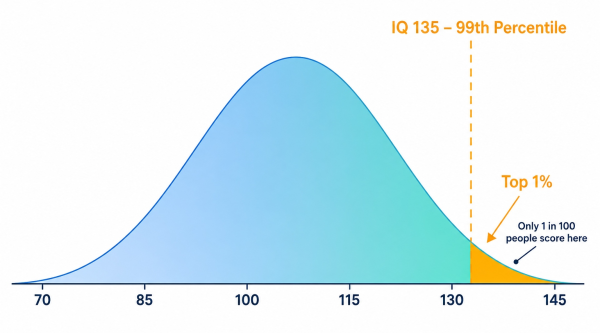
A score of 135 sits at approximately the 99th percentile, meaning roughly 99% of the population scores lower. This places it firmly in the Very Superior classification — the second-highest tier on standard IQ scales, sitting just below the Profoundly Gifted range that begins around 145 and above. Only around 1 in 100 people score at this level or higher on a well-administered IQ test.
On the standard deviation scale used by most IQ assessments — where the mean is 100 and the standard deviation is 15 — a score of 135 represents 2.33 standard deviations above the mean. This is a statistically significant distance from average and reflects a genuinely distinct cognitive profile rather than a marginal advantage. For context on how this fits into the full spectrum of IQ scores, see the IQ scale explained from low to genius.
IQ 135 Percentile and Population Context
| IQ Score | Percentile | Classification | % of Population |
| 145+ | 99.9th and above | Profoundly Gifted | ~0.1% |
| 130–144 | 98th–99.9th | Very Superior / Gifted | ~2% |
| 120–129 | 91st–97th | Superior | ~7% |
| 110–119 | 75th–90th | High Average | ~16% |
| 90–109 | 25th–74th | Average | ~50% |
| 80–89 | 10th–24th | Low Average | ~16% |
| Below 80 | Below 10th | Borderline / Extremely Low | ~9% |
A score of 135 sits near the upper boundary of the Very Superior range. It is high enough to qualify for membership in most high-IQ societies, including Mensa, which accepts the top 2% (approximately IQ 130 and above on most tests). For more on eligibility and what these organisations involve, see high-IQ societies.
Is an IQ of 135 Rare?
Yes — genuinely rare. Approximately 1 in 100 people score at or above 135 on a properly standardised IQ test. In a city of one million people, roughly 10,000 would be expected to score in this range. In a typical school of 500 students, statistically fewer than 5 would reach this level. It is rare enough to be meaningful, but not so rare as to be socially isolating in most educational or professional environments where high cognitive ability is common.
It is worth noting that online IQ tests frequently report inflated scores. A score of 135 on a free online test should be treated with considerable caution unless confirmed by a professionally administered assessment. The accuracy issues with informal testing are covered in are free online IQ tests accurate?
Cognitive Strengths Associated With IQ 135
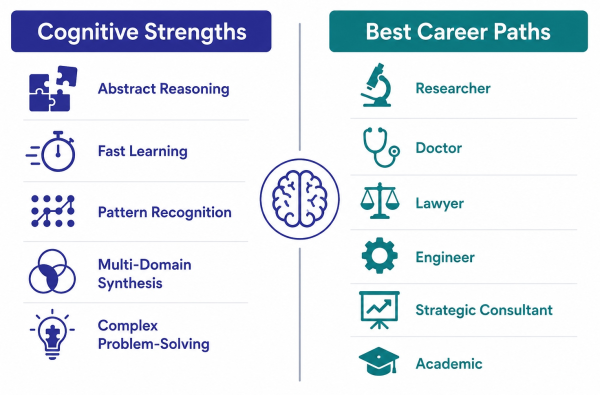
People who score around 135 typically demonstrate a consistently strong capacity for abstract reasoning — the ability to identify patterns, relationships, and logical structures that others may miss or take longer to process. They tend to learn new material quickly and with less repetition than average, make connections across different domains of knowledge, think several steps ahead in complex problem-solving, and grasp nuance, ambiguity, and multi-layered arguments with relative ease.
These strengths emerge most clearly in environments that reward intellectual depth — research, analysis, strategic planning, complex design, and advanced academic work. They are less visible in routine or highly structured tasks, which is one reason IQ alone does not determine career success or life satisfaction. For more on what IQ tests actually measure, see what is IQ — a complete guide to intelligence quotient.
IQ 135 and Career Paths
A score of 135 is well within the range associated with high performance in the most cognitively demanding professions. Research consistently shows that above-average IQ becomes increasingly predictive of job performance as role complexity rises. At the 99th percentile, individuals at this level tend to thrive in careers that require sustained intellectual engagement, independent thinking, and the ability to synthesise large amounts of complex information.
Careers commonly associated with IQ scores in the 130–140 range include academic research and university teaching, medicine and specialist surgery, law particularly at senior or academic levels, engineering disciplines especially aerospace, software, and systems engineering, theoretical physics and advanced mathematics, strategic consulting and financial analysis, and senior leadership roles in complex organisations. For a broader look at careers that align with high cognitive ability, see careers that require an IQ above 130 and what jobs require a high IQ?
IQ 135 and Emotional Intelligence
A common misconception is that very high IQ automatically translates into social ease or interpersonal effectiveness. In reality, IQ and emotional intelligence are largely independent traits. A person with an IQ of 135 may have excellent, average, or below-average emotional intelligence — these dimensions do not reliably predict one another.
In professional and personal contexts, emotional intelligence often matters as much as or more than raw cognitive ability, particularly in leadership, collaboration, and relationship-building. Some research suggests that very high IQ individuals occasionally struggle with social environments where their cognitive pace differs significantly from those around them, though this varies enormously between individuals. The relationship between these two dimensions of intelligence is explored in IQ vs EQ and careers for high IQ but low EQ individuals.
IQ 135 and Academic Performance
At this level, academic environments are often the first place where the cognitive gap becomes noticeable. Students with IQs around 135 frequently find standard curricula insufficiently challenging, which can lead to disengagement, boredom, or underachievement if appropriate enrichment is not provided. They tend to grasp concepts faster than instruction is paced, prefer depth over breadth, and may resist rote learning in favour of conceptual understanding.
Identifying and supporting intellectually gifted students early makes a significant difference to long-term academic and personal outcomes. Parents curious about what high potential looks like in children can explore signs of high intellectual potential in children.
Does IQ 135 Guarantee Success?
No — and the research is clear on this. IQ is one of the strongest single predictors of academic and professional performance, but it is far from the only one. Conscientiousness, emotional regulation, motivation, social skill, and resilience all contribute significantly to real-world outcomes, often more so than IQ once a baseline cognitive threshold has been crossed.
Many people with IQs of 135 and above do not reach their apparent potential due to poor mental health, lack of direction, interpersonal difficulties, or environmental disadvantage. Conversely, many people with average IQs achieve exceptional things through sustained effort, strategic thinking, and strong interpersonal skill. Intelligence is a resource, not a guarantee. For more on this perspective, see IQ vs problem-solving skills and IQ vs creativity.
IQ 135 vs IQ 130, 140, and 145
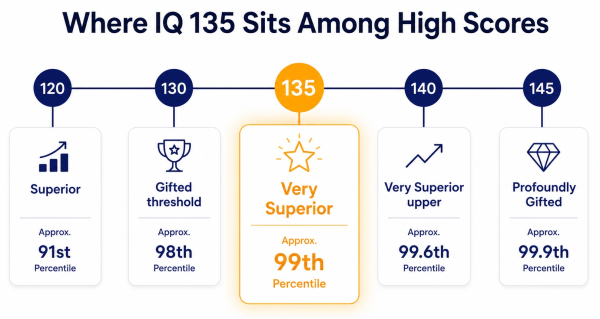
Within the gifted range, the differences between scores of 130, 135, 140, and 145 are statistically meaningful but often difficult to detect in everyday settings. All of these scores reflect exceptional cognitive ability, and the practical differences in most professional or academic environments are modest. The clearest distinctions tend to emerge in the most demanding intellectual tasks — advanced theoretical work, elite academic competition, or highly complex strategic problems.
A score of 135 sits comfortably within the range associated with intellectual giftedness without crossing into the profoundly gifted territory above 145, which brings its own distinct profile of both advantages and challenges.
How Reliable Is a Score of 135?
As with all IQ scores, a result of 135 carries a margin of error. On a professionally administered assessment, this margin is typically around 5 points in either direction. A score of 135 likely reflects a true range of approximately 130–140. Factors such as test anxiety, poor sleep, unfamiliarity with the test format, or an off day can suppress results below true ability level — or in some cases inflate them.
If your score of 135 came from an online test, treat it as an indication rather than a confirmed measurement. Professional confirmation through a qualified psychologist is worth pursuing if the result has significant implications — for example, for gifted programme eligibility, high-IQ society membership, or educational planning. The factors that affect IQ test results are covered in what affects your IQ test results.
Celebrity IQ Scores Around 135
Several well-known figures are estimated or reported to have IQs in the 130–140 range. These include scientists, writers, musicians, and business leaders who demonstrate the kind of rapid synthesis and creative application of knowledge often associated with this level of cognitive ability. You can explore verified and estimated celebrity IQ profiles in our Celebrity IQ Database, which includes figures such as Elon Musk and Barack Obama.
Final Thoughts on IQ 135
An IQ of 135 is a genuinely exceptional cognitive score — placing you in the top 1% of the population and reflecting strong capacity for abstract reasoning, rapid learning, and complex problem-solving. It is a significant advantage in intellectually demanding environments and opens doors to careers and opportunities that require high cognitive ability. But it is also just one dimension of human intelligence. How you develop, direct, and combine your cognitive ability with emotional skill, persistence, and self-awareness will ultimately determine far more than the number itself. Explore more in our IQ Scores section and take our free IQ test to benchmark your current performance.

Comments
Share Your Thoughts