In the summer of 1665, Isaac Newton was 23 years old, recently graduated from Trinity College, Cambridge, and effectively unemployed. The Great Plague had closed the university. He returned to his family's farm at Woolsthorpe Manor in Lincolnshire, where he had been born, and settled in to wait out the epidemic.
In the 18 months that followed, he invented calculus, discovered that white light contains the entire visible spectrum of colours, and formulated the law of universal gravitation. By late 1666, the Stanford Encyclopedia of Philosophy notes, he had become "de facto the leading mathematician in the world." He was 23 years old. He was in rural isolation. He told almost nobody.
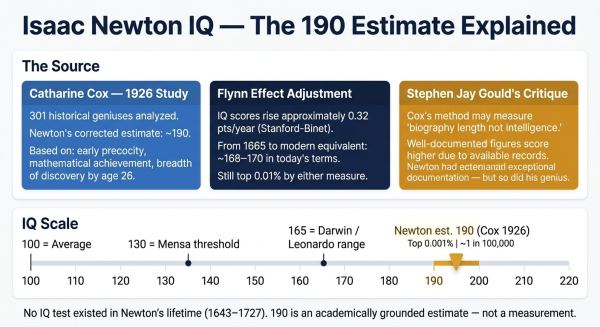
Isaac Newton's IQ is estimated at 190 by Catharine Cox's landmark 1926 historiometric study of 300 historical geniuses — among the highest estimates in the entire sample. Adjusted for the Flynn Effect, this corresponds to approximately 168–170 in modern terms. No IQ test existed during his lifetime (1643–1727). What existed instead was the most concentrated burst of scientific productivity in any single individual in the history of recorded science — and a lifetime of further work that built one of the most complete theoretical frameworks ever constructed by a human mind.
What Was Isaac Newton's IQ?
Isaac Newton's IQ is most commonly estimated at 190, derived from Catharine Cox's 1926 study Early Mental Traits of Three Hundred Geniuses — published as Volume II of Lewis Terman's Genetic Studies of Genius at Stanford University. Cox's corrected estimate for Newton is among the highest in her 301-person sample, reflecting the extraordinary breadth and depth of his documented early intellectual achievements.
The methodology, as explored in our articles on Darwin, Napoleon, and Leonardo da Vinci, uses biographical evidence of early intellectual development as a proxy for the ratio IQ formula: mental age divided by chronological age, multiplied by 100. For Newton, the available evidence is exceptionally rich — his papers, notebooks, and correspondence survive in unusual completeness, and document precocious mathematical ability alongside the extraordinary discoveries of the annus mirabilis.
Stephen Jay Gould critiqued Cox's method by noting that it tended to produce higher estimates for better-documented figures — essentially measuring the richness of the biography rather than purely the intelligence of the subject. This is a legitimate concern. But Newton's case is one where the documentation richness directly reflects extraordinary cognitive output: his notebooks reveal detailed original mathematical work from his early twenties that had no direct precedent in the existing literature. The documentation exists because the work was genuinely extraordinary, not merely because Newton happened to be well-connected or well-funded.
An adjusted figure of approximately 168–170 in modern IQ terms (correcting for the Flynn Effect — the observed multi-generational rise in IQ scores) still places Newton in the top 0.01% of the population. For context, this is higher than most estimates for Albert Einstein (~160) and Marie Curie (~185 unadjusted), and comparable only to Leonardo da Vinci (~180–220) among historical figures. For more on the framework, see our guide on the highest IQ of all time.
The Annus Mirabilis: 18 Months That Changed Science
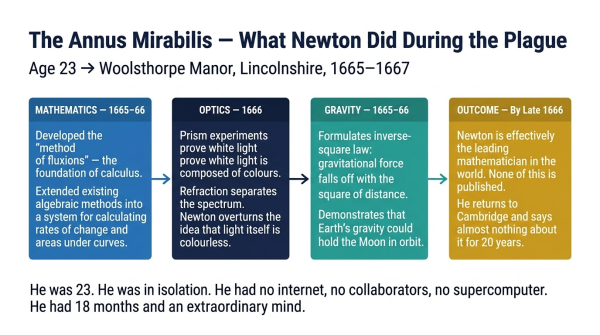
The Great Plague of London began in 1665. Cambridge University closed its gates that summer. Isaac Newton, who had just completed his undergraduate degree at Trinity College, returned to his mother's farm at Woolsthorpe Manor — a modest farmhouse about 60 miles northwest of Cambridge — and began working.
What followed is one of the most remarkable intellectual episodes in human history. Over the next 18 months, working largely alone with only books and his own notebooks, Newton made the foundational discoveries of three separate scientific disciplines:
Calculus — The Mathematical Tool That Made Modern Physics Possible
Newton called his system the "method of fluxions." The core insight was that rates of change — the speed at which one quantity changes with respect to another — could be expressed and calculated through a systematic mathematical procedure. This is what we now call differentiation. The inverse operation — finding the area under a curve — is what we call integration. Together they constitute calculus: the mathematical foundation for virtually all of physics, engineering, economics, and much of modern science.
Newton developed this system in the mid-1660s and essentially did not publish it for decades. When Gottfried Wilhelm Leibniz independently developed an equivalent system in the 1670s and published in 1684, a priority dispute of legendary bitterness ensued — one that consumed both men and divided European mathematics into opposing national camps. Modern scholarship accepts that both discoveries were genuinely independent. Leibniz's notation (the integral sign ∫ and the differential notation dy/dx) proved more convenient and is still used today; Newton's notation was largely abandoned. But the underlying mathematical framework was Newton's, developed approximately a decade before Leibniz's published version.
Optics — White Light and the Spectrum
At Woolsthorpe, Newton placed a prism in a beam of sunlight passing through a small hole in his window shutter and observed the rainbow of colours projected onto the far wall. This was not a new observation — prisms had been known to produce colour for centuries. Newton's insight was the interpretation. He argued that the prism was not adding colour to white light but separating components that were already present in it — that white light was a mixture of all spectral colours, each refracted at a slightly different angle.
He tested this by using a second prism to recombine the separated colours back into white light. The experiment worked. White light, he concluded, was not a pure substance but a compound of the entire visible spectrum. This overturned centuries of assumption about the nature of light and colour, and laid the groundwork for all subsequent optics, colour theory, spectroscopy, and eventually the quantum mechanics of photons.
Gravity and the Inverse-Square Law
The falling apple story — Newton watching an apple fall in the Woolsthorpe orchard and suddenly conceiving of gravity — is probably embellished by memory and retrospective narrative construction. What is documented is that during the plague years, Newton was working on the mathematics of circular motion and its relationship to the known astronomical regularities described by Kepler's laws. He derived the inverse-square law: that gravitational force between two bodies falls off with the square of the distance between them. He demonstrated that this was consistent with the Moon's observed orbit around the Earth, and with Kepler's relationship between orbital period and distance.
This insight was not published until the Principia in 1687 — more than 20 years later. In the interim, Newton set it aside because of small discrepancies in his calculations (caused by an imprecise value for the Earth's radius) and moved on to other problems. When Edmund Halley visited him in 1684 and asked what curve a planet would describe under an inverse-square gravitational attraction, Newton replied immediately: an ellipse. He had proved it 20 years earlier. Halley persuaded him to write it up. The result was the Principia Mathematica.
The Principia: The Most Important Scientific Book Ever Written
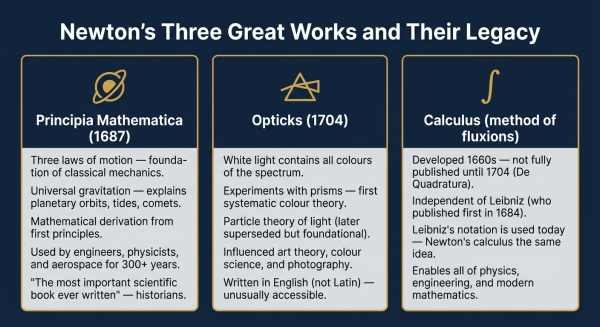
Philosophiae Naturalis Principia Mathematica, published in 1687, is the work historians most consistently identify as the most important scientific publication in history. Its argument is unified: starting from three axioms (the laws of motion), combined with the law of universal gravitation, Newton derives — through rigorous mathematical proof — a complete theory of physical motion that explains planetary orbits, tides, the paths of comets, the precession of equinoxes, the behaviour of pendulums, and the motion of projectiles.
The theoretical ambition is staggering. Before the Principia, there was no unified mathematical description of motion — there were Kepler's empirical laws of planetary motion, Galileo's experimental results for falling bodies, and various partial theories of mechanics. After the Principia, all of these were understood as special cases of a single universal law. The Sun holds the planets in their orbits by the same force that makes an apple fall to the ground. The Moon is simply a very large apple falling continuously sideways fast enough that the Earth's surface curves away beneath it at the same rate it falls.
Classical mechanics — the framework the Principia created — was not superseded until Einstein's general relativity in 1915, and remains the correct and sufficient description of motion for virtually all engineering applications that do not approach the speed of light or involve quantum-scale phenomena. The same mathematics Newton wrote in 1687 was used to calculate the trajectories of Apollo missions to the Moon 282 years later.
Newton vs Einstein: The Two Pillars of Physics
The comparison between Newton and Einstein is the most frequently attempted in the history of scientific genius assessment — and the most instructive for understanding what different types of intelligence look like.
| Dimension | Isaac Newton | Albert Einstein |
| Est. IQ (Cox/retroactive) | ~190 (Cox 1926) | ~160 (retroactive estimates) |
| Primary achievement | Classical mechanics, universal gravitation | Special and General Relativity |
| Method | Mathematical derivation from axioms | Physical intuition, thought experiments |
| Peak productive period | Age 23 (annus mirabilis) and again at ~40 (Principia) | Age 26 (annus mirabilis papers, 1905) |
| Personal character | Obsessive, secretive, vindictive, never married | Warm, politically engaged, multiple relationships |
| Legacy framework | Classical mechanics (still used for most engineering) | Relativistic physics (required at high speeds/masses) |
Einstein's Theory of Relativity did not disprove Newton — it revealed the limits of Newton's framework at velocities approaching the speed of light and at very large masses. For the vast majority of real-world physical problems, Newtonian mechanics remains both correct and sufficient. The GPS satellite system requires relativistic corrections, but the orbital mechanics of those satellites are Newtonian. The bridges, buildings, planes, and machines of the modern world were designed using Newton's equations.
Newton's higher estimated IQ — 190 versus Einstein's ~160 — may reflect the greater available documentation of his early life (supporting Cox's methodology) as much as a genuine difference in raw cognitive ability. What is beyond dispute is that both men produced theoretical frameworks of civilisational importance, in different domains and by different cognitive methods. Newton's method was more formally mathematical; Einstein's was more physically intuitive. The IQ estimates probably capture one dimension of their cognitive profiles more accurately than others. For more, see our guide on multiple intelligences.
The Darker Side: Alchemy, Obsession, and the Calculus Wars
Newton's intellectual profile cannot be honestly presented without acknowledging its darker dimensions. He was, by all historical accounts, extraordinarily difficult as a person — secretive, vindictive in disputes, and prone to what appear to have been nervous breakdowns, including a well-documented episode in 1693 that biographers have variously attributed to mercury poisoning (from his alchemical experiments), extreme sleep deprivation, or psychological collapse.
He never married and had few close personal relationships throughout his life. When he became Warden and then Master of the Royal Mint in 1696, he pursued counterfeiters with the same obsessive intensity he had devoted to mathematics — personally interrogating suspects and arranging prosecutions that led to hangings. His feud with Robert Hooke (over priority in gravity) lasted decades and ended only with Hooke's death. His dispute with Leibniz over calculus priority — in which he manipulated the Royal Society's official investigation to produce a verdict in his own favour — was one of the most sustained acts of intellectual dishonesty by a major scientist in history.
Perhaps most surprisingly to modern readers: Newton devoted approximately 30 years of his life to alchemy — seeking to transmute base metals into gold and to discover the philosophical mercury of ancient alchemists — and to biblical chronology, attempting to calculate the date of the Second Coming from scripture. More than a million words of his writings on these topics survive. He was not a rationalist who flirted with mysticism; he was a man of his era who believed the same universe he had mathematised also contained divine secrets encoded in ancient texts and natural substances. For more on what genius looks like in its full human complexity, see our guide on IQ vs EQ.
What Newton's Story Tells Us About Extreme Intelligence
Newton's life is one of the most complete demonstrations in history of what extreme analytical intelligence looks like in practice — both its extraordinary power and its specific limitations.
What it enables: the ability to hold a complex mathematical system in mind with such completeness that it can be explored, extended, and refined entirely mentally; the ability to see connections between apparently unrelated phenomena (the Moon and the apple; the prism and the colour spectrum); the ability to construct a rigorous mathematical proof from first principles and pursue it through extended chains of reasoning without error. These are the cognitive operations that an IQ of 190 (or 168–170 in modern terms) is designed to capture, and that Newton's documented work demonstrates at an extreme level.
What it does not enable: warmth in personal relationships, security in one's own priority, the emotional discipline to absorb criticism without retaliation, or the wisdom to distinguish between productive scientific investigation and unproductive mystical speculation. Newton spent more years on alchemy and biblical chronology than on mathematics and physics. His intellectual power was real and extraordinary. The wisdom to deploy it optimally was apparently absent. As the late Darwin — a very different kind of genius — understood about himself: knowing what you are bad at is often more valuable than knowing what you are good at. Newton apparently never reached that conclusion about himself.
Isaac Newton's IQ of approximately 190 (Cox 1926) represents the highest historiometric estimate for any primarily mathematical or physical scientist in the academic literature. The number exists to describe what Newton did at 23 during a plague quarantine: invented calculus, discovered the spectral composition of light, and formulated the law of universal gravitation — in 18 months, alone, in a farmhouse in Lincolnshire, with no one to tell. The Principia that published some of this work 20 years later is still in use today. The number is an attempt to summarise a mind that may simply be beyond the range of the scale used to estimate it.
Take our free IQ test to find out where your own analytical profile sits. For more historical genius comparisons, see our profiles of Marie Curie, Charles Darwin, and Albert Einstein. Explore our full Celebrity IQ database.
Frequently Asked Questions
What was Isaac Newton's IQ?
Isaac Newton's IQ is most commonly estimated at 190, based on Catharine Cox's 1926 historiometric study of 301 historical geniuses — the most academically rigorous source for historical IQ estimation. Adjusted for the Flynn Effect, this corresponds to approximately 168–170 in modern terms. No IQ test existed during his lifetime (1643–1727). The estimate reflects extraordinary documented early achievement across mathematics, optics, and mechanics.
What did Newton invent during the Great Plague?
During the Great Plague of 1665–1667, at age 23, Newton developed the method of fluxions (calculus), discovered that white light contains the visible spectrum of colours through prism experiments, and formulated the inverse-square law of universal gravitation, demonstrating that Earth's gravity could hold the Moon in orbit. By late 1666 he was effectively the world's leading mathematician. He published essentially none of this for decades.
Did Newton and Leibniz discover calculus simultaneously?
Yes. Newton developed calculus in the mid-1660s; Leibniz developed it independently in the 1670s and published first in 1684. A bitter priority dispute followed. Modern scholarship accepts both discoveries as genuine and independent. Leibniz's notation (∫, dy/dx) proved more useful and is still in use today; Newton's mathematical framework was the same underlying idea.
What is Principia Mathematica and why is it important?
Philosophiae Naturalis Principia Mathematica (1687) is widely described as the most important scientific book ever written. It presents Newton's three laws of motion and the law of universal gravitation, mathematically derived from first principles, creating a unified theory that explains planetary orbits, tides, comets, and terrestrial mechanics. It founded classical mechanics, which remained the definitive description of physical motion for over 200 years and is still used for all standard engineering calculations today.
Was Newton as difficult personally as he was brilliant scientifically?
Yes. Newton was secretive, obsessive, and vindictive in priority disputes — particularly with Robert Hooke (gravity) and Leibniz (calculus). He never married, had few close friends, and manipulated the Royal Society's investigation of the calculus dispute to rule in his own favour. He also devoted approximately 30 years to alchemy and biblical chronology — a fact his modern admirers tend to overlook. His intellectual power was extraordinary; his personal wisdom was not proportionally developed. His successor as Lucasian Professor of Mathematics at Cambridge was Stephen Hawking.

Comments
Share Your Thoughts