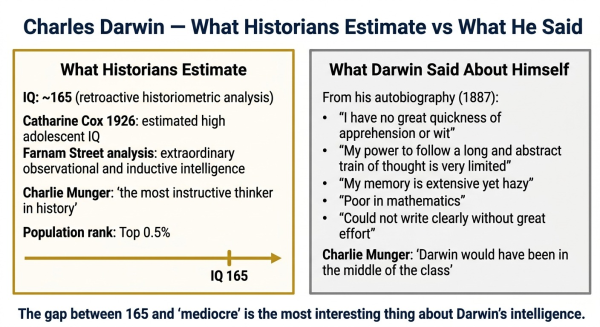
In his autobiography, written at the age of 73, Charles Darwin assessed his own mind with characteristic directness. He wrote: "I have no great quickness of apprehension or wit which is so remarkable in some clever men... My power to follow a long and purely abstract train of thought is very limited... so poor in one sense is my memory that I have never been able to remember for more than a few days a single date or a line of poetry."
This is not false modesty. Darwin's assessment of his own cognitive limitations was specific, consistent, and apparently sincere. Charlie Munger — the late vice-chairman of Berkshire Hathaway, a voracious reader who spent his life studying exemplary thinkers — agreed: he said Darwin would likely have been "in the middle of the class."
And yet Darwin produced, from that middle-of-the-class mind, the single most consequential scientific idea in the history of biology. On the Origin of Species — published in 1859 after 20 years of evidence accumulation following the insight — transformed not just biology but geology, medicine, anthropology, philosophy, and the human self-understanding of our species' place in nature. It is still the foundational text of evolutionary biology more than 165 years after its publication. No subsequent discovery has invalidated its core argument.
His IQ is estimated at approximately 165. And the gap between that estimate and his own assessment of himself as mediocre may be the most instructive thing in the entire history of human intelligence.
What Was Charles Darwin's IQ?
Charles Darwin's IQ is most commonly estimated at approximately 165, based on retroactive historiometric analysis of his documented cognitive abilities, early academic record, and scientific output. No IQ test existed during his lifetime (1809–1882). Most credible estimates place him in the 140–170 range; the 165 figure represents the most frequently cited consensus.
The historiometric methodology — developed by Catharine Cox in her 1926 study of 300 historical geniuses and explored in our articles on Leonardo da Vinci and Nikola Tesla — uses documented early intellectual development as the primary anchor for estimation. For Darwin, the available evidence includes:
- Exceptional early ability in natural observation, documented by teachers and family
- Solid academic performance at Cambridge, particularly in natural sciences and geology
- The extraordinary capacity for synthesis demonstrated in the development of natural selection theory — connecting Malthusian population theory, fossil evidence, geological change, and field observations from multiple continents into a unified explanatory framework
- Fluency in multiple scientific disciplines simultaneously: geology, zoology, botany, and what would now be called ecology
- The production of a theory of such explanatory power and predictive accuracy that it has not been substantially revised in 165 years
The estimate of 165 — while inherently imprecise — is consistent with all available evidence. For more context on how historical IQ estimates work and why they cannot be taken as precise measurements, see our guide on the highest IQ of all time.
Darwin's Own Assessment: "I Have No Great Quickness of Apprehension"
What makes Darwin's case uniquely interesting in the history of intelligence is the detailed self-assessment he left in his autobiography. Unlike most historical figures whose IQs are estimated from external evidence, Darwin provided a direct first-person account of how his own mind worked — and the picture he painted was not flattering.
From his autobiography (written 1876, published posthumously in 1887):
"I have no great quickness of apprehension or wit which is so remarkable in some clever men, for instance, Huxley. I am therefore a poor critic: a paper or book, when first read, generally excites my admiration, and it is only after considerable reflection that I perceive the weak points. My power to follow a long and purely abstract train of thought is very limited; and therefore I could never have succeeded with metaphysics or mathematics... My memory is extensive, yet hazy: it suffices to make me cautious by vaguely telling me that I have observed or read something opposed to the conclusion which I am drawing... I have a fair share of invention, and of common sense or judgment, such as every fairly successful lawyer or doctor must have, but not, I believe, in any higher degree."
This is a remarkable document. Darwin explicitly identifies what he considers his intellectual weaknesses: slow apprehension, limited abstract reasoning ability, poor memory for specific facts (dates, poetry, verbatim text), and mathematical inadequacy. He places himself in the same intellectual league as a "fairly successful lawyer or doctor" — competent professionals, but not extraordinary thinkers.
Farnam Street — whose analysis of Darwin's cognitive habits has become one of the most widely shared pieces of intellectual writing online — calls this "one of the most honest self-assessments of any great thinker in history." The question it poses is obvious and profound: if Darwin's self-assessment was accurate, how did a mind with limited abstract reasoning and hazy memory produce the most important idea in biology? And if it was inaccurate, what does that tell us about the relationship between how we think about our own minds and what those minds are actually doing? For more on this relationship, see our guide on what IQ actually measures.
The Beagle Voyage: Five Years That Changed Everything
Charles Robert Darwin was born on 12 February 1809 in Shrewsbury, England, into a prosperous family with strong intellectual traditions. His paternal grandfather Erasmus Darwin had written speculatively about evolution; his maternal grandfather Josiah Wedgwood had built the famous pottery company. His father Robert was a successful physician who expected Charles to follow him into medicine.
Darwin briefly studied medicine at Edinburgh before being repelled by the violence of surgery performed without anaesthetic. He then enrolled at Christ's College, Cambridge, ostensibly to study theology but in practice spending most of his time on natural history, geology, and beetle collecting. His Cambridge mentor, botanist John Stevens Henslow, recognised his exceptional observational abilities and recommended him for an unpaid naturalist position aboard HMS Beagle — a Royal Navy survey ship preparing for a voyage to South America.
The Beagle departed in December 1831 and returned in October 1836 — a five-year voyage that took Darwin around South America, through the Galápagos Islands, across the Pacific to Australia and South Africa, and home via the South Atlantic. Darwin spent most of his time ashore, collecting specimens, making geological observations, and recording everything in meticulous notebooks. He returned with thousands of specimens, hundreds of pages of notes, and a head full of observations that had begun to shake his previous understanding of how species came to exist.
The specific observations that proved most consequential were subtle rather than dramatic. The Galápagos finches — now iconic — were not immediately recognised by Darwin as the key evidence they later became; he initially failed to properly label which island each bird came from. What struck him more immediately was the pattern across the entire voyage: fossils of extinct species that resembled but did not match living species; the biogeography of South American species that made no sense under the "special creation" hypothesis; the way species on different but adjacent islands differed in ways that seemed adapted to local conditions. The observations accumulated into a question that demanded an answer: how do species become what they are?
The 20-Year Wait: Patience as a Form of Intelligence
Darwin formulated the core mechanism of natural selection in 1838 — two years after returning from the Beagle. The insight came partly from reading Thomas Malthus's essay on population, which described how populations grow geometrically while food supply grows arithmetically, producing competition for survival. Darwin recognised that in nature, this competition would tend to preserve variations that aided survival and eliminate those that did not — differential survival based on heritable variation. This was the mechanism he had been seeking.
He did not publish this insight until 1859. Twenty-one years passed between the theory and the book.
This 20-year delay is one of the most discussed facts in the history of science, and it reveals something important about Darwin's intelligence. He was not slow to understand his own idea — his private notebooks show he understood it clearly from 1838. He was slow to commit to publishing it because he recognised the scale of the evidential case he would need to make. The idea was extraordinary; the social and religious implications were explosive; the risk of being wrong was enormous. He responded by accumulating evidence at a scale no previous naturalist had attempted — breeding experiments, fossil evidence, geographical distribution patterns, embryological comparisons, domestic animal breeding records.
This is not the behaviour of a man with limited intelligence. It is the behaviour of a man who understands precisely the relationship between extraordinary claims and the extraordinary evidence they require. The patience is itself a form of intellectual discipline that the estimated IQ of 165 alone cannot capture. For more on this relationship, see our guide on IQ vs problem-solving.
The Wallace Crisis: When Patience Ran Out
On 18 June 1858, Darwin received a letter from Alfred Russel Wallace — a young British naturalist working in the Malay Archipelago. Enclosed was an essay titled "On the Tendency of Varieties to Depart Indefinitely from the Original Type." Darwin read it and recognised, with what he described as devastating clarity, that Wallace had independently arrived at essentially the same theory of natural selection that Darwin had been accumulating evidence for since 1838.
He wrote to his mentor Charles Lyell: "I never saw a more striking coincidence... If Wallace had my manuscript sketch written out in 1842, he could not have made a better short abstract! Even his terms now stand as heads of my chapters... So all my originality, whatever it may amount to, will be smashed."
Lyell and botanist Joseph Hooker arranged for joint presentation of Darwin's and Wallace's papers to the Linnean Society in July 1858. Neither man was present — Darwin was at his son's funeral, Wallace was still in the Malay Archipelago. Lyell and Hooker then pressured Darwin to publish immediately. He compressed his planned multi-volume work — which he had titled "Natural Selection" and which ran to hundreds of thousands of words — into a single accessible volume. On the Origin of Species by Means of Natural Selection was published on 24 November 1859. The first edition of 1,250 copies sold out on the day of publication.
The Five Habits That Outperformed the IQ
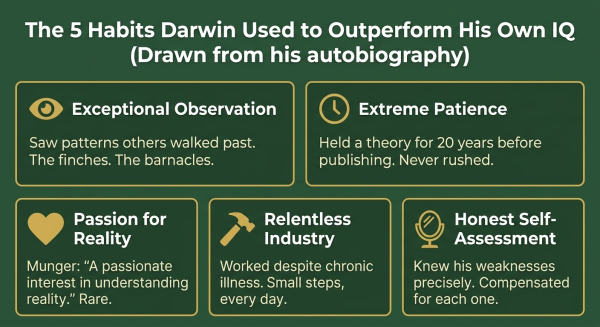
The Farnam Street analysis of Darwin's autobiography identified five cognitive habits that Darwin himself described as the source of his achievement — and that allowed him, in their framing, to systematically outperform his own stated intellectual limitations:
1. Exceptional Observational Ability
Darwin's most frequently recognised cognitive strength — and the one he himself acknowledged — was an extraordinary capacity to observe. He saw patterns in nature that contemporaries missed not because he was faster or smarter in abstract reasoning but because he was more patient and more attentive. The Galápagos finches, the fossil armadillo shells, the distribution of species on adjacent islands — these observations were available to other naturalists, but Darwin was the one who registered their significance and held them in mind long enough to develop a theory that explained them.
2. Extreme Patience and Perseverance
The 20-year accumulation of evidence before publishing is Darwin's most concrete demonstration of this quality. He spent decades on barnacles, on earthworms, on the breeding records of domestic animals — not because these were the most exciting topics available to a Victorian naturalist, but because they built the evidential case he needed. Charlie Munger described this as "dogged patience in accumulating evidence" and identified it as one of the most rare and valuable cognitive qualities in any domain.
3. A Passionate Love of Reality and Science
Munger called this Darwin's most valuable quality: "a passionate interest in understanding reality and putting it in useful order." This is not precisely intelligence in the IQ sense — it is motivational intensity directed at accurate understanding rather than social success, financial gain, or intellectual display. Darwin's private notebooks and correspondence reveal a mind that was genuinely, obsessively interested in understanding how the natural world worked — not in being seen to understand it.
4. Relentless Industry Despite Ill Health
Darwin suffered from chronic ill health for most of his adult life — a condition still not definitively diagnosed, which may have included Chagas disease (contracted in South America), or a psychosomatic component related to anxiety about his theory's implications. He typically worked only a few hours per day. Yet across those limited working hours, sustained over decades, he produced an extraordinary volume of original observation, correspondence, and published work. Small, consistent effort compounded over time produced results that brute-force intellectual effort might not have.
5. Honest Self-Assessment and Deliberate Compensation
Perhaps the rarest quality Darwin describes is his candid acknowledgment of his specific limitations and his deliberate construction of habits to compensate for them. He knew his memory was hazy for specific facts — so he kept meticulous notebooks in which he recorded everything. He knew his abstract reasoning was limited — so he worked from concrete observations, not abstract principles. He knew he was a poor writer — so he worked his drafts exhaustively through multiple revisions. He turned a clear-eyed understanding of his own weaknesses into a set of compensating systems. This is exactly the kind of metacognitive intelligence — thinking accurately about how you think — that IQ tests do not and cannot measure.
For more on how these habits relate to intelligence research, see our guide on multiple intelligences and our article on Warren Buffett's IQ — another figure who has argued that temperament and discipline matter more than raw cognitive ability above a basic threshold.
How Darwin's Profile Compares to Other Historical Geniuses
| Person | Est. IQ | Cognitive Strength | Notable Self-Limitation |
| Marie Curie | ~185 | Systematic experimentation | None documented |
| Isaac Newton | ~190 | Mathematical abstraction | Obsessive, socially withdrawn |
| Nikola Tesla | ~160–200 | Visual-spatial imagination | Poor practical intelligence; died broke |
| Albert Einstein | ~160 | Theoretical physical intuition | Poor at routine tasks; failed early exams |
| Charles Darwin | ~165 | Observation + patient synthesis | "No great quickness or wit" — his own words |
What distinguishes Darwin in this comparison is not the estimated IQ — it sits in the middle of this group — but the documented cognitive profile. Where Newton was brilliant but obsessive, Tesla was visionary but impractical, and Einstein was intuitive but distracted, Darwin was persistent, honest about his limitations, and systematically compensating for them. His intelligence was probably the least flashy in this group and produced the most enduring idea.
The Lesson in Darwin's Self-Assessment
The gap between Darwin's estimated IQ of 165 and his self-described "mediocre" intelligence is not a contradiction. It is a lesson about the relationship between intelligence and achievement that Darwin's own life resolves with unique clarity.
The historiometric estimate of 165 reflects what Darwin's cognitive machinery was objectively capable of — the speed and accuracy of pattern recognition, the capacity for cross-domain synthesis, the quality of his reasoning when applied to a problem he had spent years studying. Darwin's self-assessment of "mediocre" reflects what that machinery felt like from the inside, measured against the standards of the fastest and most brilliant minds he knew personally — men like T.H. Huxley, who could absorb, analyse, and rebut a complex argument in real time, and who Darwin explicitly identified as having the "quickness" he lacked.
Both assessments were accurate. Darwin was not quick. He was not mathematically gifted. He could not memorise poetry. He was not a brilliant conversationalist or debater. And he produced an idea of such explanatory power that it still structures the entire field of biology 165 years later. The habits — the patience, the obsessive observation, the honest self-knowledge, the relentless accumulation of evidence — turned a mind that was genuinely good but not obviously exceptional into the most consequential scientific thinker of the 19th century.
Charles Darwin's IQ of approximately 165 is an estimate of a mind that he himself described as mediocre. Both may be true simultaneously: 165 is genuinely exceptional by any population standard, yet genuinely modest compared to the fastest minds Darwin knew personally. What he demonstrated across 70 years of scientific work is that exceptional outcomes do not require exceptional speed — they require exceptional patience, exceptional honesty about limitations, and the discipline to build systems that compensate for those limitations across decades. Darwin did not outsmart his competitors. He outlasted them.
Curious where your own cognitive profile sits? Take our free IQ test — no registration, results in under 20 minutes. For more on how cognitive habits can outperform raw IQ, see our guides on IQ vs EQ and can IQ be improved? Explore our full Celebrity IQ database.
Frequently Asked Questions
What was Charles Darwin's IQ?
Charles Darwin's IQ is most commonly estimated at approximately 165, based on retroactive historiometric analysis. No IQ test existed during his lifetime (1809–1882). Most estimates range from 140 to 170. Paradoxically, Darwin's own autobiography describes his intelligence as mediocre — noting his limited abstract reasoning, poor mathematical ability, and hazy memory. The gap between the external estimate and his self-assessment is one of the most instructive facts in the history of intelligence.
What did Charles Darwin say about his own intelligence?
In his autobiography, Darwin wrote that he had "no great quickness of apprehension or wit," that his "power to follow a long and purely abstract train of thought is very limited," and that his memory was "extensive yet hazy." He placed himself at the intellectual level of a "fairly successful lawyer or doctor." Charlie Munger agreed, saying Darwin would have been "in the middle of the class."
Why did Darwin wait 20 years to publish On the Origin of Species?
Darwin formulated natural selection in 1838 but did not publish until 1859 — 21 years later. The delay reflected his characteristic insistence on assembling overwhelming evidence before committing to a public claim, his awareness of the explosive social and religious implications, and his chronic ill health. His hand was forced in 1858 when Alfred Russel Wallace sent him an essay describing essentially the same theory independently, prompting joint publication and then the urgent compression of Darwin's planned multi-volume work into On the Origin of Species.
What was the Wallace Problem?
In June 1858, Darwin received a letter from Alfred Russel Wallace containing an essay on natural selection that matched Darwin's own unpublished theory almost exactly. Darwin was devastated, writing that "all my originality, whatever it may amount to, will be smashed." Lyell and Hooker arranged joint presentation of both men's papers in July 1858, then urged Darwin to publish immediately. He compressed his planned work into the single volume published as On the Origin of Species in November 1859.
What five habits did Darwin use to overcome his limitations?
From his autobiography: (1) Exceptional observation — seeing what others missed; (2) Extreme patience — accumulating evidence for 20 years before publishing; (3) Passion for reality — genuine obsession with understanding the natural world; (4) Relentless industry — consistent work despite chronic illness; and (5) Honest self-assessment — knowing his weaknesses precisely and deliberately compensating for each one. Munger called the last of these Darwin's most rare and valuable trait.

Comments
Share Your Thoughts