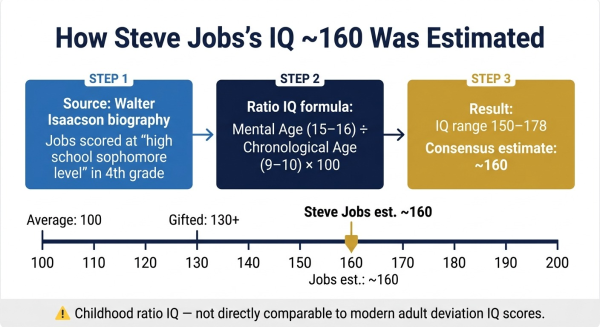
Steve Jobs's IQ is most commonly estimated at 160 — a figure derived from a childhood school test described in Walter Isaacson's authorised biography, where Jobs recalled scoring at the "high school sophomore level" while in 4th grade. Using the ratio IQ formula, this produces a range of 150 to 178, with 160 as the consensus estimate.
But here is the thing Steve Jobs himself would almost certainly have objected to about this framing: he did not believe raw IQ was the point. In interview after interview, he emphasised creativity, taste, and the ability to synthesise ideas from completely different domains — not analytical horsepower. He once said: "Creativity is just connecting things. When you ask creative people how they did something, they feel a little guilty because they didn't really do it, they just saw something."
This article examines what we know about Jobs's IQ, why the number is both real and insufficient, and what the type of intelligence he actually possessed tells us about the relationship between creativity and analytical ability.
What Was Steve Jobs's IQ?
The primary source for Steve Jobs's IQ estimate is Walter Isaacson's 2011 biography, which Jobs authorised and participated in extensively. According to the biography, near the end of 4th grade, Jobs was tested and scored at the high school sophomore level. This means he was a 4th grader — typically aged 9 or 10 — performing at the cognitive level of a 10th grader, typically aged 15 or 16.
Applying the ratio IQ formula (mental age divided by chronological age, multiplied by 100):
- Lower bound: 15 ÷ 10 × 100 = 150
- Upper bound: 16 ÷ 9 × 100 = 178
- Consensus estimate: approximately 160
This places him in the profoundly gifted range — consistent with estimates for Bill Gates (~157–160) and Albert Einstein (~160). The important caveat applies here as it does for all childhood ratio IQ scores: these figures are not directly comparable to modern adult deviation IQ scores produced by the WAIS or Stanford-Binet. They reflect extraordinary childhood cognitive ability expressed through a formula that the field has since abandoned for adult comparisons. No official adult IQ test result for Jobs was ever made public. For a full explanation of these methodological issues, see our IQ scale explained guide.
The Two Steves: Why Jobs's Intelligence Was Different From Wozniak's
To understand Steve Jobs's cognitive profile, the most instructive comparison is not with other IQ claims but with Steve Wozniak — his co-founder, and the person who actually built the Apple I and Apple II computers from the ground up.
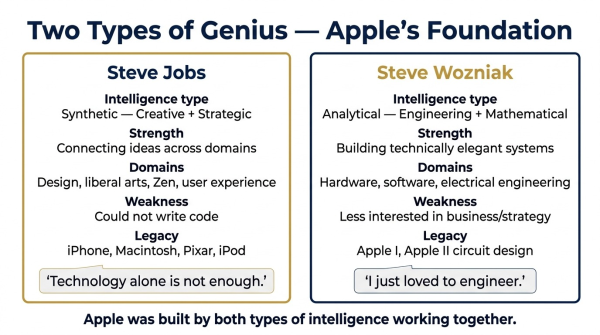
Wozniak's intelligence was analytical and engineering-based — he could design complex circuit boards in his head, write elegantly efficient code, and build hardware systems of extraordinary technical sophistication. His IQ, by most estimates, was comparable to or slightly higher than Jobs's. He was, in the conventional sense, the "smarter" engineer.
Jobs could not write code. He had no formal engineering training. By Wozniak's own account, Jobs's technical contribution to the early Apple hardware was minimal. What Jobs had was something entirely different: the ability to look at Wozniak's technical work and see what it could mean for ordinary people — and then to drive the development of products that translated that technical capability into experiences that felt magical rather than mechanical.
This is what psychologists of creativity call synthetic intelligence — the ability to connect ideas from domains that are not usually connected, and produce something new from the intersection. Jobs himself described it explicitly when he said Apple stood at the "intersection of technology and liberal arts." His intelligence was most powerfully expressed not in any single domain but in the space between domains. For more on this concept, see our guide on IQ vs creativity.
The Calligraphy Class That Changed Computing
The single most famous illustration of how Jobs's intelligence actually worked is the calligraphy class at Reed College — and it is worth examining in detail because it perfectly captures the cognitive operation that defined his career.
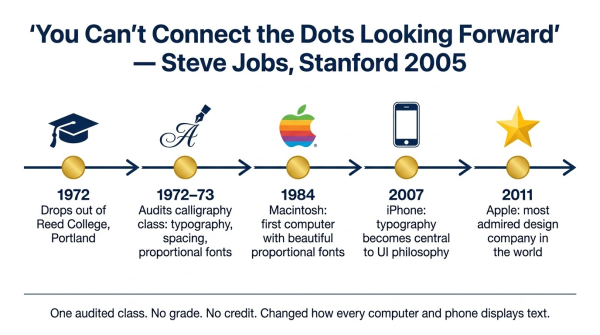
Jobs enrolled at Reed College in Oregon but dropped out after six months. However, he continued to audit classes, most famously a calligraphy course, which later influenced Apple's emphasis on typography and visual elegance. He audited the class for no grade, no credit, with no idea how it might ever be useful. It taught him about serif and sans-serif typefaces, about the space between different letter combinations, about what makes typography beautiful.
Ten years later, when designing the Macintosh, Jobs incorporated what he had learned into the first personal computer to offer multiple typefaces and proportionally spaced fonts. As he explained in his famous 2005 Stanford commencement address: "If I had never dropped in on that single course in college, the Mac would have never had multiple typefaces or proportionally spaced fonts. And since Windows just copied the Mac, it's likely that no personal computer would have them."
This is not the story of someone using analytical intelligence to solve a defined problem. This is the story of someone storing an apparently useless piece of knowledge — the aesthetics of typography — for a decade, and then recognising its application in a completely different context. It is exactly the cognitive operation that high verbal intelligence and strong working memory enable: the ability to retain diverse knowledge across time and retrieve it in unexpected combinations. For more on how this type of memory-based synthesis works, see our guide on IQ and memory.
The Reality Distortion Field: Intelligence as Persuasion
One of Jobs's most documented cognitive traits was what Apple engineer Andy Hertzfeld named his "reality distortion field" — Jobs's ability to convince himself, and others around him, to believe almost anything with a mix of charm, charisma, bravado, hyperbole, marketing, appeasement and persistence. It was said to distort his co-workers' sense of proportion and scales of difficulties and to make them believe that whatever impossible task he had at hand was possible.
The reality distortion field was both a cognitive strength and a character flaw. As a leadership tool, it enabled Apple teams to achieve things they would have declared impossible — the original Macintosh was built in under a year by a small team under extraordinary pressure, because Jobs convinced them it was achievable. As a personal trait, it contributed to catastrophic decisions: his initial refusal to accept conventional cancer treatment in 2003, his dismissal of market research as irrelevant, his absolute certainty in positions that turned out to be wrong.
From a cognitive science perspective, the reality distortion field maps onto what psychologists call high confidence under uncertainty — the ability to commit to a course of action before the evidence is conclusive, and to maintain that commitment against external doubt. At moderate levels, this correlates positively with creative achievement. At extreme levels, it produces the pattern Jobs demonstrated: extraordinary successes interspersed with costly failures driven by the same refusal to update beliefs in response to evidence. This dynamic is explored in our guide on IQ vs problem-solving.
Four Products, Four Types of Intelligence
Jobs's career produced four category-defining products, each of which illustrates a different facet of his cognitive profile:
Macintosh (1984) — Synthetic Intelligence
The Macintosh was not technically superior to competing computers. It was the first to make the graphical user interface — a concept developed at Xerox PARC — accessible and desirable to ordinary people. Jobs saw the PARC interface on a visit and recognised its significance immediately. The engineers at Xerox had invented the technology. Jobs had the synthetic intelligence to understand what it meant for people who were not engineers. He then drove his team to realise that vision over several years with an intensity that left many of them simultaneously exhausted and proud of what they had created.
Pixar (1986–1995) — Long-Term Strategic Intelligence
When Jobs bought the computer graphics division of Lucasfilm in 1986 for $5 million, it was an unproven technology company with no clear business model. Under his leadership, Pixar created the first fully computer-animated feature film, Toy Story (1995), revolutionizing animation. Jobs's patience with Pixar — which he funded through losses for nearly a decade before it became profitable — reflects a form of long-term strategic intelligence that is distinct from both analytical and creative intelligence: the ability to hold a conviction about future value across years of negative evidence.
iPod (2001) — Design Intelligence
The MP3 player existed before the iPod. Numerous companies had built functional digital music devices. Jobs's contribution was the realisation that the technology was not the product — the experience was the product. The iPod's click wheel, its seamless integration with iTunes, its packaging, its advertising — each element was designed with the understanding that people buy feelings, not specifications. This is design intelligence in its purest form: the ability to model how a product will feel in a user's hands and life, and to refuse to compromise that feeling for any technical or financial consideration.
iPhone (2007) — Disruptive Vision
The iPhone is perhaps Jobs's greatest cognitive achievement precisely because it required him to convince Apple's board to enter a market they had no experience in, convince carriers to accept terms they had never accepted before, and convince his own engineering team to build a device that defied many of the accepted constraints of mobile hardware design. The intelligence required was not technical — that was the team's job. It was the ability to hold a complete, coherent vision of a product that did not yet exist, and to drive every decision from hardware to software to packaging toward that vision without compromise.
Jobs vs Other Tech Founders: IQ in Context
| Person | Est. IQ | Primary Intelligence Type | Defining Achievement |
| Bill Gates | ~157–160 | Analytical + Strategic | Microsoft — software as an industry |
| Steve Jobs | ~160 | Synthetic + Design + Persuasive | Apple — technology as culture |
| Elon Musk | ~155 | Systems + Engineering | Tesla, SpaceX — physical world disruption |
| Mark Zuckerberg | ~152 | Analytical + Product | Facebook/Meta — social connection at scale |
The comparison with Gates is particularly instructive. Both men have IQ estimates around 160. Both built companies that became among the most valuable in human history. But they applied their intelligence in fundamentally different ways: Gates built Microsoft by understanding software as a business and an industry, negotiating licensing deals, and dominating markets through distribution. Jobs built Apple by understanding technology as a cultural and aesthetic experience, and creating products that people did not know they needed until they held them.
Same estimated IQ. Completely different cognitive strengths. Completely different outcomes. For more on how this distinction plays out, see our guide on IQ vs EQ and the Celebrity IQ database.
What Jobs Thought About Intelligence — In His Own Words
Jobs was unusually explicit about his views on intelligence and creativity. Several of his statements provide a direct window into how he understood his own cognitive profile:
- "Creativity is just connecting things. When you ask creative people how they did something, they feel a little guilty because they didn't really do it, they just saw something. It seemed obvious to them after a while."
- "I think part of what made the Macintosh great was that the people working on it were musicians, poets, artists, zoologists, and historians who also happened to be the best computer scientists in the world."
- "Technology alone is not enough. It's technology married with liberal arts, married with the humanities, that yields the results that make our hearts sing."
- "Your time is limited, so don't waste it living someone else's life. Don't let the noise of others' opinions drown out your own inner voice."
These statements describe a consistent cognitive philosophy: intelligence is most powerful when it operates across boundaries, when it refuses to be confined by domain expertise, and when it stays in contact with human meaning rather than retreating into pure abstraction. This is not the philosophy of someone who believes IQ is the primary measure of intellectual capacity — it is the philosophy of someone who understood, from direct experience, that the most valuable cognitive operations are precisely the ones that standardised tests struggle to capture. For more on this, see our guide on multiple intelligences.
The Legacy: What Happened When Jobs Was Absent
Perhaps the strongest evidence for the specific nature of Jobs's intelligence is what happened to Apple during the years he was absent. Jobs was forced out of Apple by the board in 1985, following a power struggle with CEO John Sculley — a man of considerable conventional business intelligence who nonetheless drove Apple to near-bankruptcy within a decade. Apple's market share collapsed. Its products became unfocused and undifferentiated.
Jobs returned as interim CEO in 1997, with Apple weeks from insolvency. Within four years, the iMac, iPod, and iTunes had stabilised the company. Within ten years, the iPhone had made it the most valuable company in the world. The 12-year absence and return is effectively a controlled experiment in what Jobs's specific type of intelligence contributed — and what conventional business intelligence alone could not replace.
Steve Jobs's IQ of approximately 160 reflects genuine exceptional intelligence. But the number captures only the analytical substrate. What Jobs actually built required something that no IQ test measures: the ability to see the future as a design problem, and to refuse to accept any version of it that was not worthy of the people who would live in it.
Curious how your own cognitive profile compares? Take our free IQ test — no registration, results in under 20 minutes. Explore our full Celebrity IQ database or see what scores around 160 look like in our guide on IQ 160.
Frequently Asked Questions
What was Steve Jobs's IQ?
Steve Jobs's IQ is most commonly estimated at ~160, derived from a 4th-grade school test described in Walter Isaacson's biography. Jobs scored at the "high school sophomore level" while in 4th grade, producing a ratio IQ estimate of 150–178. No official standardised adult IQ test result was ever made public.
Did Steve Jobs have a high IQ?
Yes — by all available evidence. His 4th-grade school performance suggests a childhood ratio IQ of 150–178. However, Jobs himself consistently rejected the idea that raw IQ was the key to his work, emphasising creativity, taste, and cross-domain synthesis as the more important cognitive operations.
Was Steve Jobs more creative or intelligent?
Both — but his genius was specifically the intersection of the two. His intelligence was not primarily analytical in the mathematical sense. Jobs's distinctive cognitive strength was synthetic: the ability to connect ideas from technology, liberal arts, calligraphy, Zen Buddhism, and industrial design, and produce products that were simultaneously technically advanced and emotionally resonant.
Why did Steve Jobs drop out of college?
Jobs enrolled at Reed College in Oregon in 1972 but dropped out after six months, citing the financial burden on his adoptive parents. He continued to audit classes that interested him — most famously a calligraphy course — for 18 months after dropping out. That calligraphy class later directly influenced the Macintosh's typography system, making Apple the first computer to offer proportionally spaced, beautiful fonts.
What was Steve Jobs's reality distortion field?
The "reality distortion field" was a term coined by Apple engineer Andy Hertzfeld to describe Jobs's ability to convince himself and others that apparently impossible tasks were achievable — combining charisma, persuasion, selective vision, and refusal to accept conventional limitations. It was both his greatest leadership tool and one of his most damaging personal traits.

Comments
Share Your Thoughts