An IQ score of 100 is the most common score in the world — by design. Every major IQ test is calibrated so that 100 represents the exact midpoint of the population. If you scored 100, you are not above average or below average. You are precisely average, which is exactly where most people fall. This article explains what that actually means, what you can and cannot conclude from a score of 100, and how it compares across age groups, countries, and careers.
What Does an IQ of 100 Mean?
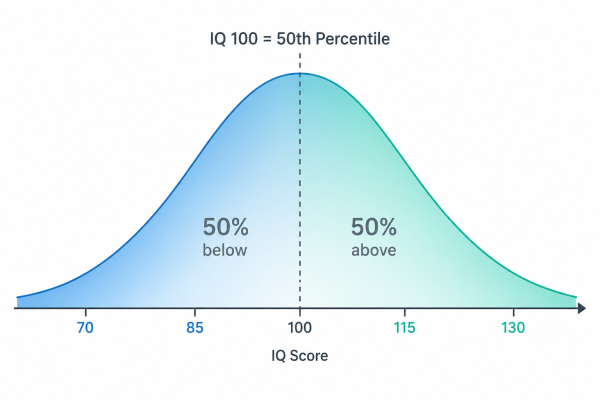
A score of 100 means your cognitive performance on the test placed you at the 50th percentile — right in the middle of the population. Half of all people score above 100, and half score below. This is not a coincidence. IQ tests are specifically designed and periodically recalibrated to maintain this midpoint through a process called norming, where scores are adjusted to match the current population distribution.
In terms of classification, a score of 100 falls squarely within the “Average” range, which spans from 90 to 109 on most scoring systems including the Wechsler Adult Intelligence Scale (WAIS) and Stanford-Binet. This range encompasses roughly 50% of the entire population. For a complete breakdown of how all scores are classified, see the IQ scale explained from low to genius.
IQ 100 Percentile and Population Context
| IQ Score | Percentile | Classification | % of Population |
| 130+ | 98th and above | Very Superior / Gifted | ~2% |
| 120–129 | 91st–97th | Superior | ~7% |
| 110–119 | 75th–90th | High Average | ~16% |
| 90–109 | 25th–74th | Average | ~50% |
| 80–89 | 10th–24th | Low Average | ~16% |
| 70–79 | 3rd–9th | Borderline | ~7% |
| Below 70 | 2nd and below | Extremely Low | ~2% |
Is an IQ of 100 Good?
Whether 100 is “good” depends entirely on your reference point. Compared to the general population, a score of 100 is perfectly normal and sufficient for the vast majority of careers, academic paths, and life goals. The majority of jobs, relationships, and social situations require no more than average cognitive ability to navigate successfully.
However, in highly selective academic environments — elite universities, competitive graduate programs, or highly technical professions — the average candidate tends to score considerably higher than 100. Context matters significantly when evaluating what any IQ score means in practice. For a broader discussion, see what is a good IQ score?
What Can You Do With an IQ of 100?
An IQ of 100 is associated with the ability to handle most standard educational curricula, learn new skills at a normal pace, manage complex everyday tasks independently, and perform competently in a wide range of professional roles. Research on IQ and job performance consistently shows that people with average IQs perform well in roles that involve routine problem-solving, structured procedures, and clear expectations.
The relationship between IQ and career outcomes is nuanced. While higher IQ scores are statistically associated with better performance in cognitively demanding roles, emotional intelligence, work ethic, interpersonal skills, and domain expertise often matter more in practice — particularly in people-facing careers. This is explored in detail in IQ vs EQ and careers for IQ 110–120.

IQ 100 and Academic Performance
In academic settings, an IQ of 100 is generally sufficient for completing a standard secondary school curriculum and entering most undergraduate degree programmes. It is associated with the ability to understand and apply new concepts at a normal pace, though students at this level may need more time or support with highly abstract material compared to peers with higher scores.
It is important not to conflate IQ with academic achievement. Many students with average IQs outperform higher-scoring peers through stronger study habits, motivation, and emotional regulation. The complex relationship between cognitive ability and academic results is examined in IQ vs academic achievement.
How Stable Is an IQ Score of 100?
IQ scores are relatively stable in adulthood, but they are not completely fixed. A person who scores 100 today might score 95 or 105 on a different test taken under different conditions. This variability — typically around 5 points in either direction on a well-administered test — reflects measurement error rather than genuine changes in intelligence.
Factors such as sleep quality, test anxiety, familiarity with the test format, and the testing environment can all influence scores in the short term. These variables are covered in depth in what affects your IQ test results and common mistakes that lower IQ test scores.
Average IQ by Country: Is 100 Still Average Everywhere?
Technically, 100 is the defined average for whichever population a test was normed on — typically Western, English-speaking populations. In practice, measured average IQ varies by country due to differences in education quality, nutrition, healthcare access, and testing methodology. Some countries report national averages above 100, others below.
This means a person scoring 100 on a US-normed test may be above or below the measured average in their own country depending on where they live. For a detailed breakdown, explore our IQ by country database, which covers average scores across regions including the United States, Europe, and Asia.
Average IQ by Age: Does 100 Mean the Same at Every Age?
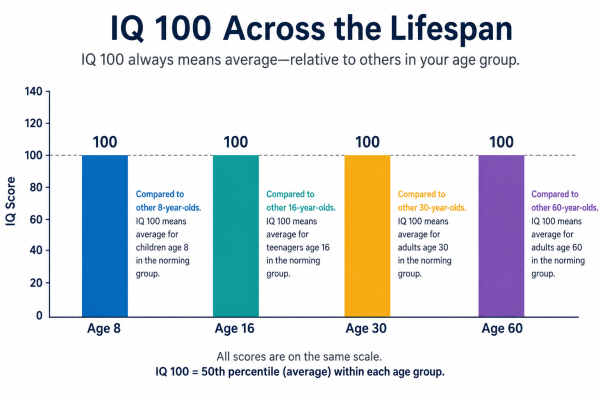
No — and this is one of the most misunderstood aspects of IQ scoring. A child who scores 100 is being compared to other children of the same age, not to adults. As people age, the norming group changes, so “100” always means “average for your age group” rather than average for all humans.
Cognitive abilities also shift naturally across the lifespan. Fluid intelligence — the ability to reason quickly and solve novel problems — tends to peak in young adulthood and gradually declines. Crystallised intelligence — accumulated knowledge and verbal ability — tends to remain stable or even improve into middle age. Both of these trends are explored in average IQ by age.
Can You Increase an IQ of 100?
Core cognitive ability is relatively stable in adults, but test performance can be improved meaningfully through better preparation, sleep, reduced anxiety, and familiarity with question formats. The realistic distinction between improving your score and improving your underlying intelligence is explained clearly in can you improve your IQ test score short-term? and can IQ be improved?
Long-term cognitive development — through education, mentally stimulating work, physical health, and sustained learning — is associated with maintaining and in some cases modestly improving cognitive performance over time. The neuroscience behind this is covered in neuroplasticity of the brain.
Famous People With Average IQ
Many highly successful people throughout history are estimated to have had IQs in or near the average range. Success in business, the arts, politics, and sport depends far more on drive, emotional intelligence, social skill, and accumulated expertise than on raw cognitive ability. An IQ of 100 has never been a barrier to achievement — as illustrated by the research covered in can someone with a low IQ be successful? and succeeding in business with a lower IQ.
IQ 100 vs Nearby Scores
If you scored close to 100 but want to understand how nearby scores compare, the differences between 95, 100, 105, and 110 are smaller than most people assume. All of these scores fall within the Average or High Average range and are associated with broadly similar cognitive profiles in everyday life. The meaningful differences in ability and outcome tend to emerge more clearly at the extremes — below 80 or above 120 — than within the middle band.
Should You Worry About an IQ of 100?
No. An IQ of 100 is exactly where the population is designed to centre. It reflects normal, functional cognitive ability and is not associated with any learning difficulty, developmental concern, or career limitation in the vast majority of contexts. If a score of 100 follows a period of struggling academically or at work, the more productive question is whether other factors — sleep, mental health, motivation, learning environment — are playing a role, rather than treating the score as a ceiling. This perspective is explored in should I worry about my IQ score?
Final Thoughts on IQ 100
A score of 100 is not a consolation prize. It is the mathematical centre of human cognitive ability as measured by IQ tests — the score that, by definition, half the world scores above and half scores below. What matters most is not where your score sits relative to a global average, but how well you understand your own cognitive strengths, manage your limitations, and continue developing throughout life. Explore more in our IQ Scores section and take our free IQ test to find out where you stand today.

Comments
Share Your Thoughts