An IQ of 123 places you at approximately the 93rd percentile — meaning you score higher than about 93 out of every 100 people in the general population. The Wechsler Adult Intelligence Scale classifies this as Superior intelligence. It represents 1.53 standard deviations above the population mean of 100, and roughly 1 in 14 people score at this level or above.
IQ 123 sits comfortably in the middle of the Superior range (IQ 120–129). It is 3 points above where the Superior classification begins (IQ 120), 2 points below IQ 125 (the approximate 95th percentile), 7 points below the conventional gifted threshold (IQ 130), and 9 points below the Mensa eligibility cutoff. It is a genuinely strong score that places a person well above most professional group averages and well above 93% of the general population.
This guide covers what the research says about IQ 123: the population statistics, what it means for professional and academic life, the context effect that changes its meaning depending on environment, and how to think about the thresholds above it.
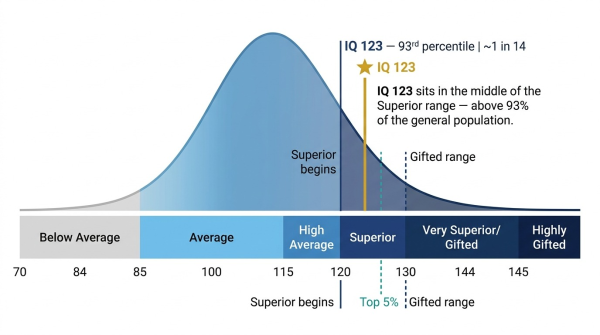
IQ 123 in Numbers: The Core Statistics
| Metric | Value at IQ 123 |
| Standard deviations above mean | 1.53 SD |
| Percentile | ~93rd |
| Frequency in general population | ~1 in 14 |
| In a room of 100 people | ~7 score at or above this level |
| In the United States (~335M) | ~23 million people |
| Wechsler classification | Superior |
| Gap to gifted threshold (IQ 130) | 7 points |
| Gap to Mensa threshold (~IQ 132) | 9 points |
IQ 123 sits between two well-known reference points. IQ 120 (1 in 11) — the professional average for doctors, lawyers, and engineers — is about 28% more common. IQ 125 (1 in 20) — the approximate 95th percentile — is about 43% rarer. The changes in rarity between these scores are genuine but not dramatic — they all occupy the same general zone of the distribution (the upper Superior range), with similar practical cognitive and career implications. For more context, see our IQ scale explained.
What IQ 123 Means in Professional and Academic Life
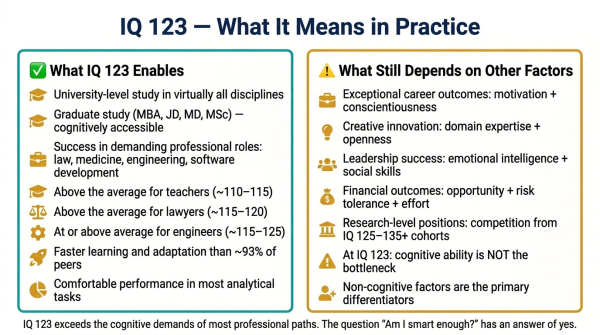
IQ 123 is a cognitively strong score that places a person above the estimated average for most major professional groups. As covered in depth in our IQ 120 guide, the professional cluster point — where doctors, lawyers, and engineers tend to average — sits at approximately IQ 120–125. IQ 123 sits within this cluster:
- Above the estimated average for teachers (~110–115)
- Above the estimated average for lawyers (~115–120)
- At or slightly below the average for general physicians (~120–125) and engineers in research roles (~120–125)
- Below the estimated average for research scientists and surgeons (~125–130)
In practical terms: IQ 123 provides sufficient cognitive access for virtually any professional or academic path. University-level study across all disciplines is well supported. Graduate programmes (MBA, JD, MD, MSc) are cognitively within reach. The most mathematically intensive research-level PhD programmes tend to average above IQ 125–130, but IQ 123 does not represent a hard barrier for advanced study in most fields.
Critically: at IQ 123, the research on the threshold effect makes a consistent and important point. Above approximately IQ 115–120, incremental IQ points explain diminishing variance in most life outcomes. From IQ 123, the question shifts from "am I cognitively capable of this?" — the answer to which is almost always yes — to "am I motivated, focused, and persistent enough to achieve what I want?" — which is where the real differentiators live. For more on this, see our guides on IQ vs EQ and IQ and income.
The Context Effect: IQ 123 in Different Environments
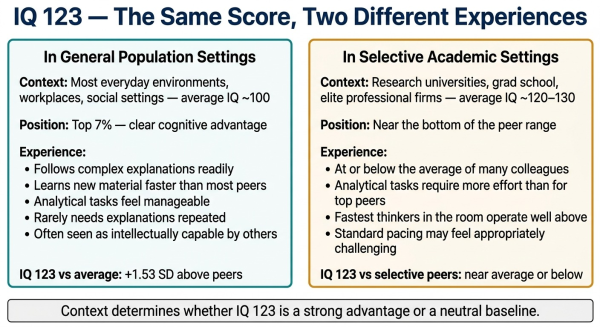
IQ 123's practical significance changes substantially depending on the cognitive level of the surrounding environment — a phenomenon explored for IQ 120 in our IQ 120 guide and valid at every Superior-range score.
In general population settings — most workplaces, most social environments, most communities drawn from the full population distribution — IQ 123 represents a clear and noticeable cognitive advantage. Information is absorbed faster, complex explanations are followed more readily, and analytical tasks that others find challenging feel more manageable. Being in the top 7% of the general population is a genuine and consistent advantage in these contexts.
In selective academic or professional settings — elite universities, competitive research programmes, leading professional firms — IQ 123 may sit near the lower end or even below the average of the participant group. A PhD programme in a highly quantitative field at a research-intensive university may average IQ 125–130 among its entering students. In such environments, the cognitive advantage that IQ 123 provides relative to the general population narrows significantly or reverses.
Neither experience is wrong — both are accurate descriptions of IQ 123's position in different contexts. Understanding the context-dependence of IQ 123 is essential for realistic self-assessment and for choosing environments where cognitive strengths are most effectively deployed.
The Cognitive Profile at IQ 123
At 1.53 standard deviations above the mean, IQ 123 reflects consistently above-average performance across the core cognitive dimensions that IQ tests measure:
Information processing speed. New material is absorbed and integrated faster than approximately 93% of the general population. Standard educational pacing provides less challenge than it does for most people. In professional settings, this manifests as following complex briefings and technical explanations with relative ease on first exposure.
Verbal comprehension and precision. Above-average vocabulary, analytical reading, and written communication accuracy. This reflects the verbal comprehension dimension of the IQ score and supports performance across virtually all professional environments that value written or oral analytical communication.
Abstract and logical reasoning. Multi-step logical problems are approached systematically and with above-average facility. Mathematical structures and conceptual frameworks are navigated more naturally than at lower cognitive levels.
Pattern recognition. Structural similarities across different domains — seeing that a problem in one field resembles a problem in another — are identified more readily. This cross-domain transfer is one of the most practically valuable features of above-average intelligence in complex work environments.
For more on how these specific cognitive strengths relate to measured intelligence, see our guide on what IQ actually measures. For how they compare to the cognitive experience at the gifted range, see our IQ 136 guide.
IQ 123 and the Thresholds Above It
People who score 123 often ask about the thresholds ahead. The honest perspective:
To IQ 125 (top 5%): 2 points. The gap to the 95th percentile is minimal and well within normal test variability. A person who scored 123 on one test might score 125 on another, or on a retest. The practical cognitive difference between IQ 123 and IQ 125 is effectively zero.
To IQ 130 (gifted range): 7 points. This is a meaningful gap — about half a standard deviation — that represents a genuine and reliable cognitive difference. Moving from IQ 123 to IQ 130 is not a retest variability difference. The research shows real differences in performance between these ranges on the most analytically demanding tasks.
To Mensa (~IQ 132): 9 points. A gap of this size is not expected to close through normal measurement error on retesting. Mensa eligibility is not a realistic near-term goal for someone genuinely scoring at IQ 123. The gap between IQ 123 and IQ 132 represents a meaningful difference in cognitive level, not just a scoring quirk. For more on Mensa qualification, see our guide on what is Mensa.
IQ 123 in Context: The Full Comparison
| IQ Score | Percentile | Rarity | Key Note |
| 115 | 84th | 1 in 6 | +1 SD / upper edge of average range |
| 120 | 91st | 1 in 11 | Superior begins / professional average |
| 123 | 93rd | 1 in 14 | IQ 123 — Top 7% |
| 124 | 94th | 1 in 16 | Functionally same as IQ 123 |
| 125 | 95th | 1 in 20 | Top 5% — IHIQS threshold (~) |
| 128 | 97th | 1 in 33 | 4 points from Mensa |
| 130 | 98th | 1 in 44 | Gifted range / Very Superior begins |
| 132 | 98.5th | 1 in 67 | Mensa threshold |
The table shows IQ 123's position clearly: in the middle of the Superior range, in the top 7% of the general population, 7 points below the gifted threshold and 9 points below Mensa. For adjacent score guides, see our pages on IQ 120, IQ 124, and IQ 128. For what comes above, see our guides on IQ 136 and IQ 140.
IQ 123 is at the 93rd percentile — top 7%, 1 in 14 people, well inside the Superior range. It places a person above 93% of the general population on analytical tasks, above the professional average for most major careers, and well within the cognitive range for success across virtually any professional or academic path. The 7-point gap to the gifted range and the 9-point gap to Mensa are both real — neither retest noise nor a simple threshold to step over. What IQ 123 does provide is a genuine cognitive foundation that is, by any research standard, more than sufficient for exceptional outcomes in essentially any domain a person chooses to pursue with sufficient motivation and persistence.
Find out where your own profile sits with our free IQ test — no registration, results in under 20 minutes. For adjacent scores, see our guides on IQ 120, IQ 124, and IQ 128. For the full context, see our IQ scale explained.
Frequently Asked Questions
What does an IQ of 123 mean?
An IQ of 123 is classified as Superior on the Wechsler scale, at approximately the 93rd percentile. It represents 1.53 standard deviations above the population mean of 100, corresponding to roughly 1 in 14 people. It is well above average, above the estimated professional average for most demanding careers, and places a person in the top 7% of the general population.
How rare is an IQ of 123?
IQ 123 corresponds to approximately the 93rd percentile — roughly 1 in 14 people. In a room of 100 randomly selected people, approximately 7 would score at this level or above. In the United States, approximately 23 million people are expected to score at or above IQ 123.
Is IQ 123 considered Superior?
Yes. The Wechsler scale classifies IQ 123 firmly in the Superior range (approximately IQ 120–129). It is above the High Average range (ending at IQ 119) and below the Very Superior / Gifted range (beginning at IQ 130). It reflects genuine above-average cognitive ability across the core dimensions of processing speed, verbal comprehension, logical reasoning, and pattern recognition.
Is IQ 123 good enough for demanding careers?
Yes. IQ 123 exceeds the estimated average IQ for teachers (~110–115), lawyers (~115–120), and general engineers (~115–125), and is at or near the average for physicians (~120–125). At this cognitive level, IQ is unlikely to be a limiting factor in any professional or academic path. Research consistently shows that above IQ 115–120, non-cognitive factors — motivation, conscientiousness, domain expertise, and social skills — are the primary determinants of career outcomes.
What is the difference between IQ 123 and IQ 124?
The 1-point difference is psychometrically meaningless — well within the standard error of measurement (±3–5 points) on any clinical IQ test. Both IQ 123 and IQ 124 reflect the same cognitive level: the 93rd–94th percentile, Superior classification, 7–8 points below the gifted range. For a detailed analysis of this range, see our IQ 124 guide.

Comments
Share Your Thoughts