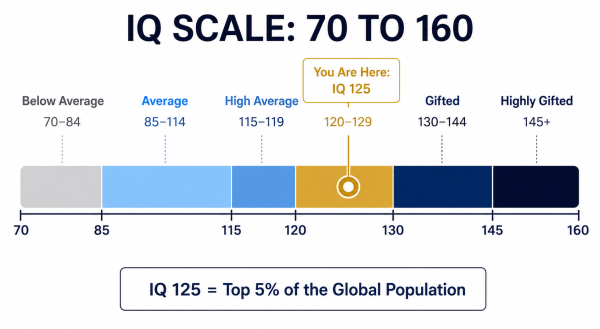
An IQ of 125 places you in the top 5% of the global population — a level of cognitive ability that the Wechsler scale formally classifies as Superior intelligence. If you have recently scored 125 on our free IQ test or a professional assessment, this guide explains exactly what that number means, how rare it is, and what you can realistically do with it.
What Does an IQ of 125 Mean?
On standardised IQ tests such as the Wechsler Adult Intelligence Scale (WAIS) and the Stanford-Binet, scores are distributed along a bell curve with a mean of 100 and a standard deviation of 15. An IQ of 125 sits 1.67 standard deviations above the mean — placing it firmly in what Wechsler classifies as the Superior range (120–129).
In plain terms, a score of 125 reflects:
- Strong fluid intelligence — the ability to reason through new problems without relying on prior knowledge
- Fast learning and retention — concepts that take most people multiple exposures to master are typically absorbed more quickly
- Advanced pattern recognition — spotting logical, numerical, and spatial relationships that others may miss
- Effective working memory — holding and manipulating multiple pieces of information simultaneously
- Verbal reasoning above the 90th percentile — clear, precise communication of complex ideas
What this score does not mean is that success is guaranteed. Research consistently shows that above IQ 120, non-cognitive factors — motivation, emotional regulation, conscientiousness, and social skill — account for an increasing share of real-world outcomes. For a detailed look at this dynamic, see our guide on IQ vs EQ — which matters more?
IQ 125 Percentile: How Rare Is It?
On a standard normal distribution with mean 100 and SD 15, an IQ of 125 corresponds to approximately the 95th percentile. This means:
- You score higher than roughly 95 out of every 100 people
- Approximately 5% of the population scores at or above this level
- In a room of 20 people chosen at random, you would likely have the highest IQ
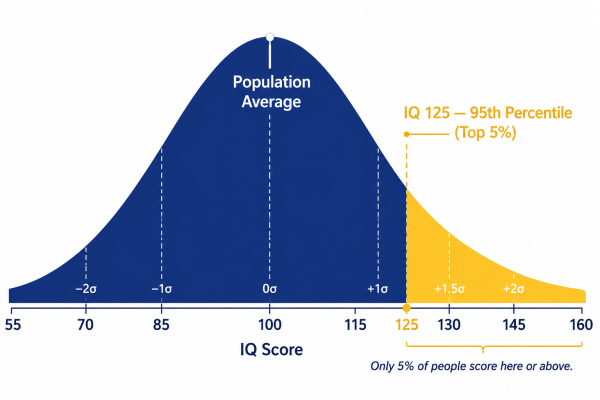
To put this in global context: with a world population of approximately 8 billion, around 400 million people share an IQ at or above 125. That sounds like a large number — but it represents only the upper 5% of human cognitive ability. For comparison, see how this sits relative to IQ 120 and IQ 132 on our IQ scores hub.
Is IQ 125 Considered Gifted?
Technically, no. Most formal definitions of giftedness — including those used by Mensa and educational psychology frameworks — set the threshold at IQ 130 or above (the 98th percentile). At 125, you fall 5 points short of that classification.
However, the practical difference between IQ 125 and IQ 130 is far smaller than the label suggests. Both scores indicate exceptional reasoning ability that the vast majority of people do not possess. The distinction matters primarily in formal contexts such as gifted education programmes or high-IQ society eligibility, not in day-to-day cognitive performance.
| IQ Score | Classification | Percentile | % of Population |
| 115 | High Average | 84th | ~16% |
| 120 | Superior | 91st | ~9% |
| 125 | Superior | 95th | ~5% |
| 130 | Gifted / Very Superior | 98th | ~2% |
| 140 | Highly Gifted | 99.6th | ~0.4% |
For reference on what the next level looks like, see our articles on IQ 126 and IQ 129. If you are curious about what the gifted threshold actually entails, our IQ 132 guide covers that in detail.
Cognitive Strengths Associated With IQ 125
Research on the Wechsler scale consistently shows that scores in the 120–129 range correlate with specific cognitive advantages. People scoring around 125 tend to demonstrate:
Verbal Comprehension
Strong command of language, vocabulary, and abstract concepts. At this level, verbal IQ typically supports nuanced writing, persuasive argumentation, and the ability to communicate complex ideas to non-specialist audiences — a skill valued in law, academia, management, and journalism.
Perceptual Reasoning
Above-average spatial reasoning and visual pattern recognition. This underpins performance in engineering, architecture, surgery, and the visual arts, as well as standardised tests that use matrix reasoning — the same type measured in our international IQ assessment.
Working Memory
The ability to hold, manipulate, and apply information in real time. Working memory at this level allows effective multitasking, rapid comprehension of dense material, and performance under cognitive load — essential in high-stakes professional environments.
Processing Speed
Faster-than-average information processing allows people at IQ 125 to reach conclusions more quickly and adapt to rapidly changing situations. This is especially valuable in fields like finance, emergency medicine, and competitive strategy. To understand how this relates to broader cognitive science, see our guide on cognitive flexibility.
Best Career Paths for IQ 125
Research on IQ and occupational performance — including Linda Gottfredson's influential work on cognitive thresholds — suggests that IQ 125 is well above the minimum cognitive threshold for virtually all professional occupations. The careers where this score provides the most meaningful advantage are those that reward complex reasoning over routine execution.

| Career Field | Why IQ 125 Fits | Average IQ in Field |
| Medicine & Surgery | Pattern recognition, rapid integration of clinical data | ~125–130 |
| Software Engineering | Abstract reasoning, logical system design | ~120–130 |
| Law (Senior/Litigation) | Verbal reasoning, multi-step argument construction | ~120–125 |
| Data Science & Finance | Quantitative reasoning, pattern detection in large datasets | ~120–128 |
| Scientific Research | Hypothesis formation, synthesis of complex literature | ~125–135 |
| Senior Management | Systems thinking, strategic decision-making under uncertainty | ~115–125 |
For a broader exploration of how cognitive ability maps to professional outcomes, see our guides on what jobs require a high IQ and jobs specifically suited to IQ 125.
The Emotional Side: What IQ 125 Feels Like in Practice
A score of 125 sits in a psychologically interesting position. It is high enough that many cognitive tasks feel relatively effortless — but not so far above average that social and professional environments feel consistently under-stimulating in the way that can affect people at IQ 140+.
Common patterns reported by people in the 120–130 range include:
- Rapid boredom in repetitive or unchallenging roles — environments that do not demand cognitive engagement tend to lead to disengagement and underperformance
- Perfectionism and high self-standards — awareness of potential can create pressure to always perform at ceiling level
- Occasional frustration in group settings — the gap between processing speed and that of peers can create impatience or communication friction
- Strong intrinsic motivation when genuinely challenged — complex, open-ended problems tend to produce deep engagement and high performance
These patterns explain why developing emotional intelligence alongside cognitive ability is so important at this level. Our free EQ Test can help you establish a baseline for your emotional intelligence profile, which research consistently shows is a strong independent predictor of leadership success and life satisfaction. For more on the relationship between intelligence and mental health, see our guide on neuroplasticity and cognitive development.
IQ 125 vs Nearby Scores: Key Differences
If your score is close to 125, you may be wondering how meaningful a few points in either direction actually are. Here is a practical comparison:
- IQ 117 — High Average range (87th percentile). Strong cognitive ability but typically requires more effort in highly abstract domains. The gap between 117 and 125 is meaningful in cognitively demanding roles.
- IQ 120 — Lower Superior range (91st percentile). Very close to 125 in practical terms; the difference is statistically real but functionally modest in most environments.
- IQ 125 — Mid Superior range (95th percentile). The sweet spot that sits above most professional cognitive thresholds without the social isolation risks associated with extreme scores.
- IQ 129 — Upper Superior range (97th percentile). One point below the gifted threshold; functionally very similar to 125 in most contexts.
- IQ 132 — Gifted range (98th percentile). Qualifies for Mensa; the cognitive gap relative to 125 is measurable, particularly in abstract reasoning speed.
Can Cognitive Performance Be Improved at IQ 125?
Core IQ — particularly crystallised intelligence — tends to remain relatively stable across adulthood. However, the cognitive performance you can express in practice is meaningfully influenced by lifestyle and deliberate practice. Evidence-based interventions that support cognitive performance include:
- Sleep quality — consistently one of the strongest modifiable predictors of cognitive performance. Chronic sleep restriction measurably impairs working memory and processing speed.
- Aerobic exercise — increases BDNF (brain-derived neurotrophic factor), supporting neuroplasticity and fluid intelligence. See our detailed guide: how exercise affects the brain.
- Deliberate learning of complex skills — learning a second language, a musical instrument, or a new technical domain creates new neural connections that support reasoning and memory.
- Reducing cognitive load — environmental organisation, single-tasking, and structured decision-making free cognitive resources for higher-order thinking.
For a comprehensive look at what the research actually says about improving intelligence, see our guide on can IQ be improved?
How Does IQ 125 Compare to Average IQ by Country?
The meaning of an IQ score also depends somewhat on geographic context. National average IQ estimates vary — countries in East Asia such as Japan, China, and South Korea consistently report national averages of 105–108, while global averages across all regions are closer to 90–95. An IQ of 125 places you well above average in every national context without exception. For more on this, see our analysis of average IQ by country.
Final Verdict: Is IQ 125 Good?
Yes — meaningfully and unambiguously. An IQ of 125 places you in the top 5% of cognitive ability globally, well above the threshold required for success in virtually all professional fields, and just 5 points below the formal gifted classification.
More importantly, it is a score range associated with genuine intellectual versatility — the ability to learn quickly, reason abstractly, and perform well across a wide range of cognitively demanding tasks. The careers, educational paths, and intellectual pursuits available to someone scoring 125 are broad and largely unconstrained by cognitive ceiling effects.
IQ 125 is not the ceiling — it is a strong foundation. What you build on it depends on curiosity, discipline, and how deliberately you develop the non-cognitive skills that convert intelligence into impact.
Ready to verify or benchmark your own score? Take our free International Standard IQ Test — no registration required, results in under 20 minutes.
Frequently Asked Questions
Is an IQ of 125 good?
Yes. An IQ of 125 is well above average and places you in the top 5% of the population. It is classified as Superior intelligence on the Wechsler scale and indicates strong analytical, verbal, and reasoning ability.
What percentile is IQ 125?
An IQ of 125 corresponds to approximately the 95th percentile, meaning you score higher than about 95 out of every 100 people.
Is IQ 125 considered gifted?
Not technically. Most definitions of giftedness begin at IQ 130. However, IQ 125 is classified as Superior intelligence and sits just 5 points below the gifted threshold — placing it well above 95% of the population. See our guide on IQ 132 for what the gifted range looks like in practice.
What jobs are best for someone with IQ 125?
IQ 125 aligns well with careers in engineering, medicine, law, data science, research, finance, and senior management — roles that reward strong analytical thinking and complex problem-solving. See our full guide on jobs for IQ 125.
Can IQ 125 be improved?
While core IQ is largely stable, cognitive performance can improve through deliberate practice, learning new skills, physical exercise, quality sleep, and reducing cognitive load. Neuroplasticity research supports meaningful gains in fluid intelligence — see our guide on can IQ be improved?
How does IQ 125 compare to IQ 120 or IQ 130?
IQ 120 sits at the 91st percentile (High Average/Superior boundary), while IQ 125 is at the 95th percentile (Superior), and IQ 130 is at the 98th percentile (Gifted). The practical cognitive differences between these scores are real but modest in most professional contexts.

Comments
Share Your Thoughts