Marilyn vos Savant is the only person to have held the Guinness World Record for the highest IQ ever recorded — a score of 228, listed in the Guinness Book of World Records from 1985 to 1989. When Guinness retired the category in 1990, she became not just the record holder but the permanent last holder, frozen at the peak of a competition that was officially declared unmeasurable.
But her story is far more interesting than a number. The same intelligence that earned her the world record was later deployed in one of the most extraordinary intellectual episodes of the 20th century — a probability puzzle that pitted her against thousands of mathematicians and PhDs, all of whom were wrong, and all of whom eventually had to admit it. This article examines what vos Savant's score actually means, why it is contested, and how she proved her intelligence in the most public way imaginable.
What Is Marilyn vos Savant's IQ?
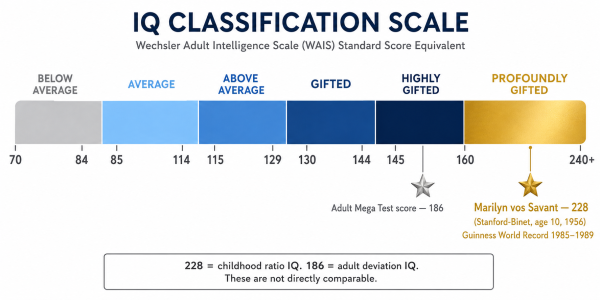
Marilyn vos Savant's most famous IQ figure is 228, derived from the 1937 Stanford-Binet Second Revision test taken when she was approximately 10 years old in September 1956. The test measured her mental age at 22 years and 10 months — the ceiling of that test version. Using the ratio IQ formula (mental age divided by chronological age, multiplied by 100), a mental age of 22.83 divided by a chronological age of approximately 10 yields a score of 228.
This figure was listed in the Guinness Book of World Records from 1985 to 1989, making vos Savant the first and only person ever officially recognised as the highest IQ holder by Guinness. In 1990, Guinness retired the Highest IQ category entirely, citing the impossibility of reliably comparing scores across different tests and eras.
Her second documented score comes from the Mega Test — a high-range intelligence test designed by Ronald K. Hoeflin, taken in the mid-1980s as an adult. She scored 46 out of 48 correct answers, producing a deviation IQ of approximately 186 using a z-score of 5.4 and a standard deviation of 16.
For context on what these extreme scores mean in population terms, see our guide on the highest IQ of all time and our IQ 160 guide.
The Science Behind the Score — and Why 228 Is Contested
The 228 figure has been disputed by psychometricians since it was first published, and the critique is substantive rather than merely envious.
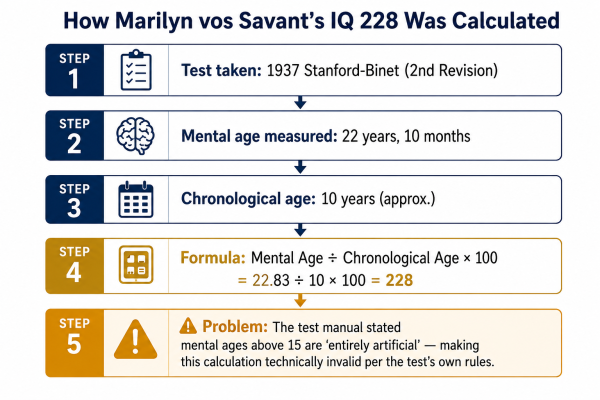
The core problem is the ratio IQ formula itself. The 1937 Stanford-Binet manual — the very test used to produce vos Savant's score — explicitly stated that "beyond fifteen the mental ages are entirely artificial and are to be thought of as simply numerical scores." In other words, the test's own authors acknowledged that the ratio formula breaks down for subjects whose mental age exceeds 15 years.
Vos Savant's mental age was assessed at 22 years and 10 months. Dividing this by a chronological age of approximately 10 and multiplying by 100 produces 228 — but the test explicitly said its mental age assessments above 15 are not meaningful for ratio calculations. Alan S. Kaufman, a leading IQ test developer and author of IQ Testing 101, wrote that the psychologist who produced the 228 figure "committed an extrapolation of a misconception, thereby violating almost every rule imaginable concerning the meaning of IQs."
Furthermore, the 1937 Stanford-Binet manual's own norms did not permit IQ scores above 170 at any age. The score of 228 was produced by extrapolating beyond the test's own designed range.
There is also a disputed question about the precise date she took the test. School records reportedly show the test was taken in March 1957, while vos Savant has consistently stated September 1956. This discrepancy — approximately six months in her chronological age, the denominator in the formula — would materially alter the calculated score.
Her adult Mega Test score of 186 is generally considered more methodologically defensible, though the Mega Test is itself a non-standardised high-range assessment not equivalent to clinical tools like the WAIS. The honest summary: her cognitive ability is extraordinary and well above any meaningful assessment ceiling. The precise number 228 is a product of an outdated formula applied beyond its validated range. For a full explanation of why scores above 160 are difficult to verify, see our guide on the IQ scale explained.
Two Scores, One Remarkable Mind
| Test | Score | Method | Age | Reliability |
| 1937 Stanford-Binet | 228 | Ratio IQ (MA ÷ CA × 100) | 10 years | ⚠️ Contested — formula invalid above mental age 15 |
| Mega Test (Hoeflin) | 186 | Deviation IQ (z-score 5.4, SD 16) | ~40 years | ✅ More defensible — adult score |
The 40-point gap between 228 and 186 is itself instructive. It is not that vos Savant became less intelligent between childhood and adulthood — it is that the two numbers measure different things using different methods. The 228 is a ratio score extrapolated beyond its validated range; the 186 is a deviation score from a high-range instrument. They cannot be directly compared, and neither can be produced by any modern clinical assessment. Both, however, indicate cognitive ability far beyond anything a standard adult IQ test can reliably measure.
Early Life: A Prodigy Hidden from Public Attention
Born Marilyn Mach on 11 August 1946 in St. Louis, Missouri, to parents of Italian and German descent, vos Savant displayed exceptional ability from early childhood. She skipped first grade and graduated high school at age 14. By age 10, she had memorised numerous books and read the entire Encyclopædia Britannica. Her parents were aware of her exceptional IQ scores but deliberately withheld the information from the public to protect her from commercial exploitation and ensure a normal childhood.
She earned a bachelor's degree in philosophy from Washington University in St. Louis in 1968, studying a discipline that — unlike most academic subjects — rewards exactly the kind of logical precision and argument structure that characterises her public intellectual work. She later worked as a teacher before transitioning into writing, which brought her to the attention of Parade magazine and ultimately to global recognition.
Ask Marilyn — Building an Intellectual Platform
In 1986, Marilyn vos Savant began writing "Ask Marilyn," a weekly column in Parade magazine — the Sunday supplement inserted into newspapers across the United States with a combined circulation in the tens of millions. The column invited readers to submit logic puzzles, mathematical problems, and intellectual questions for her to answer.
The column ran until 2022 — a 36-year run that made her one of the most consistently read public intellectuals in American history. She also developed the Numbrix number puzzle series for Parade, which continued to run after her column ended. Her books — including Ask Marilyn (1992), The Power of Logical Thinking (1996), and several others — brought her reasoning to a wider audience.
What is remarkable about the Ask Marilyn enterprise is not just its longevity but its function. Vos Savant effectively spent 36 years demonstrating that clear, rigorous logical thinking could be communicated to a general audience and applied to real problems — that intelligence is most valuable not as an abstract score but as a practical tool for clear reasoning. For more on this relationship between IQ and real-world problem-solving, see our guide on IQ vs problem-solving.
The Monty Hall Problem: The Battle That Proved Her Genius
In September 1990, a reader named Craig F. Whitaker wrote to Ask Marilyn with the following question, based on the television game show Let's Make a Deal:
Suppose you're on a game show, and you're given the choice of three doors. Behind one door is a car; behind the others, goats. You pick a door — say No. 1 — and the host, who knows what's behind all the doors, opens another door, say No. 3, which has a goat. He then says to you: "Do you want to pick door No. 2?" Is it to your advantage to switch your choice?
Vos Savant's answer was: yes, you should switch. The door you originally chose has a 1/3 chance of hiding the car. The other remaining door now has a 2/3 chance. Switching doubles your probability of winning.
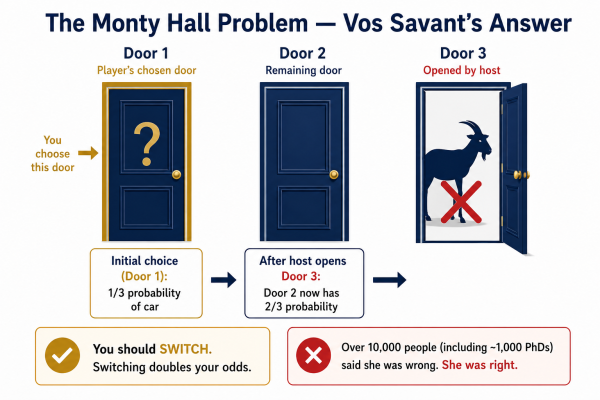
What followed was one of the most remarkable intellectual events of the 20th century. She received more than 10,000 letters, the overwhelming majority disagreeing with her answer. Of these, approximately 1,000 carried PhD signatures, many on university department letterheads. A mathematics professor from Florida State wrote: "You blew it!" A PhD wrote: "You are the goat!" Another declared: "If all these PhDs are wrong, the country would be in serious trouble."
One particularly revealing letter came from a professor at an American university: "You are utterly incorrect about the game show question, and I hope this controversy will call some public attention to the serious national crisis in mathematical education. If you can admit your error, you will have contributed constructively towards the solution of a deplorable situation. How many irate mathematicians are needed to get you to change your mind?"
She did not change her mind. She was right. Vos Savant's answer was later confirmed by independent mathematical analysis, by computer simulations, and by classroom experiments conducted by hundreds of teachers across the country. The problem is now a standard example in probability theory textbooks, and her solution is universally accepted as correct.
The episode is instructive beyond its mathematical content. It demonstrated something important about intelligence, authority, and the courage to hold a correct position against overwhelming institutional opposition. The 1,000 PhDs who wrote to correct her were not unintelligent — they were subject to the same cognitive bias (the failure to account for the host's knowledge when updating probabilities) that makes the problem difficult for everyone including experts. Her ability to reason through it correctly, communicate it clearly, and maintain it under extraordinary pressure is a demonstration of the kind of applied intelligence that no IQ test directly measures.
How Vos Savant Compares to Other High-IQ Figures
| Person | IQ Score | Method | Key Achievement |
| Marilyn vos Savant | 228 (child) / 186 (adult) | Stanford-Binet / Mega Test | Guinness record; Monty Hall; 36 years Ask Marilyn |
| Terence Tao | 225–230 | Childhood Stanford-Binet | Fields Medal; 300+ papers; Green-Tao theorem |
| William James Sidis | 250–300 (disputed) | Biographer estimate, no test | Harvard at 11; no major verified work |
| Albert Einstein | ~160 | Retroactive estimate | Nobel Prize; Theory of Relativity |
| Bill Gates | ~157–160 | SAT-based estimate | Microsoft; Fulbright-equivalent academic record |
The comparison with Terence Tao is particularly interesting. Both have childhood ratio IQ scores in a similar range. Tao's subsequent output — the Fields Medal, 300+ research papers — provides the kind of independent verification that makes his cognitive ability effectively undeniable. Vos Savant's equivalent is less dramatic by academic standards but no less impressive in its own way: 36 years of weekly public intellectual engagement, culminating in one of the most famous correct-against-the-experts moments in the history of probability theory.
What Marilyn vos Savant's Story Teaches Us About Intelligence
There are three genuinely important lessons in vos Savant's intellectual biography:
1. The number is not the intelligence
The 228 figure is methodologically contested and, by the standards of the test that produced it, technically invalid. What is not contested is her ability to reason precisely under public pressure, communicate complex logical ideas to non-specialist audiences, and maintain correct positions against expert opposition. That capacity cannot be captured in any IQ score. For more on this distinction, see our guide on IQ vs critical thinking.
2. The Monty Hall episode is a lesson in cognitive humility for everyone
The fact that nearly 1,000 PhD holders were wrong and a magazine columnist was right is not primarily a story about her intelligence. It is a story about how even expert credentials do not immunise against cognitive bias — and how the clearest thinker in the room is not always the one with the most impressive title. For more on this relationship between IQ and emotional intelligence, see our guide on IQ vs EQ.
3. Applying intelligence to communication is itself a form of genius
Vos Savant spent 36 years translating abstract logical and mathematical problems into language accessible to millions of general readers. This is a cognitive skill — the ability to model another person's knowledge state and construct an explanation that bridges the gap between your understanding and theirs — that is genuinely difficult and genuinely rare, regardless of the score on any test.
Marilyn vos Savant's IQ of 228 is the only score ever officially listed in the Guinness World Records — and it is technically contested. What is not contested is the moment she correctly solved a probability problem that stumped a thousand PhDs, refused to back down, and turned out to be right. That is what genius actually looks like in practice.
Curious where your own score sits? Take our free IQ test — no registration required, results in under 20 minutes. Explore our full Celebrity IQ database or see how vos Savant's score compares to others in our guide on the highest IQ of all time.
Frequently Asked Questions
What is Marilyn vos Savant's IQ?
Marilyn vos Savant's IQ is 228 — the highest ever officially listed in the Guinness World Records, where she appeared from 1985 to 1989. The score was derived from the 1937 Stanford-Binet test taken at age 10, using the ratio IQ formula. Her adult Mega Test score was 186. Guinness retired the Highest IQ category in 1990.
Is Marilyn vos Savant's IQ of 228 accurate?
The 228 figure is contested by psychometricians. It was produced using the obsolete ratio IQ formula on a child, and the 1937 Stanford-Binet manual itself stated that mental ages above 15 are "entirely artificial." IQ testing expert Alan S. Kaufman wrote that the psychologist who calculated 228 "violated almost every rule imaginable concerning the meaning of IQs." Her more reliable adult Mega Test score was 186.
What is the Monty Hall problem?
The Monty Hall problem is a probability puzzle: given three doors (one with a car, two with goats), after picking one and having another revealed as a goat, should you switch? Vos Savant correctly answered "yes" in her 1990 Ask Marilyn column — you double your odds by switching. Over 10,000 readers disagreed, including nearly 1,000 with PhDs. She was right. The problem is now a standard example in probability theory textbooks.
What did Marilyn vos Savant do with her intelligence?
Vos Savant wrote the Ask Marilyn column in Parade magazine from 1986 to 2022 — 36 years answering logic puzzles and reader questions for tens of millions of weekly readers. She authored multiple books, correctly solved the Monty Hall problem against widespread expert opposition, and developed the Numbrix puzzle series for Parade.
Why did Guinness stop listing highest IQ?
Guinness World Records retired the Highest IQ category in 1990, explicitly citing the unreliability of IQ tests across different eras and methodologies. Modern standardised tests ceiling at approximately 160 for adults, making extreme scores like 228 psychometrically problematic. For more detail, see our guide on the highest IQ of all time.

Comments
Share Your Thoughts