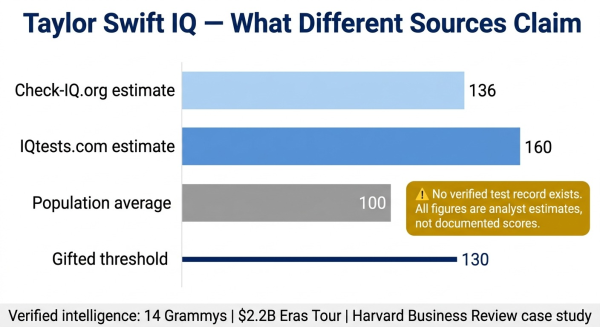
Taylor Swift's IQ has no verified public figure. The numbers circulating online — 136, 160, even higher — are analyst estimates and internet speculation, not documented test scores. She has never publicly disclosed the result of a standardised IQ assessment, and no credible source claims otherwise.
But here is what is documented: 14 Grammy Awards. 11 original studio albums spanning five genres. The highest-grossing concert tour in history at $2.2 billion. A re-recording strategy that Harvard Business Review called one of the most effective brand moves in modern music. An estimated net worth of $1.6 billion. An honorary doctorate from NYU.
The question of Taylor Swift's IQ is interesting precisely because the conventional answer — we don't know — is less interesting than what her actual record of achievement tells us about intelligence that IQ tests can and cannot capture. This article examines both.
What Is Taylor Swift's IQ? The Honest Answer
The most widely cited estimates place Taylor Swift's IQ somewhere between 136 and 160. The lower figure (136) corresponds to approximately the 99th percentile — gifted range on the Wechsler scale. The higher figure (160) would place her in the profoundly gifted range alongside estimates for Bill Gates and Albert Einstein.
Neither figure is based on documented evidence. Chief Scientist Dr Russell T. Warne, writing for RiotIQ, described the viral "160" claim as "pure internet myth" — noting that like most celebrity IQ estimates, it circulates endlessly on social media and clickbait websites without factual basis.
The honest position: Taylor Swift's IQ is unknown. What is known — and what is more interesting — is a body of documented achievement that provides its own evidence about the kind and level of intelligence she possesses. Understanding the difference between these two things matters for understanding what IQ actually measures and what it does not. For a full explanation, see our guide on IQ vs EQ — which matters more?
Five Types of Intelligence Taylor Swift Has Demonstrably Shown
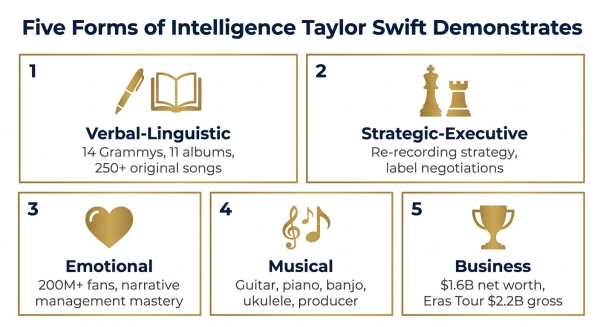
Howard Gardner's theory of multiple intelligences — which our guide on multiple intelligences covers in detail — proposes that human cognitive ability spans multiple domains that conventional IQ tests measure only partially. Taylor Swift's documented record provides strong evidence across at least five:
1. Verbal-Linguistic Intelligence
Songwriting at the level Swift operates requires exceptional verbal ability. She has written or co-written virtually every song in her catalog — more than 250 original compositions across 11 studio albums spanning country, pop, indie folk, and alternative. Her lyrics demonstrate advanced narrative architecture: the ability to construct emotionally coherent stories with specific imagery, structural variation, and consistent internal logic across 3–4 minute formats. She has won Grammy Awards for Album of the Year four times — more than any other artist in the award's history. Her verbal intelligence is not incidental to her success; it is the foundation of it.
2. Musical Intelligence
Swift plays guitar, piano, banjo, ukulele, and electric guitar — all self-taught or learned during childhood and adolescence. She has served as a producer and arranger on multiple albums, most extensively on Folklore and Evermore (2020), which she co-produced with Aaron Dessner and Jack Antonoff. Musical intelligence — the ability to perceive, create, and think in musical patterns — is one of the most well-evidenced forms of above-average cognitive ability in the developmental psychology literature. It is strongly correlated with verbal and mathematical reasoning in children and adolescents.
3. Strategic-Executive Intelligence
The re-recording strategy is the clearest single demonstration of strategic intelligence in Swift's career. When Scooter Braun's Ithaca Holdings acquired Big Machine Records in 2019 and with it the master recordings of her first six albums, Swift's response was not legal action or public complaint alone — it was a multi-year strategic operation. She re-recorded each album under her own copyright, creating "Taylor's Version" master recordings. The strategy simultaneously reclaimed her creative legacy, diminished the commercial value of the originals she did not own, generated new revenue streams through re-release campaigns, drew enormous fan support, and established a legal and cultural precedent that changed how the music industry discusses artist ownership. Harvard Business Review later published a full case study calling it one of the most effective brand strategy moves in modern music. This is not instinct. This is sophisticated multi-step strategic thinking over a five-year horizon.
4. Emotional Intelligence
Taylor Swift's relationship with her fanbase — the Swifties — is one of the most studied phenomena in contemporary music marketing. She has spent 20 years building and maintaining a parasocial relationship of extraordinary depth and durability, based on perceived authenticity, consistent narrative coherence, deliberate personal disclosure, and a fan engagement strategy involving Easter eggs, coded messages, and platform-native communication that treats her audience as co-participants in her creative world. This requires the kind of social and emotional intelligence that maps closely onto what researchers measure as EQ — the ability to perceive, understand, and strategically manage emotional information in self and others. Take our free EQ test to assess your own emotional intelligence profile.
5. Business Intelligence
Beyond the re-recording strategy, Swift has demonstrated consistent business acumen across multiple dimensions: negotiating a departure from Spotify in 2014 over streaming royalties (and forcing Apple Music to change its policy within days of a public open letter), signing with Universal Music Group in a reported deal that gave her ownership of all future masters, executing the Eras Tour across 149 shows in 21 countries over two years for a $2.2 billion gross that shattered every previous touring record in history, and managing a concert film that earned $96 million in its opening weekend — the highest-grossing concert film domestic opening in history.
The Re-Recording Strategy: A Case Study in Strategic Intelligence
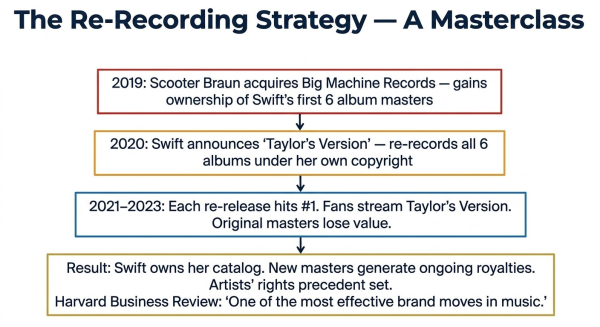
The re-recording strategy deserves closer examination as evidence of intelligence because it demonstrates the specific kind of multi-variable, long-horizon strategic thinking that correlates most strongly with high IQ in real-world contexts.
The legal foundation was precise: Swift owned the composition copyright to her songs (the music and lyrics) but not the master recordings (the specific recorded performances). Her contract with Big Machine Records permitted re-recording after a specified period — typically three years after the contract ended. She left Big Machine in 2018. This meant she could legally begin re-recording in 2021.
The strategic execution was layered. Each "Taylor's Version" album was not simply a re-recording — it was a full brand campaign. Releases were timed to coincide with the Eras Tour, creating a flywheel effect where tour momentum drove album interest and album releases drove tour excitement. Each release included "From the Vault" tracks — previously unreleased songs from the original recording era — that gave even existing fans new material to discover. The marketing strategy treated Swifties as a distributed intelligence network, seeding Easter eggs and coded clues across social media that fans decoded and shared, effectively turning the fanbase into unpaid marketing infrastructure.
The outcome: Fearless (Taylor's Version) debuted at number one. Red (Taylor's Version) debuted at number one. Each subsequent re-release was a cultural event. The originals, which Swift did not own, lost cultural relevance and streaming market share to the versions she did. The strategy achieved simultaneously: moral authority (fighting for artists' rights), commercial success (re-releases all charting at #1), legal precedent (establishing a model other artists could follow), and financial gain (new master recordings generating ongoing royalties she will receive for the rest of her life).
For more on how strategic thinking connects to IQ, see our guide on IQ vs problem-solving ability.
What Does Taylor Swift's Intelligence Profile Actually Look Like?
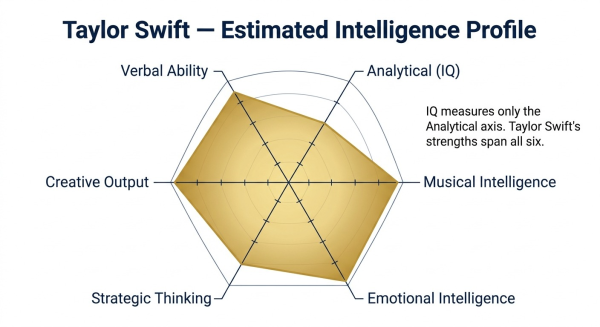
The reason the IQ question is both interesting and ultimately insufficient for understanding Taylor Swift's cognitive profile is that IQ tests are designed to measure a specific set of cognitive abilities — primarily abstract reasoning, verbal comprehension, working memory, and processing speed — that represent only a subset of the intelligence relevant to her achievements.
| Intelligence Domain | IQ Test Measures It? | Swift's Evidence |
| Abstract reasoning | ✅ Yes — core component | No direct evidence (no test) |
| Verbal comprehension | ✅ Yes — core component | Strong — 250+ original songs, 14 Grammys |
| Emotional intelligence | ❌ Not measured | Exceptional — 200M+ engaged fanbase |
| Musical intelligence | ❌ Not measured | Strong — multi-instrument, producer, arranger |
| Strategic thinking | 🟡 Partially | Exceptional — Harvard Business Review case study |
| Business acumen | ❌ Not measured | $1.6B net worth, $2.2B tour |
This profile suggests a person whose intelligence is heavily weighted toward the domains IQ tests do not measure well — emotional intelligence, musical intelligence, and strategic-executive ability — while also possessing above-average verbal intelligence that is evidenced through her songwriting. Whether her abstract reasoning IQ would test at 136, 160, or some other figure is genuinely unknown and, for understanding her actual intelligence, genuinely less interesting than the documented achievement record.
Taylor Swift vs Other Celebrity Geniuses — A Different Kind of Comparison
Most celebrity IQ articles make comparisons based on scores. Taylor Swift's case is unusual because the score is unknown — which makes the comparison more instructive than most.
| Person | IQ Evidence | Intelligence Domain Strength |
| Terence Tao | 225–230 (childhood ratio) | Abstract mathematical reasoning |
| Bill Gates | ~157–160 (SAT-based) | Systems thinking, analytical |
| Rowan Atkinson | ~178 (academic proxy) | Analytical + spatial comedy design |
| Warren Buffett | ~145–150 (various estimates) | Analytical + EQ + long-term strategy |
| Taylor Swift | Unknown — est. 136–160 | Verbal + Emotional + Strategic + Musical |
What this comparison reveals is that Swift's intelligence profile most closely resembles Warren Buffett's in one important respect: both have achieved extraordinary outcomes through a combination of analytical ability, emotional intelligence, and long-term strategic thinking that goes well beyond what any single IQ score would predict. For more on this kind of profile, see our guide on does higher IQ lead to higher income?
The NYU Commencement Address — Verbal Intelligence on Display
In May 2022, New York University awarded Taylor Swift an honorary Doctor of Fine Arts and invited her to deliver the commencement address. The speech — which she wrote herself — was widely praised for its clarity, warmth, and structural sophistication. It demonstrated exactly the kind of verbal intelligence that IQ tests do measure: precise word choice, coherent argument structure, emotional calibration for a specific audience, and the ability to deliver complex ideas accessibly without sacrificing depth.
One line from the address circulated widely: "I'm not going to stand here and tell you it's going to be okay. I'm going to instead offer you a completely different idea. I want to tell you that not knowing is the beginning of everything." This is not the language of someone with average verbal intelligence. It is the language of someone who thinks carefully about words and their relationship to meaning — precisely the cognitive operation that high verbal IQ tests measure.
What Taylor Swift's Story Teaches Us About Intelligence
The Taylor Swift IQ question is ultimately most interesting as a case study in the limits of the IQ concept itself. Her documented achievements — the Grammy record, the $2.2 billion tour, the Harvard case study, the 250+ original songs, the re-recording strategy — are the product of a cognitive profile that conventional IQ tests are not designed to capture in its entirety.
This is not a criticism of IQ tests, which measure what they measure reliably and with strong predictive validity for many outcomes. It is an observation that the kinds of intelligence most relevant to the kind of success Taylor Swift has achieved — verbal creativity, emotional attunement, long-term strategic planning, musical pattern recognition — are distributed across multiple domains that a single score cannot summarise.
Taylor Swift's IQ is unknown. Her intelligence is not. The most honest answer to "how smart is Taylor Swift?" is: smart enough to re-record six albums in two years, gross $2.2 billion on a single tour, win Grammy Album of the Year four times, and get studied at Harvard Business School — all before age 35. Whether that corresponds to IQ 136 or 160 is less interesting than the achievement itself.
Curious how your own cognitive profile compares? Take our free IQ test — no registration, results in under 20 minutes. For a broader view of celebrity intelligence, visit our Celebrity IQ database or explore our guide on Howard Gardner's multiple intelligences.
Frequently Asked Questions
What is Taylor Swift's IQ?
Taylor Swift's IQ has no verified public score. Estimates online range from 136 to 160, but none are based on documented standardised testing. The most honest answer: her IQ is unknown. What is documented is exceptional verbal ability, strategic intelligence, and emotional intelligence evidenced by 14 Grammy Awards, a $2.2 billion Eras Tour, and a re-recording strategy studied at Harvard Business School.
Is Taylor Swift a genius?
By conventional IQ-based definitions (typically IQ 140+), there is no evidence to confirm this — no verified score exists. By broader definitions — extraordinary creative output, strategic brilliance, and sustained reinvention — she has a strong case. Harvard Business Review called her re-recording strategy "one of the most effective brand moves in modern music."
What type of intelligence does Taylor Swift demonstrate?
Taylor Swift demonstrates strong evidence across five intelligence domains: verbal-linguistic (14 Grammys, 250+ original songs), musical (multi-instrument, producer), strategic-executive (re-recording strategy, Harvard case study), emotional (200M+ fanbase engagement), and business ($1.6B net worth, highest-grossing tour in history).
What was Taylor Swift's re-recording strategy?
When Scooter Braun's company acquired her former label's master recordings in 2019, Swift announced she would re-record all six affected albums as "Taylor's Version" under her own copyright. The strategy reclaimed her creative legacy, diminished the value of masters she did not own, generated new revenue, drew massive fan support, and established a precedent that changed music industry discussions about artist ownership. Harvard Business Review analysed it as a masterclass in brand strategy.
Does Taylor Swift have a university degree?
Taylor Swift does not hold a traditional university degree. She attended Hendersonville High School in Tennessee before relocating to New York for her career. In May 2022, New York University awarded her an honorary Doctor of Fine Arts, at which ceremony she delivered the commencement address.

Comments
Share Your Thoughts