An IQ of 131 sits at approximately the 98.1st percentile — meaning you score higher than about 98 out of every 100 people in the general population. The Wechsler Adult Intelligence Scale classifies this as Very Superior. It represents 2.07 standard deviations above the population mean of 100. Roughly 1 in 53 people score at this level or above.
IQ 131 occupies one of the most precisely situated positions in the entire gifted range discussion. It is exactly 1 point above the conventional gifted threshold of IQ 130 — solidly inside the gifted range. And it is exactly 1 point below the approximate Mensa eligibility threshold of IQ 132. It sits in the narrowest possible corridor between two of the most commonly discussed thresholds in the IQ score landscape.
This article covers what the research says about IQ 131: the population statistics, the honest picture of where it sits relative to the gifted and Mensa thresholds, the cognitive profile at the gifted entry point, and what matters alongside any IQ score at this level.
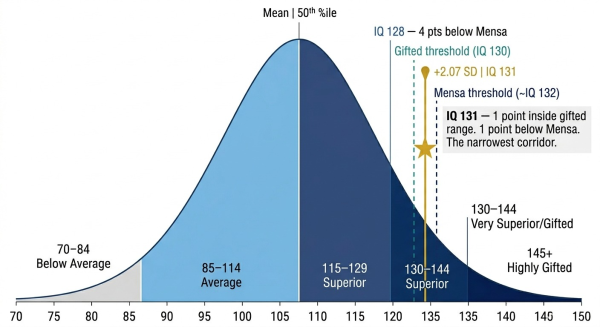
IQ 131 in Numbers: The Core Statistics
| Metric | Value at IQ 131 |
| Standard deviations above mean | 2.07 SD |
| Percentile | ~98.1st |
| Frequency in general population | ~1 in 53 |
| In a room of 100 people | ~2 score at or above this level |
| In a city of 1 million | ~19,000 people |
| In the United States (~335M) | ~6.3 million people |
| Wechsler classification | Very Superior |
| Gap above gifted threshold (IQ 130) | 1 point |
| Gap below Mensa threshold (~IQ 132) | 1 point |
IQ 131's neighbours in the distribution help establish its position. IQ 128 (1 in 33) is about 60% more common. IQ 130 (1 in 44) is about 20% more common. IQ 132 (1 in 67) is about 26% rarer. IQ 136 (1 in 122) is about 2.3 times rarer. The gifted range (IQ 130+) spans a wide segment of the upper distribution tail, and IQ 131 is right at its beginning. For the full distributional context, see our IQ scale explained.
The 1-Point Corridor: IQ 131 Between Two Thresholds
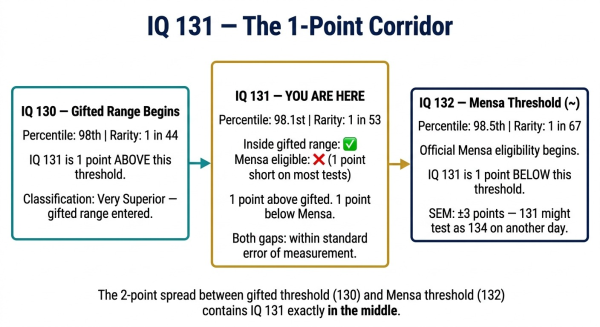
IQ 131 is defined by its position relative to two thresholds — one below it and one above it — both separated from it by 1 point:
IQ 130: The Gifted Threshold — Cleared
The conventional gifted threshold — the lower boundary of what most educational frameworks call "gifted" — is IQ 130. IQ 131 sits 1 point above this, placing it solidly inside the gifted range from its first score. The cognitive profile associated with the gifted range — faster processing, stronger abstract reasoning, tendency toward depth over breadth, context-dependent peer experience — applies at IQ 131, though at the less extreme end of this range. The gifted threshold is explored in detail in our IQ 140 guide.
IQ 132: The Mensa Threshold — Not Yet Cleared
Mensa International requires scores at or above the 98th percentile — approximately IQ 130–132 on the WAIS-IV. The precise threshold varies slightly by test and norming version, but approximately IQ 132 is most commonly cited. IQ 131 at the 98.1st percentile falls just below this — technically not Mensa-eligible by the most commonly applied threshold.
The standard error of measurement (SEM) on the WAIS-IV is approximately ±3 points at the 95% confidence interval. A person scoring 131 on one testing occasion carries a confidence interval of approximately 127–135 — which includes IQ 132. This means Mensa eligibility is not ruled out by a score of 131; it is simply uncertain. The most reliable pathway for anyone interested in Mensa membership who scores near this range is to sit an official Mensa supervised qualifying test, which will produce an independent score. A retest might produce 132 or above; it might not. For more on Mensa qualification, see our guide on what is Mensa.
The 2-Point Corridor
IQ 131 sits precisely in the 2-point corridor between the gifted threshold (IQ 130) and the Mensa threshold (IQ 132). This is a genuinely unusual position: it is the only integer that simultaneously clears the gifted threshold and falls short of the Mensa threshold while being just 1 point from each. As explored in our IQ 133 guide (the mirror case — 1 point above Mensa), these 1-point gaps near key thresholds are consistently within normal measurement variability and should not be overinterpreted in either direction.
The Cognitive Profile at the Gifted Entry Point
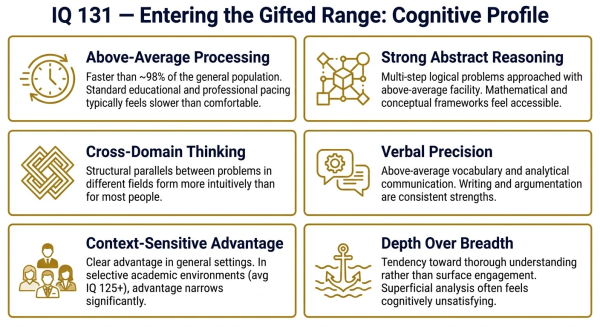
IQ 131 places a person at the entry point of the gifted range, producing a cognitive profile that is meaningfully different from the Superior range (IQ 120–129):
Processing speed above 98% of peers. At 2.07 standard deviations above the mean, information is absorbed significantly faster than almost all people in everyday environments. Standard educational and professional pacing — designed for the median cognitive level — typically feels slower than comfortable. Complex explanations and technical content follow on first exposure without the effort that most people experience.
Strong abstract reasoning. Multi-step logical and mathematical problems are approached with above-average ease. The cognitive architecture at IQ 131 handles complexity that requires deliberate effort at lower cognitive levels as a natural and comfortable process. This underlies the advantage in the most analytically demanding professional and academic roles.
Cross-domain pattern recognition. Structural parallels between problems in different fields are identified more intuitively. This cross-domain transfer — recognising that a challenge in one domain has the same underlying logic as a challenge in another — becomes increasingly accessible as cognitive ability rises into the gifted range and above.
Depth preference. People at the gifted entry point commonly report a strong pull toward thorough, systematic understanding rather than surface-level engagement. This reflects the intensity of cognitive engagement associated with the gifted range, even at its lower boundary. For parents navigating this in children, see our guide on gifted vs high achiever.
Context-dependent experience. In general population environments, IQ 131 is a very clear cognitive advantage. In highly selective academic or research settings — where the peer average may be IQ 125–130 — this advantage narrows significantly. This context-dependence is a consistent feature of the gifted range, explored across our IQ score guides from IQ 120 upward.
What IQ 131 Predicts and What Matters Alongside It
The research literature on the gifted range (IQ 130+) — explored in detail across our guides on IQ 133, IQ 136, and IQ 140 — consistently establishes several well-supported findings that apply at IQ 131:
Strong academic and professional outcomes. Individuals in the top 2% of cognitive ability produce academic and professional achievements at significantly higher rates than the broader population on average. The SMPY longitudinal data shows that the top 2% (approximately IQ 130+) significantly outperforms even the already-gifted 5% on objective measures of lifetime achievement.
The threshold effect still applies. As Warren Buffett has argued — once above approximately IQ 130, temperament matters more than additional intelligence for investment outcomes. IQ 131 is right at Buffett's stated threshold. The cognitive foundation is more than sufficient for exceptional achievement in virtually any domain. What determines whether those achievements are realised is motivation, conscientiousness, domain focus, emotional regulation, and the quality of effort brought over time. For more, see our guides on IQ vs EQ and IQ and income.
IQ 131 in Context: The Full Comparison
| IQ Score | Percentile | Rarity | Key Note |
| 128 | 97th | 1 in 33 | 4 points from Mensa |
| 130 | 98th | 1 in 44 | Gifted range begins |
| 131 | 98.1st | 1 in 53 | Inside gifted. 1 point below Mensa. |
| 132 | 98.5th | 1 in 67 | Mensa threshold (~) |
| 133 | 98.7th | 1 in 77 | 1 point above Mensa |
| 134 | 98.9th | 1 in 84 | Mensa comfortably; Intertel borderline |
| 136 | 99.2nd | 1 in 122 | Intertel comfortably |
The table shows IQ 131's precise position: the only integer inside the gifted range that remains below the Mensa threshold. For adjacent score guides, see our pages on IQ 128, IQ 133, and IQ 136. For more on what lies further above, see our guides on IQ 140 and IQ 145.
IQ 131 is at the 98.1st percentile — roughly 1 in 53 people. It sits in the narrowest possible corridor: 1 point above the gifted threshold (IQ 130) and 1 point below the Mensa threshold (~IQ 132). Both gaps are within normal test measurement variability. What IQ 131 establishes is that you are solidly inside the top 2% of the cognitive distribution, in the gifted range, with the full cognitive foundation needed for exceptional achievement across virtually any domain. The 1-point distance to Mensa is worth a supervised retest if membership matters. The cognitive reality on either side of that line is identical.
Find out exactly where you sit with our free IQ test — no registration, results in under 20 minutes. For adjacent scores, see our guides on IQ 128, IQ 133, and IQ 136. For the Mensa qualification process, see our guide on what is Mensa.
Frequently Asked Questions
What does an IQ of 131 mean?
An IQ of 131 is classified as Very Superior on the Wechsler scale, at approximately the 98.1st percentile. It represents 2.07 standard deviations above the population mean of 100, corresponding to roughly 1 in 53 people. It is 1 point above the gifted threshold (IQ 130) and 1 point below the approximate Mensa threshold (~IQ 132) — the only integer that occupies this specific corridor.
How rare is an IQ of 131?
IQ 131 corresponds to approximately the 98.1st percentile — roughly 1 in 53 people. In a room of 100 randomly selected people, approximately 2 would score at this level or above. In the United States, approximately 6.3 million people are expected to score at or above IQ 131. In a city of 1 million, approximately 19,000 people would meet this score.
Does IQ 131 qualify for Mensa?
Not quite — IQ 131 falls approximately 1 point below the Mensa threshold (~IQ 132, top 2%). Given the standard error of measurement (±3 points at 95% CI), a person scoring 131 might score 132+ on an official Mensa supervised test. Anyone near this range who is interested in Mensa membership should sit an official Mensa qualifying session rather than relying on a single prior test score.
Is IQ 131 considered gifted?
Yes. IQ 131 is 1 point above the gifted threshold of IQ 130, solidly inside the gifted range. It is classified as Very Superior on the Wechsler scale. The cognitive characteristics associated with the gifted range — faster processing, stronger abstract reasoning, depth preference, and context-dependent peer advantage — apply at IQ 131, at the entry end of this range.
What is the difference between IQ 131 and IQ 132?
The 1-point difference is within normal test measurement error and has no meaningful cognitive significance. The only practical difference is Mensa eligibility: IQ 132 technically meets the threshold while IQ 131 does not. Both are inside the gifted range, at the 98th–98.5th percentile, and reflect the same cognitive level. See our adjacent guide on IQ 133 for the mirror case — 1 point above Mensa.

Comments
Share Your Thoughts