Scored a 132 on an IQ test? You have questions — and they are probably not just "is this good?" but deeper ones: What does this actually mean for how I think? Why do I sometimes feel average despite this number? And what should I do with it? This guide answers all of those — honestly, with research to back it up. For broader context on all score ranges, see the IQ Scores guide.
What IQ 132 Actually Means: The Statistics
On any standard IQ test (mean = 100, standard deviation = 15), a score of 132 sits 2.13 standard deviations above the population mean. That places you at the 98.4th percentile — meaning you scored higher than approximately 98 out of every 100 people tested. Roughly 1 in 50 people reach this level.
| IQ Score | Percentile | Classification | Rarity |
| 100 | 50th | Average | 1 in 2 |
| 115 | 84th | Above Average | 1 in 6 |
| 125 | 95th | Superior | 1 in 20 |
| 130 | 98th | Gifted (Mensa threshold) | 1 in 50 |
| 132 | 98.4th | Gifted | ~1 in 63 |
| 145 | 99.9th | Highly Gifted | 1 in 1,000 |
On the Wechsler scale (WAIS-IV) — the clinical gold standard for adult IQ assessment — a score of 132 falls in the "Very Superior" classification. The term "Gifted" is widely used in educational psychology for scores at 130 and above. To understand how these scales differ and what they actually measure, read the guides on the Wechsler IQ Test and the IQ Scale Explained.
Does IQ 132 Qualify for Mensa?
Yes — with an important nuance. Mensa International requires a score at or above the 98th percentile, regardless of which test you use. The specific score threshold depends on the scale:
- On the WAIS / Stanford-Binet (SD = 15): cutoff is approximately IQ 130.
- On the Cattell scale (SD = 24): cutoff is IQ 132.
- On most supervised online equivalents: the cutoff is reported at the 98th percentile.
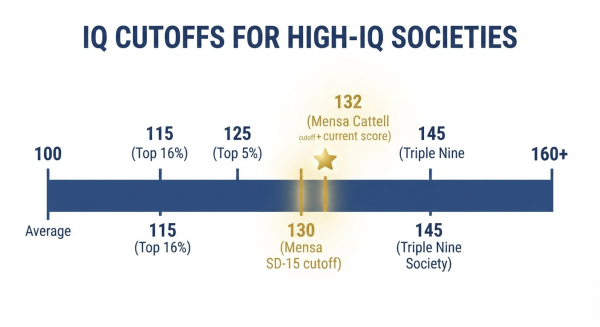
A score of 132 on an SD-15 test qualifies comfortably — and places you above Mensa's cutoff, not just at it. For more on what membership involves and whether it is worth pursuing, read What Is Mensa and explore the full list of High IQ Societies. If you want to challenge yourself further at the upper cognitive range, the High Range IQ Test is designed specifically for above-average scores.
Cognitive Traits at IQ 132: What Research Shows
A score of 132 reflects a specific cognitive profile — not just "being smart." Research consistently identifies the following characteristics in individuals at this level:
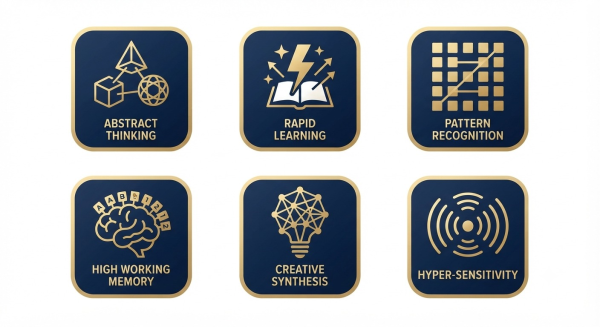
1. Accelerated Information Processing
People at IQ 132 absorb and integrate new concepts significantly faster than average. They often grasp the underlying structure of a subject after minimal exposure — not just memorizing facts but understanding how systems work. This is linked to both high working memory capacity and processing speed, two of the four index scores on the WAIS-IV. Explore how these capacities are measured in the WAIS-IV complete guide.
2. Advanced Abstract and Systems Thinking
At 2+ standard deviations above the mean, individuals typically show strong fluid intelligence — the ability to reason through novel problems without relying on prior knowledge. This manifests as comfort with theoretical frameworks, philosophical complexity, and multi-variable problems that most people find overwhelming. It is one reason why careers in research, law, and strategic planning are strong fits at this level.
3. High Working Memory
Working memory — the ability to hold, manipulate, and apply multiple pieces of information simultaneously — is one of the most practically important cognitive capacities at this level. It underlies effective planning, complex reasoning, and the ability to follow or construct elaborate arguments. See the full guide on IQ and Memory for the research behind this connection.
4. Intense Curiosity and Depth Orientation
Gifted individuals rarely find surface-level explanations satisfying. They tend to pursue topics to unusual depth, ask follow-up questions instinctively, and feel frustration when discussions remain shallow. This is both a strength — it drives mastery — and a social challenge, since most conversations are not calibrated for this level of depth.
5. The "Hyper Brain / Hyper Body" Effect
Research on gifted adults has identified what some call the hyper brain / hyper body pattern: individuals with higher IQs may experience heightened psychological reactivity (deeper rumination, more intense worry) alongside heightened physiological reactivity (stronger stress responses, sensory sensitivity). This is not a disorder — it is a different calibration. It means that emotional regulation and self-awareness are especially important skills for people in this IQ range. Our EQ Test and the guide on IQ vs EQ are useful complements to understand this dimension.
6. Perfectionism and Imposter Syndrome
A consistent finding in gifted adult research is that high internal standards create a paradox: the more capable you are, the more acutely you perceive gaps in your own knowledge. Imposter syndrome — the feeling of not being as competent as others perceive you — is disproportionately common in gifted individuals. This is compounded by the fact that high-IQ people often gravitate toward environments (elite universities, competitive firms) where everyone around them is also highly capable, making their own abilities feel ordinary by comparison.
IQ 132 is well above the threshold at which cognitive ability stops being a limiting factor in most careers. Beyond this point, what differentiates outcomes is almost always motivation, emotional intelligence, and the quality of sustained effort — not IQ itself.
Why People with IQ 132 Often Feel "Not That Smart"
This is one of the most searched questions about high IQ — and one of the most honest things to address. The phenomenon is real and well-documented. Several factors drive it:
- Reference group effects: If you spend time in environments where the average IQ is also 120–130+ (graduate school, competitive firms, research labs), your score stops feeling exceptional — because it isn't, relative to that group.
- Dunning-Kruger in reverse: Gifted people tend to know enough to know what they don't know. This awareness of the depth of their own ignorance creates a persistent sense of inadequacy that average performers don't experience.
- High internal standards: When you hold yourself to an unusually high bar, you notice every failure to meet it — and discount successes as "just what anyone would have done."
- Social masking: Many gifted individuals have learned to downplay their abilities socially, leading them to genuinely forget what their baseline cognitive level actually is relative to the broader population.
Understanding your own cognitive profile more fully — including emotional and personality dimensions — can help. Consider taking the MBTI Personality Test and DISC Assessment alongside your IQ results for a more complete picture.
What the Research Says: Long-Term Outcomes at IQ 132
Park, Lubinski, and Benbow (2008), publishing in Psychological Science, tracked gifted individuals over 30 years through the Study of Mathematically Precocious Youth (SMPY). Their data showed that even within the top 1% of IQ scores, higher scores predicted meaningfully better outcomes — more patents, more publications, higher earnings, and greater creative achievement. Individuals scoring at roughly IQ 127–137 showed elevated creative achievement relative to lower-ability peers — a range that includes IQ 132 squarely.
The practical implication: IQ 132 is not just a label. It is a cognitive profile associated with measurably better performance in complex, demanding environments — when supported by effort, direction, and emotional stability. For comparison, see the breakdowns for IQ 128, IQ 133, and IQ 140.
Best Career Paths for IQ 132
At IQ 132, cognitive ability is rarely the limiting factor. The most important career question is not "what can I do?" — it is "what environment will challenge and engage me consistently?" Gifted individuals tend to underperform in roles that are repetitive, low-complexity, or heavily procedural, not because they cannot do the work but because cognitive understimulation leads to disengagement.
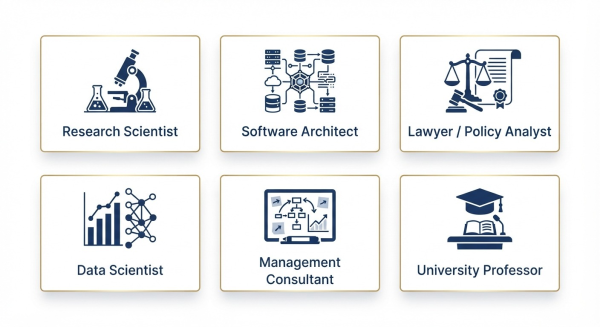
STEM and Research
- Research Scientist: Abstract modeling, hypothesis testing, and long-form intellectual focus.
- Software Architect / AI Engineer: Systems-level thinking, novel problem-solving. See IQ for software engineers.
- Data Scientist: Pattern detection, statistical reasoning, and cross-domain synthesis.
Law, Strategy, and Policy
- Lawyer / Constitutional Scholar: Complex argumentation, multi-variable legal reasoning.
- Management Consultant: Strategic diagnosis and high-stakes decision frameworks.
- Policy Analyst: Systems-level thinking about complex social or regulatory problems.
Medicine and Psychology
- Physician / Surgeon: High cognitive demand, diagnostic reasoning. See average IQ of doctors.
- Clinical or Research Psychologist: Theoretical depth and human behavioral complexity.
Academia and Creative Fields
- University Professor / Researcher: Autonomy, intellectual depth, and long-form mastery.
- Entrepreneur (complex domains): Systems innovation, risk modeling, and pattern-based opportunity identification.
For more on matching cognitive profile to career path, see careers requiring IQ above 130, high IQ low EQ career pitfalls, and jobs for IQ 130–140.
IQ 132 and Social Experience: What It Actually Feels Like
The social dimension of high IQ is understudied and often misrepresented. The common stereotype — that gifted people are awkward or isolated — is not supported by research. What research does show is that high-IQ individuals often experience a mismatch of cognitive pace in everyday social settings: conversations that resolve too quickly, discussions that don't go deep enough, and a persistent sense that most interactions stay at a surface level.
This is not antisociality. It is a calibration difference. Gifted individuals typically connect well in environments where intellectual depth is valued — research teams, specialized communities, creative collaborations. The challenge is finding those environments, not fixing a social deficit. For context on how IQ interacts with emotional and social development from childhood, see IQ vs EQ in childhood and signs of a gifted child.
Is IQ 132 a Ceiling or a Starting Point?
Neither framing is quite right. A score of 132 is a snapshot of current cognitive performance — not a fixed trait and not a destiny. Research on neuroplasticity confirms that the brain continues to adapt with sustained effort. The Flynn Effect — rising IQ scores across generations linked to environmental improvements — demonstrates that measured IQ is substantially shaped by experience, not only genetics. The guide on whether IQ can be improved explains what the evidence actually supports.
What IQ 132 gives you is a high-performance cognitive baseline. What you build on it — through direction, discipline, and emotional depth — is entirely open.
Frequently Asked Questions
Is IQ 132 considered gifted?
Yes. IQ 132 falls in the Gifted / Very Superior classification on the Wechsler scale and sits at the 98.4th percentile — above approximately 98 out of 100 people. It comfortably exceeds the Mensa International admission threshold on standard SD-15 tests.
What percentile is IQ 132 exactly?
IQ 132 corresponds to the 98.4th percentile on the standard bell curve (mean = 100, SD = 15). It sits 2.13 standard deviations above the population mean, making it statistically rare at approximately 1 in 63 people — slightly rarer than the commonly cited "1 in 50" for IQ 130.
Does IQ 132 qualify for Mensa?
Yes. Mensa requires a score at or above the 98th percentile. On SD-15 tests (WAIS, Stanford-Binet), that is IQ 130. On the Cattell scale (SD = 24), the cutoff is 132. A score of 132 on any standard SD-15 test qualifies with margin. Explore how to join Mensa online for the process.
Why do people with IQ 132 sometimes feel average?
Several well-documented factors contribute: reference group effects (if your environment is filled with other high-IQ people, 132 feels ordinary), Dunning-Kruger in reverse (knowing enough to know how much you don't know), and high internal standards that make competent performance feel unremarkable. This feeling is common and does not reflect actual ability.
What famous people have an IQ around 132?
Estimated celebrity IQ scores are rarely verified and widely debated. That said, IQ 132 is within the range cited for many accomplished scientists, authors, and leaders. Explore the Celebrity IQ Database for detailed breakdowns — and the important caveats about how these estimates are derived. For context on the very highest documented scores, see highest IQ in history.

Comments
Share Your Thoughts