An IQ of 124 places you at approximately the 94th percentile — meaning you score higher than about 94 out of every 100 people in the general population. The Wechsler Adult Intelligence Scale classifies this as Superior intelligence. It represents 1.60 standard deviations above the population mean of 100, and roughly 1 in 16 people score at this level or above.
IQ 124 occupies a specific and clearly defined position in the Superior range. It is 4 points above IQ 120 (where the Superior classification begins), 1 point below IQ 125 (the approximate 95th percentile marker), 6 points below the conventional gifted threshold of IQ 130, and 8 points below the Mensa eligibility cutoff. It is in the top 6% of the general population — genuinely above average, above most professional group averages, and approaching but not yet at the thresholds that mark the gifted range.
This guide covers what the research says about IQ 124: the population statistics, the cognitive profile, what it opens professionally and academically, how it compares to professional averages, and how to think about its position relative to the thresholds above it.
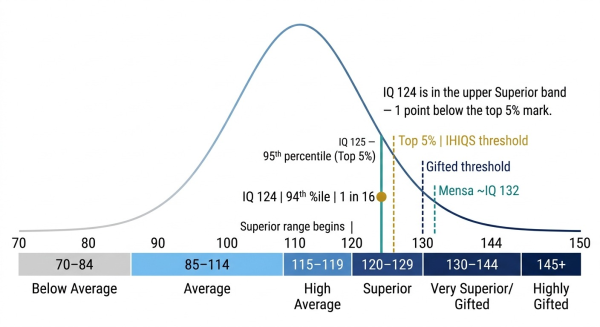
IQ 124 in Numbers: The Core Statistics
| Metric | Value at IQ 124 |
| Standard deviations above mean | 1.60 SD |
| Percentile | ~94th (94.5th) |
| Frequency in general population | ~1 in 16–18 |
| In a room of 100 people | ~6 score at or above this level |
| In the United States (~335M) | ~20 million people |
| Wechsler classification | Superior |
| Gap to top 5% (IQ 125) | 1 point |
| Gap to gifted threshold (IQ 130) | 6 points |
| Gap to Mensa threshold (~IQ 132) | 8 points |
IQ 124's position relative to adjacent scores helps clarify what it means. IQ 120 (1 in 11) is about 70% more common. IQ 125 (1 in 20) is about 25% rarer. IQ 128 (1 in 33) is twice as rare. The changes between these scores are genuine but not dramatic — they all occupy the same general zone of the distribution (the upper Superior range), and their practical cognitive and career implications are more similar than different. For the full distributional context, see our IQ scale explained.
The 1-Point Gap: IQ 124 and the Top 5% Threshold
One of the most psychologically interesting features of IQ 124 is its position relative to the 95th percentile. IQ 125 corresponds to approximately the 95th percentile — the top 5% of the population, which is the threshold used by the International High IQ Society (IHIQS) as its basic eligibility cutoff. IQ 124 sits just 1 point below this threshold.
It is important to understand what this 1-point gap actually means — and doesn't mean. The standard error of measurement (SEM) on the WAIS-IV is approximately 2–3 points per subtest and approximately 2.16 points for the Full Scale IQ at the 95% confidence interval. This means a reported score of 124 reflects a confidence interval of approximately 120–128 at 95% confidence. The 1-point gap between IQ 124 and IQ 125 is smaller than the standard error of measurement — it is, in rigorous psychometric terms, not a meaningful or reliable distinction between two specific scores.
In practice: a person who scores 124 on one properly administered clinical IQ test might score 125, 127, or 122 on a different occasion, with a different test, or under slightly different conditions. The 1-point difference should not be read as a definitive statement that the person is "below the top 5%" in any precise sense. For more on this, see our guide on IQ 128 and measurement error, where this principle is explored in the context of the Mensa threshold.
The Cognitive Profile at IQ 124
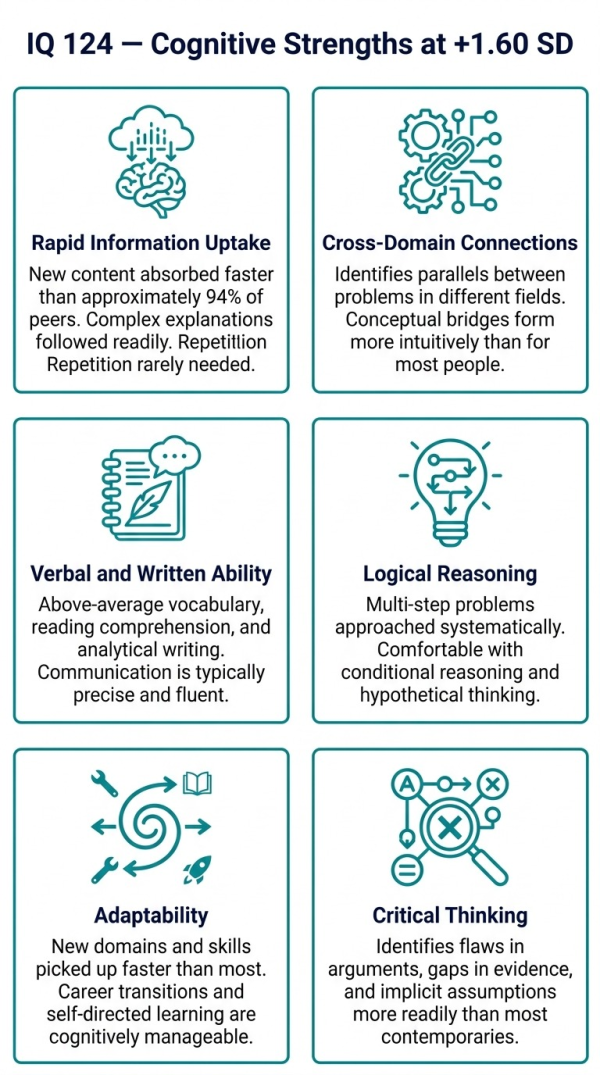
At 1.60 standard deviations above the mean, IQ 124 reflects a cognitive profile that is meaningfully above average across the core dimensions measured by IQ tests:
Rapid information uptake. New content is absorbed and integrated faster than approximately 94% of the general population. Standard educational and professional environments provide material at a pace that is comfortable but not maximally stimulating — material that feels effortful for many is manageable on first exposure at IQ 124. This is a real and consistent cognitive advantage in most everyday settings.
Cross-domain connections. The ability to identify parallels between problems in different fields — to see that a challenge in business strategy has the same underlying logic as a challenge in game theory, or that a biological pattern resembles a social one — is more accessible at IQ 124 than at lower cognitive levels. This cross-domain transfer is a practically useful cognitive capability in complex professional roles.
Verbal and written ability. Above-average vocabulary, reading comprehension, and analytical writing come more naturally. This is reflected in the verbal comprehension dimension of most IQ assessments, which is one of the strongest individual predictors of general intelligence and one of the most practically valuable cognitive capabilities in professional life.
Logical reasoning. Multi-step problems are approached systematically with above-average facility. Conditional reasoning, hypothetical thinking, and the ability to trace the logical consequences of premises are developed above the population average.
Adaptability. New domains and skills are acquired faster than most peers. A person at IQ 124 who decides to change careers, learn a new technical skill, or enter a new field of study will typically do so more efficiently than the average person — not because the cognitive advantage is enormous, but because it compounds over time and with sustained effort. For more on how these cognitive strengths relate to measured intelligence, see our guide on what IQ actually measures.
IQ 124 vs Professional Averages: Where It Puts You
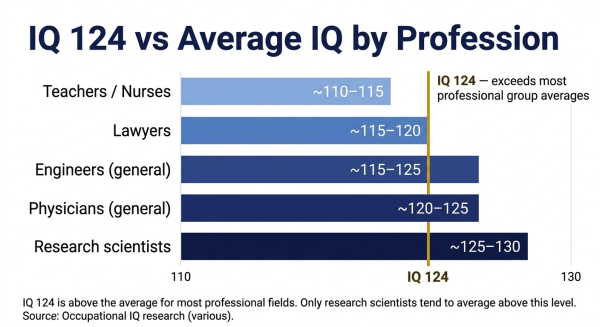
One of the most practically useful ways to understand IQ 124 is to compare it to the estimated average IQ for major professional groups. As explored in our IQ 120 guide, the professional cluster point sits at approximately IQ 120 — the average for physicians, lawyers, and engineers. IQ 124 sits above this cluster:
| Profession | Estimated Average IQ | IQ 124 Position |
| Teachers | ~110–115 | Above average for profession |
| Nurses / allied health | ~110–115 | Above average for profession |
| Lawyers | ~115–120 | Above average for profession |
| Engineers (general) | ~115–125 | At or above average for profession |
| Physicians (general) | ~120–125 | At or just above average for profession |
| Research scientists / surgeons | ~125–130 | Below average for this group |
The pattern is clear: IQ 124 is above the average for most professional fields, at or near the average for the most analytically demanding common professions (medicine, engineering), and below average only for the most cognitively selective research-intensive roles. In most professional environments a person at IQ 124 will encounter, they will be at or above the cognitive average of their colleagues. For more context, see our IQ 120 guide.
What IQ 124 Opens — and What It Doesn't Limit
IQ 124 supports success across virtually all professional and academic pathways:
University and graduate study. Undergraduate success across all disciplines is cognitively supported at IQ 124. Graduate study (MBA, JD, MD, MSc) is well within reach. The most mathematically intensive doctoral programmes (pure mathematics, theoretical physics, research statistics) tend to attract candidates averaging above IQ 128–130, but IQ 124 does not represent a hard barrier for advanced study in most fields.
Professional practice. Law, medicine (clinical practice), engineering, software development, finance, business strategy, architecture, and scientific research are all cognitively accessible at IQ 124. In most of these environments, IQ 124 will place a person at or above the cognitive average of their professional peer group.
Career adaptability. The ability to transition between fields, acquire new technical skills, and adapt to changing professional environments is meaningfully supported at IQ 124. In an era of rapid technological change, this adaptability is one of the most practically valuable aspects of above-average cognitive ability.
What IQ 124 does not limit — at this level or any other — is the range of outcomes possible. The research on the threshold effect consistently shows that above approximately IQ 115–120, incremental IQ points explain diminishing variance in most life outcomes. Charles Darwin, with an estimated IQ of 165, attributed his achievement to patience, observation, and honest self-assessment — not to raw cognitive firepower. Warren Buffett explicitly argues that above IQ 130, temperament matters more than intelligence for investment outcomes. At IQ 124 — well above the threshold for most professional demands — the question of what cognitive ability can achieve shifts entirely to motivation, character, and focus. For more, see our guides on IQ vs EQ and IQ and income.
IQ 124 and High-IQ Society Access
IQ 124 sits at an interesting position relative to the lowest-tier high-IQ societies. The International High IQ Society (IHIQS) accepts members scoring in the top 5% (approximately IQ 124–125 and above). IQ 124 at the 94th percentile is at or very close to this threshold — whether it qualifies depends on the specific test administered and the exact threshold applied.
The most important high-IQ society for most people considering membership is Mensa International, which requires scores at or above the 98th percentile (~IQ 132). IQ 124 falls 8 points below this threshold. Given the standard error of measurement (±3–5 points), the gap is larger than what normal test variability would be expected to bridge — a person genuinely scoring at IQ 124 would not, on average, score at 132+ on a retest. For more on Mensa qualification and what the thresholds mean, see our guide on what is Mensa.
IQ 124 in Context: The Full Comparison
| IQ Score | Percentile | Rarity | Key Note |
| 120 | 91st | 1 in 11 | Superior range begins; professional average |
| 124 | 94th | 1 in 16 | Top 6% — just below the top-5% mark |
| 125 | 95th | 1 in 20 | Top 5% — IHIQS threshold (approx.) |
| 127 | 96th | 1 in 28 | Top 4%; 3 points below gifted |
| 128 | 97th | 1 in 33 | 4 points from Mensa |
| 130 | 98th | 1 in 44 | Very Superior / Gifted range begins |
| 132 | 98.5th | 1 in 67 | Mensa threshold |
The table shows IQ 124's clear position: solidly in the Superior range, in the top 6% of the population, 1 point below the top-5% mark, and 6 points below the gifted threshold. For adjacent score guides, see our pages on IQ 120, IQ 127, and IQ 128. For what comes above, see our guides on IQ 136 and IQ 140.
IQ 124 is at the 94th percentile — top 6%, 1 in 16 people, 1 point below the top-5% mark and 6 points below the gifted range. It is classified as Superior on the Wechsler scale and reflects genuine, consistent cognitive advantages in processing speed, pattern recognition, verbal precision, and abstract reasoning. In most professional environments, it places a person at or above the cognitive average of their colleagues. What it does not determine — at this level or any other — is what those cognitive advantages are deployed toward. That question belongs to the character, motivation, and choices that no IQ score describes.
Find out where you sit with our free IQ test — no registration, results in under 20 minutes. For adjacent scores, see our guides on IQ 120, IQ 127, and IQ 128. For the full distributional context, see our IQ scale explained.
Frequently Asked Questions
What does an IQ of 124 mean?
An IQ of 124 is classified as Superior on the Wechsler scale, at approximately the 94th percentile. It represents 1.60 standard deviations above the population mean of 100, corresponding to roughly 1 in 16 people. It is 1 point below the top-5% mark (IQ 125), 6 points below the gifted threshold (IQ 130), and 8 points below the Mensa eligibility cutoff (~IQ 132). It indicates above-average processing speed, verbal precision, logical reasoning, and pattern recognition.
How rare is an IQ of 124?
IQ 124 corresponds to approximately the 94th percentile — roughly 1 in 16 to 18 people. In a room of 100 randomly selected people, approximately 6 would score at this level or above. In the United States, approximately 20 million people are expected to score at or above IQ 124. It is genuinely above average and in the top 6%, though more common than the gifted threshold (IQ 130, 1 in 44).
Is IQ 124 considered Superior?
Yes. The Wechsler Adult Intelligence Scale classifies IQ 124 firmly in the Superior range (approximately IQ 120–129). It is above the High Average range (which ends at IQ 119) and below the Very Superior or Gifted range (which begins at IQ 130). It reflects genuinely above-average cognitive ability.
Does IQ 124 qualify for any high-IQ societies?
IQ 124 is at or very close to the International High IQ Society (IHIQS) threshold, which accepts members scoring in the top 5% (approximately IQ 124–125 or above). It does not qualify for Mensa International (~IQ 132, top 2%). The 1-point difference between IQ 124 and IQ 125 is within measurement error — anyone near this threshold should verify the specific qualifying test requirements.
What careers are associated with IQ 124?
IQ 124 supports virtually all demanding professional paths. It is above the estimated average for teachers (~110–115), nurses (~110–115), and lawyers (~115–120), and at or near the average for engineers (~115–125) and physicians (~120–125). At this level, cognitive ability is not the limiting factor in career outcomes — motivation, conscientiousness, domain expertise, and social skills become the primary determinants.

Comments
Share Your Thoughts