An IQ score between 130 and 140 places you in the Very Superior range — the top 2% of the population. At this level, cognitive ability is a genuine advantage in demanding professional environments. But knowing your score is only the first step. Understanding which careers make the best use of exceptional reasoning ability, rapid learning, and strong abstract thinking is what turns that advantage into a meaningful direction. This guide covers the careers most aligned with an IQ in the 130–140 range, why they suit this cognitive profile, and what actually determines success at this level.
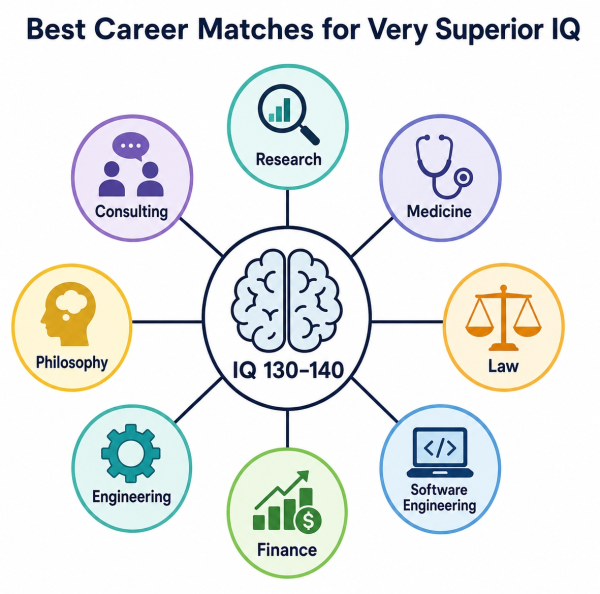
Why IQ 130–140 Opens Specific Career Doors
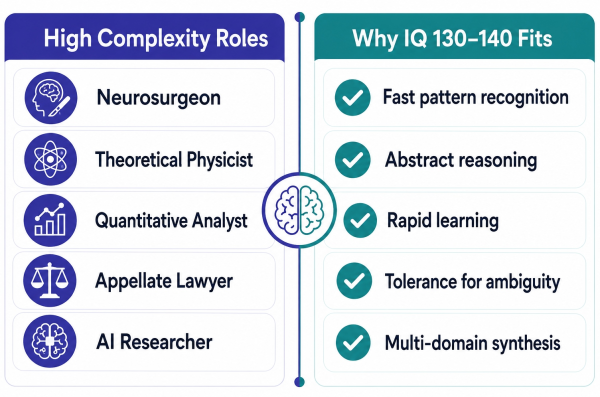
Research on IQ and job performance consistently shows that cognitive ability becomes increasingly predictive of success as role complexity rises. In routine or highly structured jobs, the difference between an IQ of 100 and 135 is modest in practice. But in careers that require synthesising large amounts of ambiguous information, reasoning under uncertainty, building novel frameworks, or mastering vast technical domains quickly, that gap becomes significant and measurable.
People with IQs in the 130–140 range tend to learn faster and with less repetition, make connections across domains that others miss, tolerate and enjoy cognitive complexity rather than avoiding it, and identify errors, gaps, and inefficiencies that peers may overlook. These traits are assets in any environment that rewards intellectual depth. For a broader understanding of where this score sits in the overall population, see what an IQ of 135 means and the IQ scale explained.
The Most Suitable Careers for IQ 130–140
1. Academic Research and University Teaching
Research careers are among the most natural fits for people in the very superior IQ range. The ability to identify gaps in existing knowledge, design rigorous studies, synthesise large bodies of literature, and develop original theoretical frameworks maps almost directly onto the cognitive strengths associated with IQ 130–140. University researchers in fields such as physics, mathematics, cognitive science, economics, and medicine consistently score in this range or higher.
Academic careers also reward intellectual independence and sustained deep focus — traits that often accompany high fluid intelligence. The challenge is that academic pathways are long and competitive, requiring not just cognitive ability but also persistence, communication skill, and political savvy within institutions.
2. Medicine and Specialist Surgery
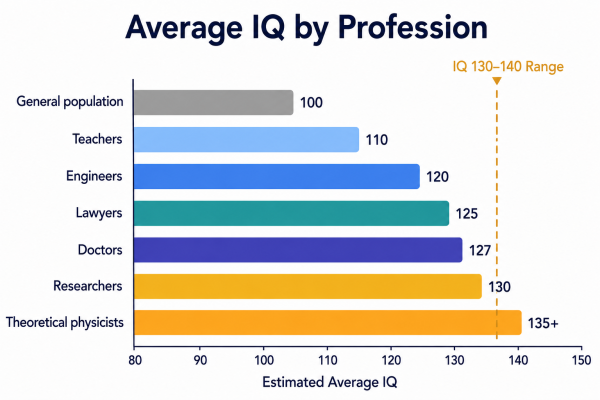
Medicine is one of the most cognitively demanding professions in terms of the volume and complexity of knowledge required. Medical school selection processes and the demands of clinical training effectively filter for candidates in the upper cognitive ranges. Studies on physician IQ consistently find averages in the 120–130 range, with specialists in complex fields such as neurosurgery, cardiothoracic surgery, and academic medicine typically scoring at or above 130.
What makes medicine particularly suited to IQ 130–140 is the combination of pattern recognition under pressure, rapid integration of new clinical evidence, and complex differential diagnosis — all of which benefit directly from strong fluid and crystallised intelligence. See average IQ of doctors for a detailed breakdown by speciality.
3. Law — Senior Litigation, Academic Law, and Policy
High-level legal practice demands the ability to process large volumes of complex text, identify logical inconsistencies, construct multi-layered arguments, and anticipate counterarguments across extended timeframes. Senior litigation, constitutional law, academic legal scholarship, and policy work at the intersection of law and government all sit comfortably in the IQ 130–140 career band.
General practice law and most corporate legal work are accessible at somewhat lower IQ levels, but the most intellectually demanding branches of the profession — appellate advocacy, complex commercial arbitration, international law — consistently attract and reward people at the upper cognitive ranges.
4. Software Engineering and Computer Science Research
At the highest levels, software engineering and computer science are deeply abstract disciplines. Designing complex system architectures, developing novel algorithms, working in machine learning research, or building compilers and operating systems requires a level of abstract reasoning and logical rigour that aligns well with IQ scores in the 130–140 range.
The technology industry is notable for having one of the highest average IQ distributions of any major sector, with research roles at leading companies and universities attracting candidates consistently in the very superior range. For a broader look at how IQ relates to this field, see is IQ important for software engineers?
5. Engineering — Aerospace, Systems, and Structural
Complex engineering disciplines that require integrating multiple technical systems, managing second and third-order effects, and solving problems with no established precedent are natural environments for IQ 130–140. Aerospace engineering, systems engineering, and structural engineering at the frontier of applied research all benefit from the pattern recognition speed and logical depth associated with this cognitive range.
Engineering roles at large organisations also increasingly require strong communication and team leadership — a reminder that technical intelligence alone is insufficient for senior advancement in most engineering careers.
6. Quantitative Finance and Algorithmic Trading
The quantitative end of finance — derivatives pricing, portfolio optimisation, algorithmic trading strategy, and risk modelling — requires a rare combination of advanced mathematics, statistical reasoning, and fast pattern recognition under pressure. Hedge funds and investment banks actively recruit candidates with exceptional quantitative ability, and roles in this space consistently attract people in the IQ 130–140 range and above.
The financial rewards in quantitative finance are among the highest of any profession, but the environment is intensely competitive and demanding, with performance evaluated continuously and objectively.
7. Philosophy and Theoretical Social Science
Academic philosophy, particularly in logic, philosophy of mind, philosophy of science, and formal ethics, is among the most abstract intellectual disciplines. The ability to construct valid arguments from minimal premises, identify hidden assumptions, and engage rigorously with competing frameworks maps closely onto the cognitive profile of IQ 130–140.
Similarly, theoretical work in economics, political science, and sociology — building formal models, testing causal claims against complex data, and synthesising cross-disciplinary research — suits people who combine high fluid intelligence with deep domain expertise.
8. Strategic Consulting and Senior Management
Top-tier management consulting firms such as McKinsey, BCG, and Bain are well known for recruiting heavily from the upper cognitive ranges. The work involves rapidly learning the operations of unfamiliar industries, identifying root causes of complex organisational problems, and synthesising recommendations from incomplete and conflicting data — all within tight time constraints.
Senior executive roles in large complex organisations similarly reward the ability to hold multiple competing priorities in mind simultaneously, anticipate systemic consequences of decisions, and communicate complex reasoning clearly to diverse stakeholders. See what jobs require a high IQ for a broader list of high-cognitive-demand roles.
9. Psychiatry and Clinical Psychology
Clinical psychiatry and research psychology require the simultaneous integration of biological, psychological, and social frameworks to understand and treat complex mental health presentations. The diagnostic reasoning involved is highly pattern-based and benefits strongly from high fluid intelligence, as does the ability to engage with the dense research literature that underpins evidence-based practice.
These fields also require strong emotional intelligence alongside high cognitive ability — a combination that is not guaranteed by a high IQ score but that is essential for clinical effectiveness. For more on how these two dimensions interact, see IQ vs EQ.
10. Advanced Mathematics and Theoretical Physics
Pure mathematics and theoretical physics represent perhaps the most cognitively demanding disciplines in existence. Research in these fields requires sustained engagement with abstract structures that have no direct physical referent, and the ability to hold and manipulate complex logical chains without external scaffolding. Average IQ among professional mathematicians and physicists is estimated consistently above 130, with many of the most productive researchers scoring considerably higher.
These careers are among the most intellectually fulfilling for people in the very superior range but also among the most demanding in terms of sustained focus and tolerance for extended periods without clear progress.
What IQ 130–140 Does Not Guarantee
High cognitive ability is a significant advantage but not a guarantee of career success or personal fulfilment. Research consistently shows that above a certain cognitive threshold — often estimated around IQ 120 — the marginal return of additional IQ points diminishes relative to non-cognitive factors.
Conscientiousness, emotional regulation, interpersonal skill, and the ability to tolerate ambiguity and setback all contribute independently to career outcomes. Many people with IQs in the 130–140 range underperform relative to their apparent potential due to poor mental health, lack of direction, interpersonal difficulties, or environments that do not challenge them adequately. Equally, many people with average IQs achieve exceptional things through sustained effort, strategic focus, and strong social skill.
The careers listed above suit IQ 130–140 not because they are closed to people with lower scores, but because they make the best and most consistent use of the specific cognitive strengths that this score range reflects. For a broader perspective on how intelligence relates to achievement, see IQ vs problem-solving skills and IQ vs critical thinking.
The Role of Emotional Intelligence at This Level
One pattern that appears with some consistency among very high IQ individuals is a disconnect between cognitive ability and social effectiveness. High fluid intelligence does not automatically produce empathy, self-awareness, or the ability to read social situations accurately — and in environments that require team leadership, client management, or cross-functional collaboration, the absence of these skills can become a significant career limiter regardless of cognitive score.
The most successful people in cognitively demanding careers tend to combine high IQ with well-developed emotional intelligence and strong communication ability. If you have an IQ in the 130–140 range, developing these complementary skills alongside your cognitive strengths is likely to produce better long-term career outcomes than focusing on cognitive development alone. See careers for high IQ but low EQ individuals and IQ vs soft skills in hiring for more on this dynamic.
How to Confirm Your IQ Score Before Making Career Decisions
If your score of 130–140 came from a free online test, it is worth seeking professional confirmation before using it to guide significant career decisions. Online tests frequently produce inflated results, and a score in this range deserves verification through a properly standardised assessment administered by a qualified psychologist. For more on the reliability of different types of IQ assessments, see are free online IQ tests accurate? and what affects your IQ test results.
Final Thoughts: Making the Most of IQ 130–140
An IQ of 130–140 is a rare and genuinely valuable cognitive advantage. The careers that make the best use of it are those that offer intellectual complexity, continuous learning, and problems that require original thinking rather than the routine application of established procedures. Medicine, research, law, engineering, quantitative finance, and advanced academia all fit this profile.
But the score is only the starting point. Direction, discipline, emotional skill, and sustained effort are what convert high cognitive ability into a career that is both successful and meaningful. Explore more in our Careers section and take our free IQ test to benchmark your current cognitive performance.

Comments
Share Your Thoughts