An IQ of 127 places you at approximately the 96th percentile — meaning you score higher than about 96 out of every 100 people in the general population. The Wechsler Adult Intelligence Scale classifies this as Superior intelligence. It represents 1.8 standard deviations above the population mean of 100, and roughly 1 in 28 people score at this level or above.
IQ 127 sits in an interesting position on the scale: above the professional averages for most major occupations, in the top 4% of the population, and just 3 points below the conventional gifted threshold of IQ 130. It is not quite at the doorstep of Mensa — that is a 5-point gap — but it is in the approach zone where the thresholds above it start to feel relevant and reachable rather than abstract.
This guide covers what the research says about IQ 127: the population statistics, the cognitive profile, the distance to the next thresholds, what it opens professionally and academically, and how to think about the score in relation to adjacent values.
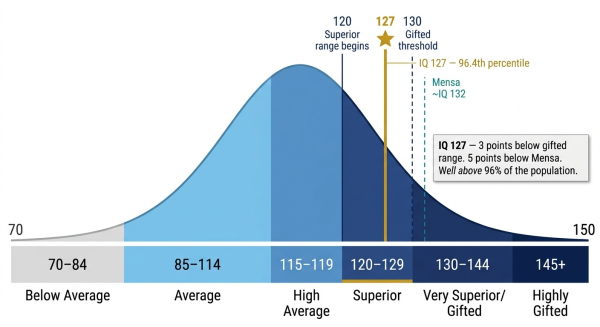
IQ 127 in Numbers: The Core Statistics
| Metric | Value at IQ 127 |
| Standard deviations above mean | 1.80 SD |
| Percentile | ~96th (96.4th) |
| Frequency in general population | ~1 in 28 |
| In a room of 100 people | ~4 score at or above this level |
| In the United States (~335M) | ~12 million people |
| Wechsler classification | Superior |
| Gap to gifted range (IQ 130) | 3 points |
| Gap to Mensa threshold (~IQ 132) | 5 points |
Positioning IQ 127 among familiar reference points helps contextualise what the number means. IQ 120 (91st percentile, 1 in 11) is roughly 2.5 times more common than IQ 127. IQ 128 (97th percentile, 1 in 33) is just 1 point higher and in nearly identical territory. IQ 130 (98th percentile, 1 in 44) is about 60% rarer than IQ 127. The gaps around IQ 127 are genuine but not large — it sits in a zone of the distribution where each point represents a modest rather than dramatic change in rarity or cognitive experience. For the full picture, see our IQ scale explained.
The Cognitive Profile at IQ 127
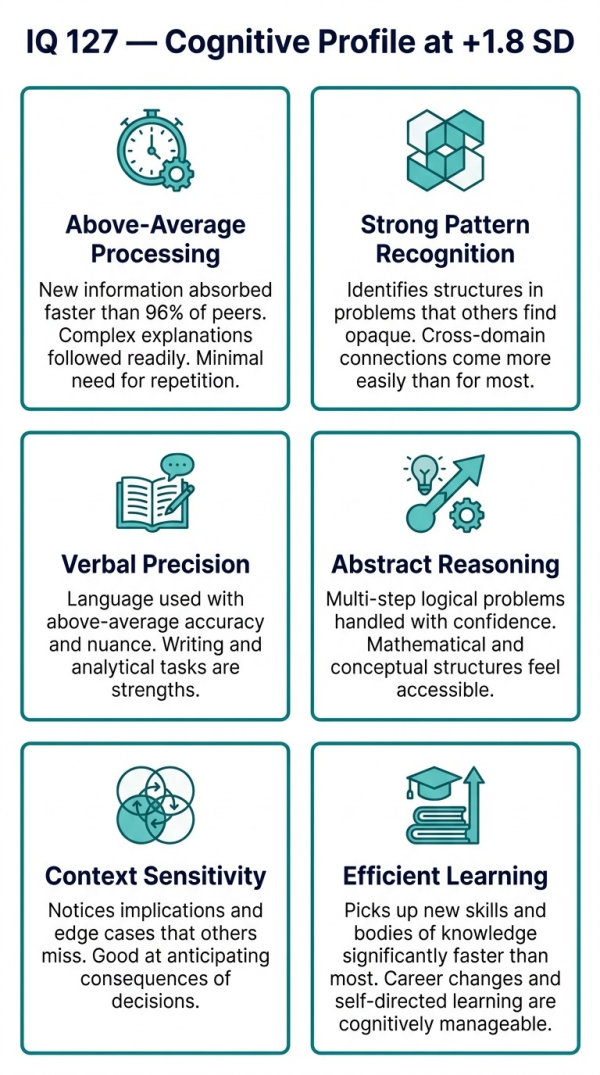
At 1.8 standard deviations above the mean, IQ 127 reflects a cognitive profile that is meaningfully and consistently above average across the core dimensions that IQ tests measure:
Processing speed. New information is absorbed and integrated faster than approximately 96% of the general population. In everyday educational and professional settings, this manifests as following complex explanations readily on first exposure, rarely needing material repeated, and keeping pace with demanding content without the effortful processing that most people experience.
Pattern recognition. Structural similarities between problems in different domains are identified more readily. The ability to see that a challenge in one field has the same underlying shape as a challenge in another — the cross-domain transfer that underlies much of what we call insight — is more accessible at IQ 127 than at lower cognitive levels. This is one of the most practically useful features of above-average intelligence in complex professional environments.
Verbal precision. Language — written and spoken — is typically deployed with above-average accuracy and nuance. Vocabulary is broader, reading comprehension is faster, and analytical writing comes more naturally. This reflects the verbal comprehension subtest performance that contributes to full-scale IQ at this level.
Abstract reasoning. Multi-step logical and mathematical problems are approached with confidence. Hypothetical reasoning — tracing the consequences of different possibilities — is more natural. This directly supports performance in analytically demanding academic and professional roles.
Efficient learning. New skills and domains of knowledge are acquired faster than approximately 96% of peers. This is not a trivial advantage: someone who learns new material at significantly above-average speed will, over a career, build substantially deeper expertise in the same number of working years, and will be better positioned to adapt to career changes, technological shifts, and novel challenges. For more on how these cognitive strengths relate to measured intelligence, see our guide on what IQ actually measures.
IQ 127 in Professional and Academic Life
IQ 127 comfortably exceeds the average estimated IQ for most major professional groups. As discussed in our IQ 120 guide, the average IQ for lawyers is approximately 115–120, for physicians approximately 120–125, and for engineers approximately 115–125. IQ 127 sits above all of these averages — meaning a person at this level is cognitively above the average of their professional peer group in most demanding fields.
This has practical implications:
- In law: IQ 127 sits above the average for practising lawyers. Law school is cognitively accessible, bar exam success is supported, and the analytical demands of legal practice fall within comfortable cognitive reach
- In medicine: IQ 127 supports medical school completion and clinical practice. The most research-intensive specialties (research medicine, theoretical biology, complex surgery) tend to attract candidates averaging above 125–130, but IQ 127 is well within the range for most clinical medicine
- In engineering and technology: Software development, systems engineering, and most technical roles are well within cognitive reach at IQ 127. Research-intensive engineering roles at the most selective institutions tend to average above 130, but IQ 127 is competitive in the broader field
- In academic study: University-level study across all disciplines is accessible. Graduate study (MBA, JD, MSc, MD) is achievable. The most mathematically intensive doctoral programmes tend to average above 130 in their applicant pools, but IQ 127 does not preclude admission or success in most graduate fields
Crucially: at IQ 127, cognitive ability is almost certainly not the limiting factor in career achievement. The research on the threshold effect — explored in depth in our guides on IQ vs EQ and IQ and income — consistently shows that above approximately IQ 115–120, incremental IQ points explain diminishing variance in most life outcomes. Motivation, conscientiousness, domain expertise, social skills, and resilience determine a larger share of who succeeds than the cognitive advantage that IQ 127 represents over IQ 115 or IQ 120.
The 5-Point Question: IQ 127 and the Thresholds Above It
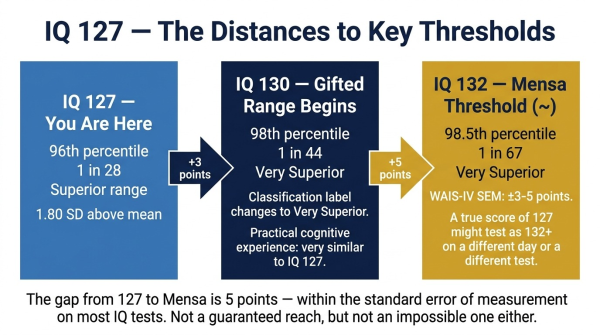
The most common follow-up question from people who score 127 is about the thresholds ahead: how close is this to gifted? How close to Mensa? The honest answer requires understanding both the distances and the measurement error of IQ tests.
The distances
IQ 127 to IQ 130 (gifted range): 3 points. The classification changes from Superior to Very Superior, and the Wechsler classification begins to use language like "gifted." The practical cognitive experience at IQ 127 and IQ 130 is not dramatically different — the gap is real but not large.
IQ 127 to the Mensa threshold (~IQ 132): 5 points. Mensa requires scores at or above the 98th percentile, which on the WAIS-IV corresponds to approximately IQ 130–132. IQ 127 at the 96th percentile falls short of this.
The measurement error reality
As explored in detail in our IQ 128 guide, all IQ tests carry a standard error of measurement. For the WAIS-IV, the SEM is approximately 2.16 points at the 95% confidence interval level, producing a confidence interval of roughly ±4–5 points around any reported score. This means a reported score of 127 is best understood as a range of approximately 122–132 at 95% confidence.
The practical implications:
- The 5-point gap from IQ 127 to Mensa eligibility is within the confidence interval of the score — it is not a guaranteed reach, but it is not beyond the range of normal test variability
- A person whose true cognitive ability corresponds to IQ 127 might score 132 on a given testing occasion, and might score 122 on another
- Anyone scoring 127 who is interested in Mensa should consider sitting an official Mensa supervised test, which will produce an independent score to compare
For more on Mensa qualification, see our guide on what is Mensa.
IQ 127 vs IQ 128: Why the 1-Point Difference Doesn't Matter
Many people searching for IQ 127 are comparing it to IQ 128 (the subject of our adjacent guide). It is worth addressing this directly: the 1-point difference between IQ 127 and IQ 128 is psychometrically meaningless.
The WAIS-IV reports IQ scores as integers, but the underlying measurement is continuous and carries uncertainty of ±3–5 points at the 95% confidence interval. A difference of 1 point between two test results — or two scores reported from the same test on different occasions — carries essentially no interpretive weight. Both IQ 127 and IQ 128 are at the 96th–97th percentile, in the Superior classification, 3–5 points below the gifted threshold, and reflective of the same general cognitive level.
The practical difference between IQ 127 and IQ 128 in cognitive experience, career outcomes, academic performance, or any other real-world domain is effectively zero. Both scores reflect the same position on the intelligence distribution: the upper tier of the Superior range, approaching but not yet at the gifted threshold. For more on why single-point score differences should not be over-interpreted, see our guide on how accurate are IQ tests?
IQ 127 in Context: The Full Comparison
| IQ Score | Percentile | Rarity | Classification | Key Note |
| 120 | 91st | 1 in 11 | Superior | Superior range begins; professional average |
| 124 | 94th | 1 in 16 | Superior | Top 6% |
| 125 | 95th | 1 in 20 | Superior | Top 5% threshold |
| 127 | 96th | 1 in 28 | Superior | Top 4% | 3 pts below gifted |
| 128 | 97th | 1 in 33 | Superior | Functionally identical to IQ 127 |
| 130 | 98th | 1 in 44 | Very Superior | Gifted range begins |
| 132 | 98.5th | 1 in 67 | Very Superior | Mensa threshold (~) |
The table illustrates IQ 127's clear position: solidly in the Superior range, in the top 4% of the general population, 3 points below the gifted threshold, and 5 points below Mensa eligibility. For adjacent score guides, see our pages on IQ 120, IQ 128, and IQ 136. For more context on what the gifted range above it involves, see our IQ 140 guide.
What IQ 127 Predicts — and What Matters More
The research on what IQ 127 specifically predicts is consistent with the broader literature on the Superior range:
Strong academic performance. University-level study across most disciplines is well supported. Graduate programmes in most fields are accessible. The most mathematically intensive research programmes tend to average above IQ 130 in their pools, but IQ 127 is competitive in the wider graduate landscape.
Success in complex professional roles. Cognitively demanding jobs — those requiring sustained reasoning, novel problem-solving, and rapid learning — are well within reach at IQ 127. Research on cognitive ability and job performance consistently shows that IQ 127 supports high performance in these roles relative to the general population.
Above-average income trajectory. The research on IQ and income shows a positive relationship that continues meaningfully through the Superior range. IQ 127 is associated with above-average income outcomes, though the relationship is not linear and conscientiousness, social skills, and domain expertise explain substantial additional variance.
Above IQ 120–125, the research on the threshold effect makes one point consistently: incremental IQ points matter less than the character and environmental factors that determine whether cognitive capacity is effectively deployed. As Darwin demonstrated — with an estimated IQ of 165 — the habits of patience, observation, honest self-assessment, and persistent effort explained more of his achievement than the raw score. At IQ 127, the cognitive foundation is more than sufficient for exceptional outcomes in virtually any domain. What determines whether those outcomes are achieved is not a question that any IQ test can answer.
IQ 127 sits at the 96th percentile — the top 4%, 1 in 28 people, 3 points below the gifted range and 5 points below Mensa. It falls in the Superior classification and reflects above-average processing speed, verbal precision, pattern recognition, and abstract reasoning. It is the score of someone who will typically find standard professional and academic environments cognitively comfortable and who scores above most of the people around them in analytically demanding tasks. What it does not determine — at this level or any other — is what those cognitive resources will be used for, or how well.
Find out where you sit with our free IQ test — no registration, results in under 20 minutes. For adjacent scores, see our guides on IQ 125, IQ 128, and IQ 140. For the full context of where this score sits, see our IQ scale explained.
Frequently Asked Questions
What does an IQ of 127 mean?
An IQ of 127 is classified as Superior on the Wechsler scale, at approximately the 96th percentile (96.4th). It represents 1.8 standard deviations above the population mean. It sits 3 points below the gifted range (IQ 130) and approximately 5 points below the Mensa threshold (~IQ 132). It indicates above-average processing speed, verbal precision, pattern recognition, and abstract reasoning.
How rare is an IQ of 127?
IQ 127 corresponds to approximately the 96th percentile — roughly 1 in 28 people in the general population. In a room of 100 randomly selected people, approximately 4 would score at this level or above. In the United States, approximately 12 million people are expected to score at or above IQ 127.
Is IQ 127 close to gifted?
Yes. IQ 127 is 3 points below IQ 130 (the conventional gifted threshold) and 5 points below the Mensa eligibility threshold (~IQ 132). At 1.8 standard deviations above the mean, it is closer to the gifted range than to the average. The 5-point gap to Mensa is within the standard error of measurement of most IQ tests, meaning a person scoring 127 might score 132 on a retest.
What careers are associated with IQ 127?
IQ 127 opens virtually all demanding professional and academic paths. It exceeds the estimated average IQ for lawyers (~115–120), engineers (~115–125), and physicians (~120–125). At this level, cognitive ability is unlikely to be the limiting factor in any career — motivation, domain expertise, conscientiousness, and social skills become the primary determinants of outcomes.
What is the difference between IQ 127 and IQ 128?
The 1-point difference is psychometrically meaningless — well within the standard error of measurement (±3–5 points) of any clinical IQ test. Both IQ 127 and IQ 128 reflect the same position: the 96th–97th percentile, Superior classification, 3–5 points below the gifted range. For a detailed analysis of this range, see our IQ 128 guide.

Comments
Share Your Thoughts