An IQ of 134 sits at approximately the 98.9th percentile — meaning you score higher than about 98.9 out of every 100 people in the general population. The Wechsler Adult Intelligence Scale classifies this as Very Superior. It represents 2.27 standard deviations above the population mean of 100. Roughly 1 in 84 people score at this level or above.
IQ 134 occupies a specific and well-defined position in the gifted range. It is 4 points above the conventional gifted threshold of IQ 130, 2 points above the Mensa eligibility threshold of approximately IQ 132, and 1–3 points below the Intertel threshold of approximately IQ 135–137. It sits in the narrow corridor between two of the most well-known high-IQ society thresholds — comfortably above one, approaching the other.
This guide covers what the research says about IQ 134: the population statistics, the cognitive profile in the gifted range, the high-IQ society landscape, what it predicts for academic and professional outcomes, and what the evidence says about what matters alongside it.
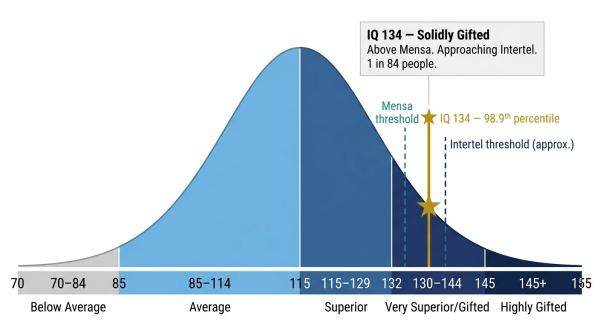
IQ 134 in Numbers: The Core Statistics
| Metric | Value at IQ 134 |
| Standard deviations above mean | 2.27 SD |
| Percentile | ~98.9th |
| Frequency in general population | ~1 in 84–90 |
| In a room of 100 people | ~1 person expected at or above this level |
| In a city of 1 million | ~12,000 people |
| In the United States (~335M) | ~4 million people |
| Wechsler classification | Very Superior |
| Above Mensa threshold (~IQ 132) by | 2 points |
| Below Intertel threshold (~IQ 135–137) by | 1–3 points |
The rarity comparison with adjacent scores helps establish IQ 134's position. IQ 128 (1 in 33) is 2.5 times more common. IQ 136 (1 in 122) is 1.5 times rarer. IQ 140 (1 in 261) is three times rarer. The gifted range (IQ 130–145) spans a substantial portion of the upper tail of the distribution, and IQ 134 sits near its lower-middle portion. For the full distributional context, see our IQ scale explained.
IQ 134 and the High-IQ Society Landscape
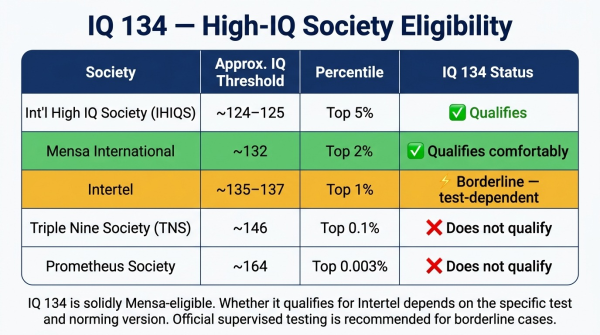
IQ 134's position relative to high-IQ society thresholds is one of its most defining features. It sits precisely in the corridor between two of the most commonly discussed eligibility thresholds:
Mensa International — Qualifies Comfortably
Mensa International requires scores at or above the 98th percentile (approximately IQ 130–132) on a qualifying standardised test. IQ 134 exceeds this threshold by 2 points, making Mensa eligibility straightforward and comfortable. For more on Mensa membership, see our guide on what is Mensa. Notable Mensa members across our database include Nolan Gould (IQ 150) and James Woods (~IQ 180), both confirmed Mensa members.
Intertel — Borderline
Intertel requires scores at or above the 99th percentile — approximately IQ 135–137 depending on the specific test. IQ 134 at the 98.9th percentile is just below this threshold. Whether a specific score of 134 qualifies depends on the qualifying test used and its norming. The standard error of measurement on most IQ tests (±3–5 points) means a person scoring 134 might score 136–138 on a retest — making Intertel eligibility genuinely possible but not certain. This is the same borderline dynamic explored in our IQ 136 guide.
Triple Nine Society — Does Not Qualify
The Triple Nine Society requires scores at or above the 99.9th percentile (approximately IQ 145–146). IQ 134 at the 98.9th percentile falls well short of this requirement. For more on the full landscape of high-IQ societies, see our guide on high-IQ societies.
The Cognitive Profile at IQ 134
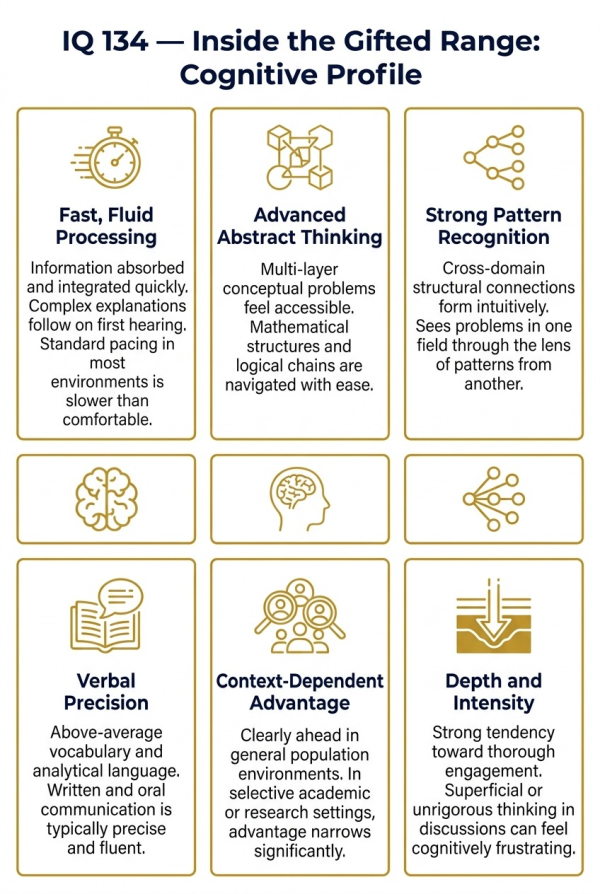
IQ 134 places a person firmly inside the gifted range, producing a cognitive experience that differs meaningfully from both the average population and from scores just below the gifted threshold:
Fast, fluid processing. At 2.27 standard deviations above the mean, information is absorbed and integrated faster than approximately 99% of the general population. Standard educational and professional pacing — designed for the median cognitive level — frequently feels slower than comfortable. Complex explanations that many people need repeated follow on first hearing. This is a consistent and noticeable cognitive advantage in virtually all everyday environments.
Advanced abstract thinking. Multi-layer conceptual problems — those requiring the simultaneous tracking of multiple abstract variables and their relationships — feel accessible at IQ 134 in a way that requires deliberate effort at lower cognitive levels. This underlies the advantage in analytically demanding academic and professional roles: the cognitive architecture is sufficient for complexity that many peers find taxing.
Cross-domain pattern recognition. The ability to identify structural parallels between problems in different fields is more developed at IQ 134. The person who sees that a problem in organisational management has the same underlying game-theoretic structure as a problem in international relations is exercising exactly this cross-domain transfer — a capability that becomes increasingly accessible as cognitive ability rises through the gifted range.
Verbal precision. Above-average vocabulary, analytical reading comprehension, and precision in written and oral communication reflect the verbal comprehension dimension of IQ 134. This is practically valuable across virtually all professional environments that require written analysis, persuasion, or complex communication.
Context-dependent advantage. In most everyday environments — the general population, most workplaces, most social settings — IQ 134 is a clear and noticeable cognitive advantage. In highly selective environments — top research universities, elite research institutions — the cognitive advantage narrows significantly or disappears, as the average IQ of participants in such settings can approach or exceed 130. For more on this context effect, see our IQ 120 guide and IQ 136 guide.
What IQ 134 Predicts — and What Matters Alongside It
The research literature on IQ 134 and its adjacent range (the gifted range, IQ 130–145) consistently establishes several well-documented findings:
Strong predictors at IQ 134
Academic achievement across demanding disciplines. IQ 134 is consistently associated with exceptional academic performance across undergraduate and most graduate disciplines. The SMPY (Study of Mathematically Precocious Youth) longitudinal data shows that individuals in the top 1–2% of cognitive ability at age 12 — which roughly corresponds to IQ 130–140 — go on to produce academic and professional achievements at dramatically higher rates than the already-gifted comparison group. IQ 134 sits comfortably within this high-performing range.
Occupational performance in demanding roles. Research on IQ and job performance consistently identifies cognitive ability as the single strongest individual predictor of performance in cognitively complex occupations — especially those requiring sustained abstract reasoning, novel problem-solving, and rapid learning. At IQ 134, essentially all professional cognitive demands fall within comfortable cognitive reach.
Learning efficiency. New domains, skills, and bodies of knowledge are mastered faster than approximately 99% of the general population. Over a career, this learning advantage compounds — a person who acquires new expertise significantly faster than peers will build substantially deeper knowledge in the same time investment.
What IQ 134 does not guarantee
The threshold effect identified in the broader intelligence research literature applies at IQ 134 as at every other level above IQ 115–120. Above the point where cognitive ability is sufficient for the task, the primary differentiators of who achieves exceptional outcomes shift to motivation, conscientiousness, domain expertise, emotional intelligence, and the quality of opportunities and relationships available.
As Warren Buffett (IQ ~155) has noted, once above approximately IQ 130, temperament matters more than intelligence for investment outcomes — and this principle extends broadly across domains. Charles Darwin (~IQ 165) explicitly attributed his achievements to habits — patience, observation, honest self-assessment — rather than raw cognitive horsepower. At IQ 134, the cognitive foundation is more than sufficient for exceptional achievement in virtually any domain. What determines whether those outcomes are achieved requires factors that no IQ test measures. For more on this, see our guides on IQ vs EQ and IQ and income.
IQ 134 in the Wider Gifted Range: Notable Figures
IQ 134 is within the estimated range for several notable public figures whose IQ estimates place them in the 130–140 bracket. As explored in our celebrity IQ database, estimates in this range include Napoleon Bonaparte (~140–145 by Catharine Cox's 1926 estimate), Shakira (~140, self-confirmed), and various historical figures whose retroactive estimates cluster in this range.
The cognitive profile at IQ 134 is what Warren Buffett would recognise as sufficient for investment excellence — his own statement is that above approximately IQ 130, temperament rather than additional IQ explains the difference between great and exceptional outcomes. IQ 134 exceeds his stated threshold by 4 points. Explore more in our full Celebrity IQ database.
IQ 134 in Context: The Full Comparison
| IQ Score | Percentile | Rarity | Key Threshold or Note |
| 128 | 97th | 1 in 33 | 4 points from Mensa |
| 130 | 98th | 1 in 44 | Gifted range begins / Mensa (~) |
| 132 | 98.5th | 1 in 67 | Mensa threshold |
| 134 | 98.9th | 1 in 84 | Mensa comfortably; Intertel borderline |
| 135 | 99th | 1 in 100 | Intertel threshold (approx.) |
| 136 | 99.2nd | 1 in 122 | Intertel comfortably; 1 in 122 |
| 140 | 99.6th | 1 in 261 | Terman "genius" threshold |
| 145 | 99.9th | 1 in 741 | Triple Nine Society |
The table shows IQ 134's precise position: solidly inside the gifted range, 2 points above Mensa, 1–3 points below Intertel, and separated from the Terman genius label (IQ 140) by 6 points. For adjacent score guides, see our pages on IQ 128, IQ 136, and IQ 140. For what comes further above, see our guides on IQ 145 and IQ 160.
IQ 134 corresponds to the 98.9th percentile — roughly 1 in 84 people, solidly inside the gifted range, comfortably above Mensa, and 1–3 points below Intertel. The cognitive profile it reflects — fast fluid processing, advanced abstract thinking, strong pattern recognition, and verbal precision — is genuinely exceptional by population standards and well above what most professional and academic environments require. The research on the gifted range consistently shows that from this point forward, what determines who achieves exceptional outcomes is not whether someone has enough cognitive ability — they do — but what they bring alongside it: the motivation, the character, the domain focus, and the persistence to deploy cognitive resources effectively across years and decades.
Find out where your own cognitive profile sits with our free IQ test — no registration, results in under 20 minutes. For adjacent scores, see our guides on IQ 128, IQ 136, and IQ 140. For the high-IQ society landscape, see our guides on Mensa and high-IQ societies.
Frequently Asked Questions
What does an IQ of 134 mean?
An IQ of 134 falls in the Very Superior or Gifted range on the Wechsler scale, at approximately the 98.9th percentile. It represents 2.27 standard deviations above the population mean of 100, corresponding to roughly 1 in 84 people. It sits 2 points above the Mensa threshold (~IQ 132) and 1–3 points below the Intertel threshold (~IQ 135–137).
How rare is an IQ of 134?
IQ 134 corresponds to approximately 1 in 84 to 90 people — the 98.9th percentile. In a room of 100 randomly selected people, approximately 1 person would score at this level or above. In a city of 1 million, approximately 12,000 people would score at or above IQ 134. In the United States, approximately 4 million people would be expected to meet this score.
Does IQ 134 qualify for Mensa?
Yes. IQ 134 exceeds the Mensa International threshold of approximately IQ 132 (top 2%) by 2 points. A score of 134 on a qualifying standardised test would comfortably meet Mensa's admissions criteria. For more on qualification, see our guide on what is Mensa.
Is IQ 134 close to Intertel?
Yes. IQ 134 sits 1–3 points below the Intertel threshold of approximately IQ 135–137 (top 1% / 99th percentile). Whether a specific score of 134 qualifies depends on the test used. Given the standard error of measurement (±3–5 points), someone scoring 134 might score at the Intertel threshold on a retest. Official supervised testing is recommended for borderline cases.
Is IQ 134 considered gifted?
Yes. IQ 134 is solidly inside the gifted range, which most frameworks define as beginning at IQ 130. It is classified as Very Superior on the Wechsler scale. The gap from the gifted threshold (IQ 130) to IQ 134 is 4 points — comfortably inside the range, not at its borderline. Modern clinical tests do not use "gifted" as a diagnostic label — this terminology comes from educational frameworks.

Comments
Share Your Thoughts