An IQ score of 126 raises an immediate question: exactly how good is this, and what does it mean in practice? This guide gives you the precise statistics, the correct classification, what research shows about outcomes at this level, and why one particular combination — IQ plus conscientiousness — matters most here. For full IQ range context, see the IQ Scores guide.
IQ 126: The Exact Statistics
On the standard bell curve (mean = 100, SD = 15), a score of 126 sits 1.73 standard deviations above the population mean, placing it at the 96th percentile. You score higher than approximately 96% of the general population. Roughly 1 in 25 people score at this level or above — or about 4% of the population.
| IQ Score | Percentile | SD Above Mean | Rarity |
| 115 | 84th | +1.0 | 1 in 6 |
| 120 | 91st | +1.33 | 1 in 11 |
| 126 | 96th | +1.73 | ~1 in 25 |
| 130 | 98th | +2.0 | 1 in 50 |
| 135 | 99th | +2.33 | 1 in 100 |
On the WAIS-IV, IQ 126 is classified as Superior — the band covering 120–129. This is one tier below Very Superior / Gifted (130+). Approximately 5% of the population scores above 125, making this a genuinely uncommon cognitive profile — though not as rare as the gifted range. For comparison with neighboring scores, see IQ 122 at the 93rd percentile, IQ 125 at the 95th, and IQ 128 at the 97th. To understand the full classification framework, read The IQ Scale Explained.
IQ 126 and the Mensa Threshold: How Close?
A common question for people scoring in this range is whether they qualify for Mensa. The answer is: not quite. Mensa International requires a score at or above the 98th percentile, which corresponds to approximately IQ 130 on SD-15 tests. IQ 126 at the 96th percentile falls 4 points and 2 percentile positions short of the Mensa cutoff.
This does not diminish the score — it simply places it in a different band. IQ 126 is in the same cognitive territory as many highly successful professionals in demanding fields. It is 26 points above the population mean, a gap that becomes most visible in tasks involving novel problem-solving under time pressure or multi-variable complexity. Read more in the What Is Mensa guide and the High IQ Societies overview.
The Research Finding That Matters Most at IQ 126
Here is the most practically important research finding for people in the Superior IQ range: studies on occupational outcomes show that at this level, the combination of IQ and conscientiousness consistently outperforms either factor alone.
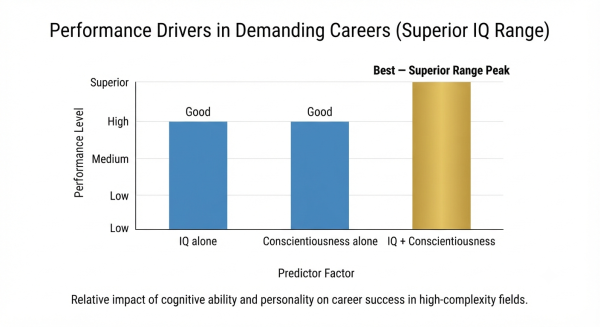
What this means in practice: at IQ 126, cognitive ability provides broad access to demanding careers — medicine, law, research, engineering, senior leadership — but long-term performance and advancement are most strongly predicted by discipline, reliability, and follow-through. IQ opens doors; conscientiousness determines how far you go through them.
IQ 126 provides the cognitive foundation for virtually any demanding professional track. What differentiates outcomes at this level is not more intelligence — it is the sustained application of the intelligence you already have.
Research on average IQ by profession puts this in concrete terms: physician mean IQ is approximately 120–125 across multiple studies, attorney mean approximately 115–122. IQ 126 exceeds both of these averages, meaning cognitive ability alone is not the limiting factor in these careers. See average IQ of doctors, average IQ of lawyers, and average IQ by profession for the full data.
Cognitive Profile at IQ 126
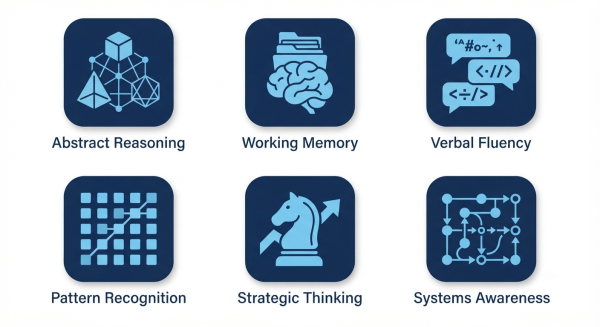
1. Advanced Abstract Reasoning
People at IQ 126 identify structural relationships in data, systems, and arguments that are not immediately obvious. They can hold and manipulate mental models of complex problems, evaluate multiple solution paths simultaneously, and recognize when a problem is being framed incorrectly. This is the cognitive basis of strong performance in mathematics, systems design, research, and strategic planning.
2. Reliable Working Memory
Working memory — the ability to hold and manipulate multiple pieces of information in real time — is typically well above average in this range, enabling effective multi-step planning, tracking competing variables, and following complex reasoning chains. See IQ and Memory for the research behind this connection.
3. Verbal Fluency and Linguistic Precision
Command of language at IQ 126 tends toward sophistication: structured argumentation, nuanced vocabulary, recognition of implication and subtext, and the ability to adapt communication style for different audiences. This strength directly supports success in law, writing, leadership, teaching, and any role where clarity of thought must be externalized as clarity of communication. Explore the Linguistic Intelligence guide for more.
4. Pattern Recognition and Systems Thinking
A consistent strength in the Superior range is the ability to detect patterns and interconnections across domains — identifying inefficiencies in workflows, contradictions in reasoning, or structural similarities between apparently unrelated problems. This "systems thinking" capability is valuable in any role requiring strategic diagnosis or cross-domain synthesis.
5. Rapid Learning Curve
New domains, frameworks, and skill sets come naturally at this cognitive level. People with IQ 126 typically grasp not just the content of a new subject but its underlying architecture — enabling faster transfer to adjacent problems and reducing the time required to reach competence in unfamiliar areas.
Best Career Paths for IQ 126
At IQ 126, cognitive access is not the constraint. The relevant question is which environments will sustain engagement and reward the combination of analytical depth and domain expertise over the long term.
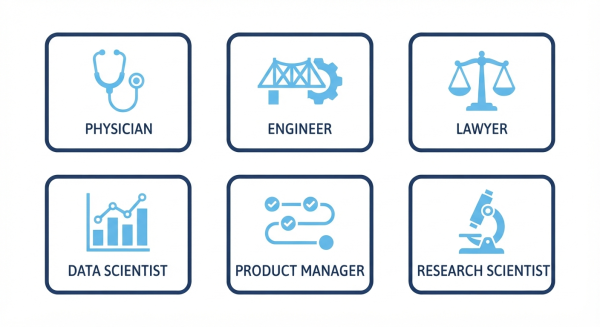
Medicine and Life Sciences
- Physician / Specialist: Complex diagnostic reasoning, continuous learning, high cognitive stakes. Mean physician IQ ~120–125 — IQ 126 is above this baseline. See average IQ of doctors.
- Research Scientist: Abstract modeling, hypothesis testing, long-form intellectual focus.
- Pharmacist / Clinical Researcher: Combines systematic knowledge with analytical judgment.
Technology and Engineering
- Software Engineer / Systems Architect: Pattern-detection, structured problem-solving, continuous domain evolution. See IQ for software engineers.
- Data Scientist / Analyst: Quantitative reasoning, statistical modeling, cross-domain synthesis.
- Civil / Electrical Engineer: Structured creativity, long-form analytical focus.
Law, Finance, and Strategy
- Lawyer / Legal Analyst: Multi-layered argumentation, verbal precision, strategic judgment. Mean attorney IQ ~115–122 — IQ 126 is above this. See average IQ of lawyers.
- Financial Analyst / CPA: Complex financial modeling and reasoning within structured frameworks.
- Management Consultant / Product Manager: Strategic diagnosis, cross-functional communication, systems-level thinking.
Education and Creative Fields
- Academic Researcher / Lecturer: Intellectual depth, long-form mastery, knowledge creation.
- Technical Writer / Journalist: Translating complex ideas into clear communication.
- UX Designer / Architect: Merging analytical and creative thinking in human-centered design.
For more on career and cognitive fit, see jobs for IQ 125, jobs for IQ 110–120 for comparison, and average IQ by profession.
IQ 126 and the Broader Intelligence Picture
IQ 126 measures specific cognitive capacities — abstract reasoning, working memory, processing speed, verbal comprehension. It does not measure creativity, emotional intelligence, practical judgment, resilience, or interpersonal skill — all of which contribute independently to life and career outcomes. Research consistently shows that at the Superior IQ level, these non-cognitive factors become increasingly important differentiators.
Understanding your full cognitive and personality profile gives a more useful picture than any single number. Consider exploring:
- Emotional Intelligence (EQ) Test — a key predictor of leadership and relationship outcomes
- IQ vs EQ — when cognitive ability matters most, and when EQ takes over
- MBTI Personality Test — how you process information and interact with others
- Multiple Intelligences Theory — a broader framework for cognitive strengths
- EQ vs IQ in the workplace — what employers actually value
Frequently Asked Questions
What percentile is IQ 126?
IQ 126 corresponds to the 96th percentile — meaning you score higher than approximately 96% of the general population. It sits 1.73 standard deviations above the mean on a standard SD-15 scale. Roughly 1 in 25 people score at this level or above.
Is IQ 126 considered gifted?
No — IQ 126 is classified as Superior on the WAIS-IV, not Gifted. The Gifted / Very Superior classification begins at IQ 130. IQ 126 is an excellent score in the top 4% of the population, but it does not formally reach the gifted threshold or Mensa's 98th-percentile requirement.
Is IQ 126 good enough for demanding professional careers?
Yes. Research on average IQ by profession shows that the cognitive baseline for demanding careers — physician (~120–125), lawyer (~115–122), engineer (~115–120) — is below IQ 126. This means cognitive ability is not the limiting factor for these careers at this score level. Long-term performance is most strongly predicted by the combination of IQ and conscientiousness — disciplined, reliable application of the cognitive ability you have. See IQ and income for broader outcome research.
How does IQ 126 compare to IQ 120 or IQ 130?
IQ 120 sits at the 91st percentile (1 in 11), IQ 126 at the 96th (1 in 25), and IQ 130 at the 98th (1 in 50). The practical cognitive differences between these scores are real but modest in everyday contexts. The most meaningful threshold in this range is IQ 130 — the Mensa cutoff and formal start of the Gifted classification. IQ 126 is 4 points below that boundary. See IQ 120 and IQ 132 for detailed comparisons.
What famous people have an IQ around 126?
Estimated IQ scores for public figures are rarely verified and widely debated. IQ 126 is within the range commonly cited for many successful politicians, executives, and academics. Explore the Celebrity IQ Database for specific breakdowns — and the important caveats about how these estimates are derived.

Comments
Share Your Thoughts