If you or someone you care about received an IQ score of 80, the first question is usually some version of: Is this bad? The honest answer is: it is below the population average, but it is not what most people fear when they hear "low IQ." This guide gives you the accurate classification, the precise percentile, the research on real-life outcomes, and a clear-eyed look at what an IQ of 80 actually means day to day. For the full IQ range context, see the IQ Scores guide.
First: The Classification Most Articles Get Wrong
One of the most common errors in articles about IQ 80 is calling it "borderline." That is incorrect according to the WAIS-IV — the most widely used adult intelligence assessment in the world.
| IQ Range | WAIS-IV Classification | Percentile Range |
| 69 and below | Extremely Low | Below 2nd |
| 70–79 | Borderline | 2nd–8th |
| 80–89 | Low Average ← IQ 80 is here | 9th–23rd |
| 90–109 | Average | 25th–73rd |
| 110–119 | High Average | 75th–90th |
| 120–129 | Superior | 91st–97th |
| 130+ | Very Superior | 98th+ |
IQ 80 is formally classified as Low Average — the same band that runs from 80 to 89. The Borderline classification is 70–79. This distinction matters practically: Low Average individuals almost universally function independently in daily life, complete high school, hold jobs, and manage the routine demands of adult living without significant difficulty. For full context on the IQ scale and how labels have evolved over time, read The IQ Scale Explained and What Is IQ.
IQ 80: The Exact Statistics
On the standard bell curve (mean = 100, SD = 15), a score of 80 sits 1.33 standard deviations below the population mean, placing it at the 9.12th percentile. This means you score higher than approximately 9% of the general population — or equivalently, about 1 in 11 people score at this level or below.
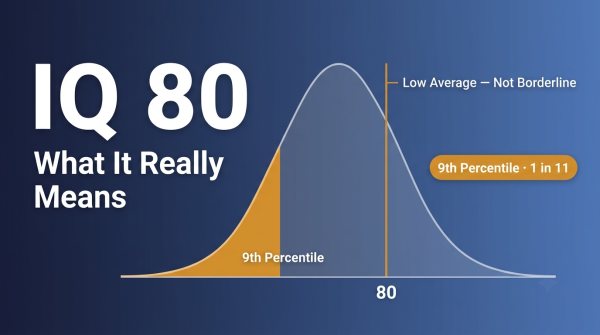
Approximately 16% of the population scores in the entire Low Average band (80–89). This is not a rare profile — it represents roughly 1 in 6 adults. For comparison: IQ 75 sits at the 5th percentile (Borderline), while IQ 85 reaches the 16th percentile — the lower edge of the central 68% of the distribution. IQ 90 marks the entry into the Average range at the 25th percentile.
The Measurement Error Problem: Is 80 Really 80?
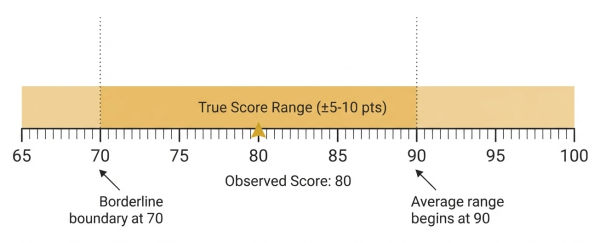
This is a nuance most articles skip entirely. All IQ tests carry a standard error of measurement of approximately ±5–10 points. An observed score of 80 means the true score could plausibly fall anywhere between 70 and 90 — spanning the boundary between Borderline and Low Average, or even reaching the lower edge of Average.
Practical implications of this:
- A single test score of 80 should never be treated as a fixed, permanent fact about cognitive ability.
- Retesting under different conditions — less stress, more familiarity with the test format, better sleep — can move the score meaningfully.
- Environmental factors including test anxiety, language background, and socioeconomic stress all affect results. The Flynn Effect research demonstrates that measured IQ responds significantly to environmental conditions across generations.
- For educational or clinical decisions, a professionally administered test (WAIS-IV or Stanford-Binet) is essential — online tests have higher error margins.
An IQ score of 80 is an estimate of performance on one test session — not a permanent label, not a ceiling, and not a complete picture of a person's cognitive strengths.
What IQ 80 Looks Like in Daily Life
Research on the Low Average range consistently shows one thing: ordinary participation in daily life is the norm, not the exception. People scoring in the 80–89 range live independently, raise families, hold jobs, and navigate the practical demands of adult life successfully. What research does identify as more effortful at this level:
- Dense abstract reasoning: Multi-step logical problems, algebraic thinking, or philosophical argumentation require more time and support than for mid-range scorers.
- Fast-paced academic environments: Timed tests and lecture-heavy instruction formats favor processing speed, which can be less strong in this range.
- Heavy verbal instruction: Learning from written manuals or long spoken explanations is less effective than hands-on demonstration and repetition.
- Novel complex tasks: Adapting to rapidly changing, high-ambiguity situations can feel more cognitively demanding.
None of these represent absolute limitations — they are contextual differences in how someone learns most effectively, not whether they can learn at all. For context on how the lower end of the scale is defined and supported, see the Borderline IQ guide and IQ 70 explained.
Cognitive Strengths and Challenges at IQ 80
| Strengths | Challenges |
| Practical, concrete problem-solving | Abstract and symbolic reasoning |
| Learning through observation and doing | Learning from verbal or written instruction alone |
| Strong memory for lived experience and routines | Working memory under multi-step complexity |
| Social empathy and interpersonal reliability | Fast-paced timed test environments |
| Consistency and dependability in structured roles | Novel high-ambiguity situations |
The strengths in this profile are genuinely valuable — and often underweighted by educational systems that favor abstract academic performance. Emotional intelligence, for example, is a significant predictor of workplace success and relationship quality, and it operates largely independently of IQ. Explore the EQ Test and read IQ vs EQ to understand how these two dimensions interact.
Can Someone with IQ 80 Hold a Job and Live Independently?
Yes — and research is unambiguous on this point. Studies on the Low Average range consistently show that people in the 80–89 band manage work, family, and practical responsibilities without significant difficulty, especially in structured environments with clear expectations. The research by Riotiq and multiple meta-analyses on occupational functioning confirms: IQ 80 is not a barrier to functional adult life.
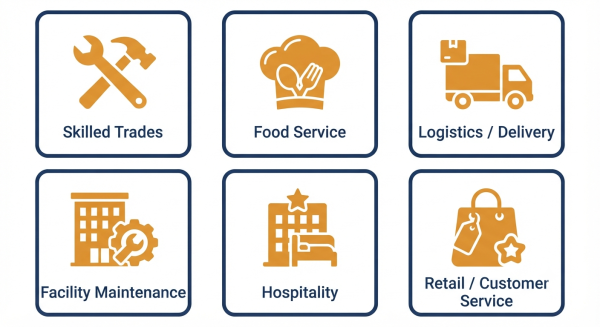
Career environments that tend to be strong fits at IQ 80:
Skilled Trades and Manual Work
- Construction support, landscaping, plumbing assistance
- Auto repair technician, assembly line operator
- Electrical installation support
Service and Hospitality
- Food service — kitchen prep, dishwashing, counter service
- Housekeeping, hotel operations, facility cleaning
- Retail sales support and stock management
Logistics and Operations
- Courier and delivery work, warehouse operations
- Transportation support, loading dock roles
- Inventory and stock control
Maintenance and Facilities
- Building maintenance, groundskeeping
- Janitorial and sanitation roles
- Equipment operation in structured settings
What unites these roles is structure, repetition, and practical skill — environments where reliability, work ethic, and accumulated experience are valued as much as or more than abstract reasoning ability. For broader context on how IQ maps to career access across the full range, see average IQ by profession and jobs where EQ beats IQ.
How IQ 80 Affects Learning: What Actually Helps
IQ 80 doesn't limit whether someone learns — it shapes how they learn most effectively. The research on instructional design for the Low Average range is consistent: the standard lecture-and-textbook model is poorly matched to this cognitive profile, while alternative formats show strong results.
What works well:
- Demonstration first, rules second: Seeing a process done before being asked to understand the theory behind it.
- Shorter instruction chunks: Breaking complex tasks into clearly sequenced steps rather than presenting them all at once.
- Repetition with variation: Practicing the same skill in slightly different contexts to build flexible application.
- Immediate, specific feedback: Knowing what to adjust in real time rather than waiting for a test result.
- Vocational and apprenticeship formats: On-the-job training, trade schools, and skill-based certification programs are structurally better matched to this learning profile than traditional academic tracks.
Parents supporting a child in this range will find practical strategies in supporting a child with below-average IQ and IQ testing for kids. For broader research on whether cognitive training can shift IQ performance, read whether IQ can be improved and the guide on neuroplasticity.
The Danger of Labels: What a Score Does Not Tell You
An IQ score of 80 measures performance on a specific type of cognitive task under specific conditions on one particular day. It does not measure:
- Creativity, emotional intelligence, or social skills
- Practical judgment built from experience
- Work ethic, persistence, and reliability
- Artistic, musical, or physical ability
- Character, kindness, or relational intelligence
Research by Howard Gardner on Multiple Intelligences and decades of research on IQ and income outcomes both confirm that cognitive test scores are one predictor among many — and often not the most important one in long-term life satisfaction or career success. The guide on low IQ success stories documents individuals who built meaningful careers and lives well below the average IQ threshold.
Internalizing an IQ label — especially a below-average one — can create a self-limiting belief that quietly undermines motivation over time. A score is a starting point for understanding how you learn, not a verdict on what you can achieve.
Frequently Asked Questions
Is IQ 80 considered low?
IQ 80 is classified as Low Average on the WAIS-IV — below the statistical population midpoint of 100, but not borderline and not intellectually disabled. The Borderline classification covers IQ 70–79. About 16% of the population scores in the 80–89 Low Average band, making it relatively common. Most people in this range live independently and function well in daily life.
What percentile is IQ 80?
IQ 80 corresponds to approximately the 9.12th percentile — meaning you score higher than about 9% of the general population. It sits 1.33 standard deviations below the mean on a standard SD-15 scale. Roughly 1 in 11 people score at this level or below.
What is the difference between IQ 80 and borderline IQ?
On the WAIS-IV, IQ 80 is the starting point of the Low Average range (80–89). Borderline is 70–79. An IQ of 80 specifically is above the borderline threshold — a meaningful distinction because it predicts significantly better functional independence and occupational access than scores in the 70–79 range.
Can someone with IQ 80 go to college?
It depends on the program and the support available. Many people with IQ 80 complete high school and pursue vocational certificates, trade qualifications, or community college programs — particularly in practical, applied fields. Traditional four-year academic degree programs with heavy abstract reasoning demands are more challenging at this level, though not impossible with strong motivation and appropriate support structures.
How accurate is a single IQ test result of 80?
All IQ tests have a standard error of measurement of approximately ±5–10 points. An observed score of 80 means the true score is likely somewhere between 70 and 90. Environmental factors — test anxiety, fatigue, language background, test familiarity — can shift results meaningfully. For diagnostic or educational decisions, a professionally administered assessment (WAIS-IV or Stanford-Binet) by a qualified psychologist is required. Take the International Standard IQ Test on this site for a free baseline assessment.

Comments
Share Your Thoughts