An IQ of 142 is one of the rarest cognitive profiles measurable on a standard intelligence test. This guide gives you the precise statistics, what research shows about cognitive performance at this level, how it compares to neighboring scores, and what it means practically for career and daily life. For full IQ range context, see the IQ Scores guide. If you want to verify your score at this range, the High Range IQ Test is designed specifically for above-average cognitive profiles.
IQ 142: The Exact Statistics
On the standard bell curve (mean = 100, SD = 15), a score of 142 sits 2.8 standard deviations above the population mean. That places it at the 99.73rd percentile — meaning you score higher than approximately 997 out of every 1,000 people tested. Roughly 1 in 370 people reach this level, placing IQ 142 in the top 0.27% of the population.
| IQ Score | Percentile | SD Above Mean | Rarity |
| 130 | 98th | +2.0 | 1 in 50 |
| 135 | 99th | +2.33 | 1 in 100 |
| 140 | 99.62nd | +2.67 | 1 in 261 |
| 142 | 99.73rd | +2.8 | ~1 in 370 |
| 143 | 99.83rd | +2.87 | 1 in 500 |
| 146 | 99.9th | +3.07 | 1 in 1,000 |
On the WAIS-IV, IQ 142 is classified as Very Superior. In educational psychology, it falls firmly in the Exceptionally Gifted territory — well above the standard Gifted threshold of 130, and just below the Profoundly Gifted range (~145+). To understand the full classification system, read The IQ Scale Explained and the WAIS-IV complete guide.
IQ 142 vs. IQ 140 and IQ 143: What Changes?
A common question for scores in this range is how meaningful the 1–3 point differences are between IQ 140, 142, and 143. The honest answer: the practical cognitive experience between these scores is modest, but the statistical rarity increases significantly with each point at the extreme upper tail of the distribution.
- IQ 140 — 99.62nd percentile, 1 in 261
- IQ 142 — 99.73rd percentile, 1 in 370
- IQ 143 — 99.83rd percentile, 1 in 500
All three fall in the Exceptionally Gifted range. The meaningful threshold differences at this level are the Mensa cutoff (IQ 130), the Intertel cutoff (~IQ 137), and the Triple Nine Society cutoff (~IQ 146) — not the individual point differences between 140, 142, and 143.
Is IQ 142 "Genius"? The Research Answer
The word "genius" appears constantly in discussions of scores above 140. The scientific reality: genius is not a formal psychometric classification. Lewis Terman used IQ 140+ as a threshold for "genius" in his early Stanford studies, but that label has since been retired from modern psychometrics. Today, no standardized classification system uses the term.
What research does confirm about IQ 142: it is a cognitive profile associated with exceptional performance on abstract reasoning, working memory, and fluid intelligence tasks — and it is measurably present in roughly 0.27% of the population. Whether that produces "genius-level output" depends on focus, domain expertise, direction, and sustained effort — not IQ alone. For the full history and nuance, read the guide on highest IQ in history.
IQ 142 gives you the cognitive hardware for exceptional performance. Whether it produces exceptional outcomes depends entirely on how that hardware is used.
High-IQ Society Eligibility at IQ 142
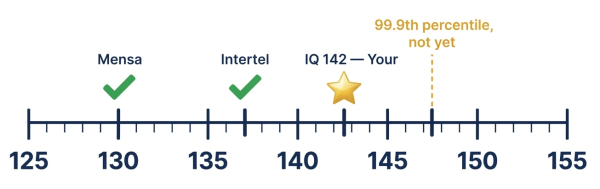
| Society | Threshold (SD-15) | Percentile | IQ 142 Eligible? |
| Mensa International | ~130 | 98th | ✔ Yes — significant margin |
| Intertel | ~137 | 99th | ✔ Yes |
| Triple Nine Society | ~146 | 99.9th | ✘ Not yet (~4 points short) |
| Mega Society | ~176 | 99.9999th | ✘ No |
IQ 142 qualifies for both Mensa and Intertel. The Triple Nine Society requires approximately IQ 146 on SD-15 tests — IQ 142 falls short by approximately 4 points. Read more in the What Is Mensa guide, how to join Mensa online, and the full High IQ Societies overview.
Cognitive Profile at IQ 142: What Research Shows
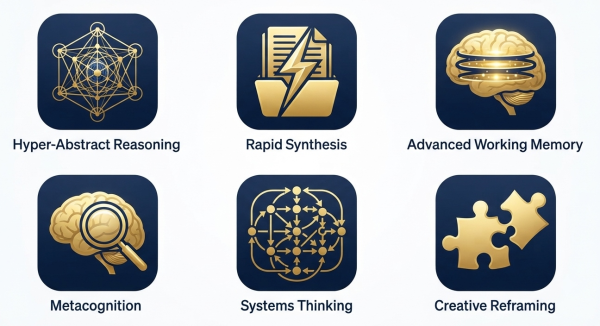
1. Hyper-Abstract Reasoning
At IQ 142, individuals perceive structural connections between ideas that appear unrelated at the surface level. They think in frameworks and models rather than isolated facts, enabling navigation of multi-layered problems that overwhelm most analytical minds. This is the cognitive basis of theoretical science, constitutional law, and philosophical innovation. For how this is measured, see Verbal and Nonverbal Tests of Intelligence.
2. Rapid Information Synthesis
New domains, frameworks, and conceptual systems are absorbed quickly and deeply — not just the content but the underlying architecture. This enables effective self-directed learning across fields and fast transfer of insight from one domain to another. Research on cognitively gifted individuals consistently finds this cross-domain synthesis as one of the most distinctive markers of very high-range intelligence.
3. Exceptional Working Memory
Working memory at this cognitive level — the ability to hold, manipulate, and apply multiple streams of information simultaneously — enables long chains of reasoning, mental simulation of complex scenarios, and real-time analysis of multi-variable problems. This is directly relevant to research, law, finance, and any role requiring sustained cognitive load under novel conditions. See the IQ and Memory guide for the research on this connection.
4. Advanced Metacognition
Individuals at IQ 142 consistently show strong metacognitive awareness — monitoring and refining their own reasoning processes in real time. They catch logical errors in their own thinking before others point them out, model multiple competing hypotheses simultaneously, and adjust analytical frameworks fluidly when initial approaches fail. This metacognitive sophistication is a key differentiator between Very Superior and High Average intelligence.
5. The Ceiling Effect at This Range
A nuance most articles miss: standard IQ tests are poorly calibrated above IQ 140. Most tests are normed for the general population, with a measurement ceiling around 140–150. At IQ 142, you are near the top of what standard tests can reliably distinguish — meaning your true cognitive range may be understated by the score. This is why high-range tests using harder items exist for upper-end measurement. Explore the guide on cognitive benchmarking for more on this.
Personality Patterns at IQ 142
While IQ and personality are distinct constructs, research on individuals in the Exceptionally Gifted range identifies consistent behavioral tendencies:
- Intellectual independence: Strong preference for evidence and personal verification over consensus or authority. This drives innovative thinking but can create friction in conventional organizational environments.
- Low tolerance for inefficiency: Difficulty maintaining patience in bureaucratic, slow-moving, or illogical environments. This is productive when channeled into reform but can create social friction when not managed.
- Existential and philosophical depth: Questions about purpose, meaning, consciousness, and moral structure emerge frequently and persistently. This is a strength for creative and philosophical work but can produce rumination without deliberate management.
- Hyper-brain / hyper-body reactivity: Research on gifted adults suggests heightened psychological and physiological reactivity — deeper rumination, more intense emotional responses, stronger sensory sensitivity — at this cognitive level. Understanding this dimension is as important as understanding the cognitive dimension. Take the EQ Test and read IQ vs EQ and IQ and mental health for research on this intersection.
Best Career Paths for IQ 142
At IQ 142, the primary career risk is chronic understimulation. The relevant question is not "what can I do?" but "what environment will remain genuinely challenging over the long term?" Research on gifted adults consistently shows that high-IQ individuals in low-complexity roles experience significantly higher rates of disengagement and career dissatisfaction.
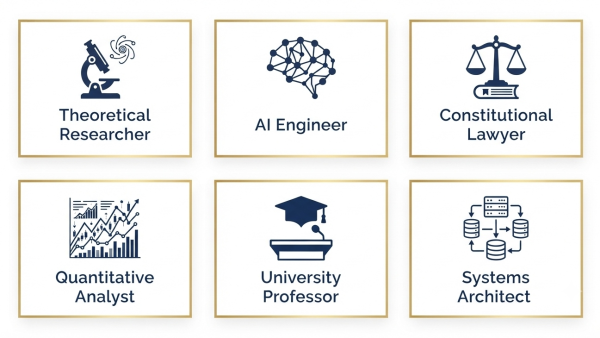
Research and Hard Sciences
- Theoretical Physicist / Mathematician: Abstract modeling, open problems, no ceiling on complexity.
- AI / Machine Learning Researcher: Systems thinking, frontier problems, rapid domain evolution. See IQ for software engineers.
- Neuroscientist / Cognitive Researcher: Deep theoretical and empirical complexity, direct relevance to intelligence itself.
Law, Finance, and Strategy
- Constitutional / International Lawyer: Multi-layered argumentation, high intellectual stakes, novel precedent-setting. See average IQ of lawyers.
- Quantitative Analyst / Portfolio Strategist: Mathematical modeling, probabilistic reasoning under uncertainty.
- Management Consultant (complex domains): Strategic diagnosis, cross-domain synthesis, organizational complexity.
Medicine and Academia
- Physician / Specialist: Complex diagnostic reasoning, continuous learning. See average IQ of doctors.
- University Professor / Research Fellow: Intellectual autonomy, long-form mastery, knowledge creation.
- Entrepreneur (complex domains): Systems innovation, pattern-based opportunity identification.
For additional career guidance, see careers requiring IQ above 130, jobs for IQ 130–140, and high IQ low EQ career pitfalls.
The Social Experience at IQ 142
At IQ 142, the pool of natural intellectual peers is roughly 0.27% of the population — approximately 1 in 370 adults. In most everyday social environments, this creates a persistent mild mismatch: conversations that resolve at a pace or depth that feels understimulating, and a sense of operating at reduced cognitive capacity in ordinary interactions.
Research on gifted adults is clear: this is not antisociality and not a social deficit. It is a calibration difference. The practical response is deliberate community-building — research teams, specialized professional networks, intellectual communities — where depth and curiosity are the shared currency rather than the exception. For context on how giftedness shapes social development from childhood, see signs of a gifted child and IQ vs EQ in childhood.
IQ 142 and Neuroplasticity
No IQ score is biologically fixed. Research on neuroplasticity confirms that cognitive performance continues to respond to environmental demands throughout adulthood. The Flynn Effect — decades of rising global IQ scores linked to environmental improvements — demonstrates that measured IQ is substantially shaped by education, nutrition, and cognitive engagement. And as noted above, the ceiling effect on standard tests means an observed 142 may be an underestimate of the true range. Read whether IQ can be improved for what the evidence supports.
Frequently Asked Questions
What percentile is IQ 142?
IQ 142 corresponds to the 99.73rd percentile on the standard bell curve (mean = 100, SD = 15). It sits 2.8 standard deviations above the population mean. Approximately 1 in 370 people score at this level or above — top 0.27% of the population.
Is IQ 142 considered genius?
"Genius" is not a formal psychometric classification in modern psychology. Historically associated with IQ 140+, the term has been retired as a scientific label. IQ 142 is classified as Very Superior / Exceptionally Gifted — a top 0.27% score associated with exceptional cognitive performance. Whether it produces genius-level outcomes depends on direction, sustained effort, and domain engagement — not IQ alone.
How does IQ 142 compare to IQ 143?
IQ 142 sits at the 99.73rd percentile (1 in 370) and IQ 143 at the 99.83rd (1 in 500). Both fall in the Exceptionally Gifted range. The 1-point difference reflects a meaningful statistical rarity shift at the upper tail of the distribution, but the practical cognitive experience between the two scores is minimal. See the full IQ 143 guide for detailed comparison.
Does IQ 142 qualify for the Triple Nine Society?
No. The Triple Nine Society requires approximately the 99.9th percentile, corresponding to IQ ~146 on SD-15 tests. IQ 142 at the 99.73rd percentile falls approximately 4 points short of this threshold. It qualifies comfortably for Mensa and Intertel. See the High IQ Societies guide for the full breakdown of eligibility criteria.
What famous people have an IQ around 142?
Estimated IQ scores for public figures are rarely verified and widely debated. IQ 142 is within ranges commonly cited for various scientists, authors, and innovators. Explore the Celebrity IQ Database for detailed breakdowns — and the highest IQ in history guide for the most extreme documented scores and how they were derived.

Comments
Share Your Thoughts